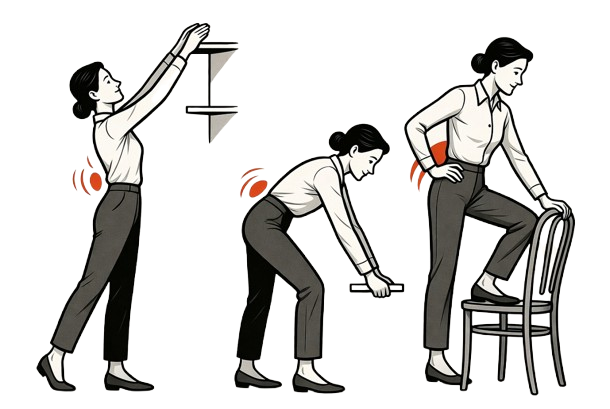
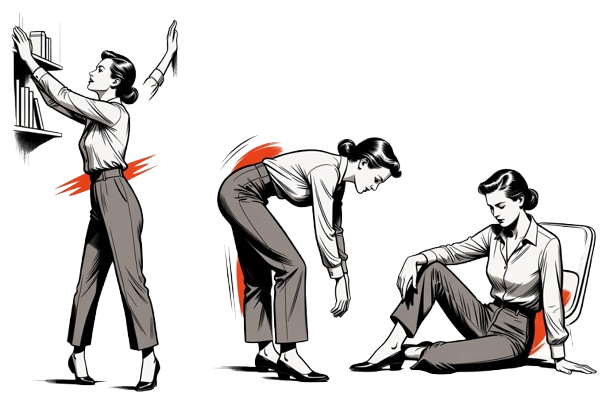
Let's start with the honest acknowledgment: rest and stretching are appropriate first-line responses to many types of back pain. An acute muscle strain from lifting something awkwardly, a minor sprain from a sudden movement, a temporary flare from unusual activity — these often resolve with a few days of relative rest, gentle movement, and basic stretching. The body's healing capacity is remarkable, and for self-limiting injuries it deserves the chance to do its work.
The problem arises when rest and stretching are applied to pain that isn't self-limiting — pain that has a structural deficit, a significant soft tissue component, or a neurological element that passive approaches cannot address. Applying rest and stretching to these problems doesn't make them worse in the short term — but it delays appropriate care, allows the underlying problem to compound, and gives the pain time to become chronic with all the neurological sensitization that entails.
Here are five signs that your back pain has moved beyond what rest and stretching can resolve.
Sign 1: It Keeps Coming Back
Recurrent back pain — episodes that resolve and then return, often triggered by progressively less significant events — is one of the clearest signals that a structural deficit is driving the problem. Each episode may feel like a new injury, but the pattern of recurrence indicates that the underlying vulnerability has never been addressed.
The most common underlying vulnerability is weakness in the deep lumbar stabilizers — the muscles that protect the spine from loading events that would otherwise produce injury. Without sufficient stabilizer strength, minor mechanical provocations trigger pain episodes that rest resolves temporarily. The structural weakness remains. The next episode is inevitable.
Recurrent back pain that keeps returning despite apparent recovery between episodes almost always requires structured strengthening — not more rest and stretching.
Sign 2: It Radiates Into Your Leg or Arm
Pain that travels from the spine into the limbs — leg pain from lumbar involvement, arm pain or hand numbness from cervical involvement — indicates nerve root irritation or compression. This is a structural problem that requires structural intervention.
Stretching can temporarily relieve nerve tension but does not address the disc, bone spur, or other structure that is compressing the nerve. Rest reduces loading but does not rebuild the muscular support that reduces that loading long-term. Radicular symptoms that persist beyond two to three weeks warrant comprehensive assessment and targeted treatment.
Still living around your pain?
Let's change that. Call us and describe what you're dealing with — we'll tell you honestly if we can help.
Six weeks is the conventional threshold between acute and subacute pain — and it is a meaningful clinical marker. Pain that persists beyond six weeks without clear improvement is demonstrating that the natural healing trajectory has stalled. Something is maintaining the pain that the body is not resolving on its own.
This may be an unresolved structural problem, a significant soft tissue component that requires manual therapy to address, a muscular deficit that is perpetuating the pain cycle, or the beginning of the central sensitization process that makes pain progressively harder to treat. At six weeks without meaningful improvement, passive approaches have had their chance. Comprehensive assessment is warranted.
Sign 4: It Is Limiting What You Can Do
Pain that is changing how you live — limiting your ability to work, exercise, play with your children, sleep, or do the things that matter to you — has crossed a threshold that justifies proactive intervention. Adapting your life around pain is not management. It is accommodation of a problem that is robbing you of quality of life.
The longer these accommodations persist, the more entrenched the compensatory patterns become — in movement, in muscle activation, in neural processing. Earlier intervention means fewer habits to unlearn and a more complete return to full function.
Sign 5: You Have Already Tried and the Pain Came Back
If you have previously received treatment — chiropractic, massage, physical therapy, injections — and experienced improvement followed by return of the same pain, this is the clearest signal that the root cause was not addressed. Treatment that produces temporary relief without lasting change is treating a symptom, not a source.
The question to ask after a relapse is not "what should I try next" but "what has not yet been addressed." In our experience, the most common unanswered question in recurrent back pain is the deep lumbar extensor strength deficit — the muscular vulnerability that no amount of chiropractic adjustment, massage, or standard physical therapy reliably corrects, because none of these modalities specifically trains the muscles that need training.
You've tried other things.
This is different. Our approach addresses the structural deficit most treatments miss entirely.
If any of these five signs describe your situation, the most valuable next step is a comprehensive assessment that looks at the full picture — structural, muscular, and neurological — rather than treating the symptom in isolation.
Call us and describe what you are dealing with. Tell us how long it has been going on, what you have already tried, and what the pattern of your pain looks like. We will tell you honestly what we think is driving it and whether our approach is likely to help. If we don't think we can add meaningful value to what you have already received, we will tell you that too — and point you toward who can.
The conversation costs nothing. Continuing to wait costs more than most people realize.
Trent Shuford, LMT, Cert. MedX Tech.
Not sure if this is right for you?
We put together a straightforward guide to help you decide before you call.