MedX Spinal Care in Redmond: Isolated Strengthening for the Back and Neck
FDA-registered technology for targeted lumbar and cervical rehab.
Your plan is built after the first conversation. Meet Trent →
Everything You Need to Know About MedX Spinal Strengthening
Our 11-page clinical guide covers the science, the research, and exactly what to expect — written for both clients and physicians. Download free, delivered instantly.
- The pelvic restraint secret — why MedX works when nothing else has
- Peer-reviewed studies summarized in plain language
- Conditions treated & client selection criteria
- Expert quotes from orthopedic surgeons & researchers
- FAQ: surgery, insurance, timeline, and what to expect
MedX Clinical Guide
11-page PDF · Free download
🔒 Your info is private. We'll send your guide + a short follow-up series. Unsubscribe anytime.
Why MedX Reaches What Other Treatments Can't
The deep spinal extensors are the muscles that hold your spine in alignment under load. They sit beneath the surface muscles that conventional exercise and manual therapy can reach. MedX equipment is engineered to isolate them, measure them objectively, and rebuild them with progressive load. Here is what that actually means.
Pelvic Restraint Isolates the Target
Without pelvic restraint, the powerful hamstrings and gluteals do most of the work in any back-strengthening movement — leaving the deep extensors weak and bypassed. The MedX restraint system locks the pelvis in place, forcing the lumbar extensors to work alone. This is why standard gym work and home exercises consistently fail to address true spinal weakness.
Progressive Resistance That Adapts to You
Conventional rehab equipment offers fixed resistance that does not match the natural strength curve of the spine. MedX provides variable resistance calibrated to the strength curve at every degree of motion — meaning you load the muscle correctly through the entire range, not just at the easy or hard points. This is what produces measurable strength gains.
Objective Measurement, Not Estimation
Most rehabilitation programs assume progress. MedX measures it. Strength testing every 3 degrees of motion produces an objective record of where you are and how you are improving. You see your numbers go up. So does your physician. This is the difference between a program built on assumption and one built on data.
This is why clients who have tried physical therapy, chiropractic, injections, and conventional rehab equipment without lasting success often respond to MedX. They have not failed treatment — they have been treated with tools that could not reach the source of the problem.
What the research shows
MedX machines restrain the pelvis so the lower back muscles do the work on their own. In a randomized trial, the same exercise without the restraint did not build lumbar strength or reduce pain. (Smith et al., 2011)
In a 1995 study of 895 people with chronic low back pain, 76% of those who completed an isolated lumbar strengthening program reported good or excellent results. At one year, 94% of them said the improvement had lasted. (Nelson et al., 1995)
In a 1999 study, 60 people who had been told they needed spinal surgery entered an isolated strengthening program. About 16 months later, 3 of the 38 who could be reached had gone on to surgery. The authors noted the study's limits. (Nelson et al., 1999)
In a 1992 study of 90 people with neck strain or disc problems, eight weeks of isolated cervical strengthening increased neck strength and range of motion and reduced pain. (Highland et al., 1992)
These are published study results, not a promise of results for any one person. Your plan is built after the first conversation.
See all the researchWhat a MedX Program Actually Looks Like
A typical MedX strengthening program runs eight to sixteen weeks. Here is the honest version of what to expect.
Baseline Strength Testing
Objective measurement of your isolated lumbar and cervical extensor strength every 3 degrees of motion. We compare your numbers to age and gender norms established in published research. You leave with a clear picture of where you actually are — often the first objective measurement of spinal strength you have ever had.
Progressive Strengthening
Short, focused, all-out sets on the MedX equipment. Most sessions are about 25 minutes, actual time under load is roughly 90 to 120 seconds. Strength is retested at fixed intervals so progress is measurable.
Consolidation and Discharge Planning
Strength is now significantly above baseline. We work on holding the gains, addressing any remaining structural patterns, and transitioning you toward the maintenance frequency that keeps you out of the cycle long-term.
Some clients need fewer sessions. Some need more. We will tell you honestly what your situation looks like after the baseline test.
Targeted Lower Back Strengthening
The MedX Lumbar Extension Machine targets lower back muscles with a precise restraint system that prevents hamstring and glute interference. It provides progressive resistance over a 72° range of motion, with isometric testing every 3° compared to established norms — giving you measurable, objective progress data every session.
- Targets the deep lumbar extensors in chronic low back pain
- Improves spinal stability and endurance
- Supports pre-op and post-op spinal care
- Objective strength testing every 3° of motion
The lumbar extension protocol is supported by multiple peer-reviewed studies including Risch et al. (1993) and Pollock et al. (1989). See the full research summary →
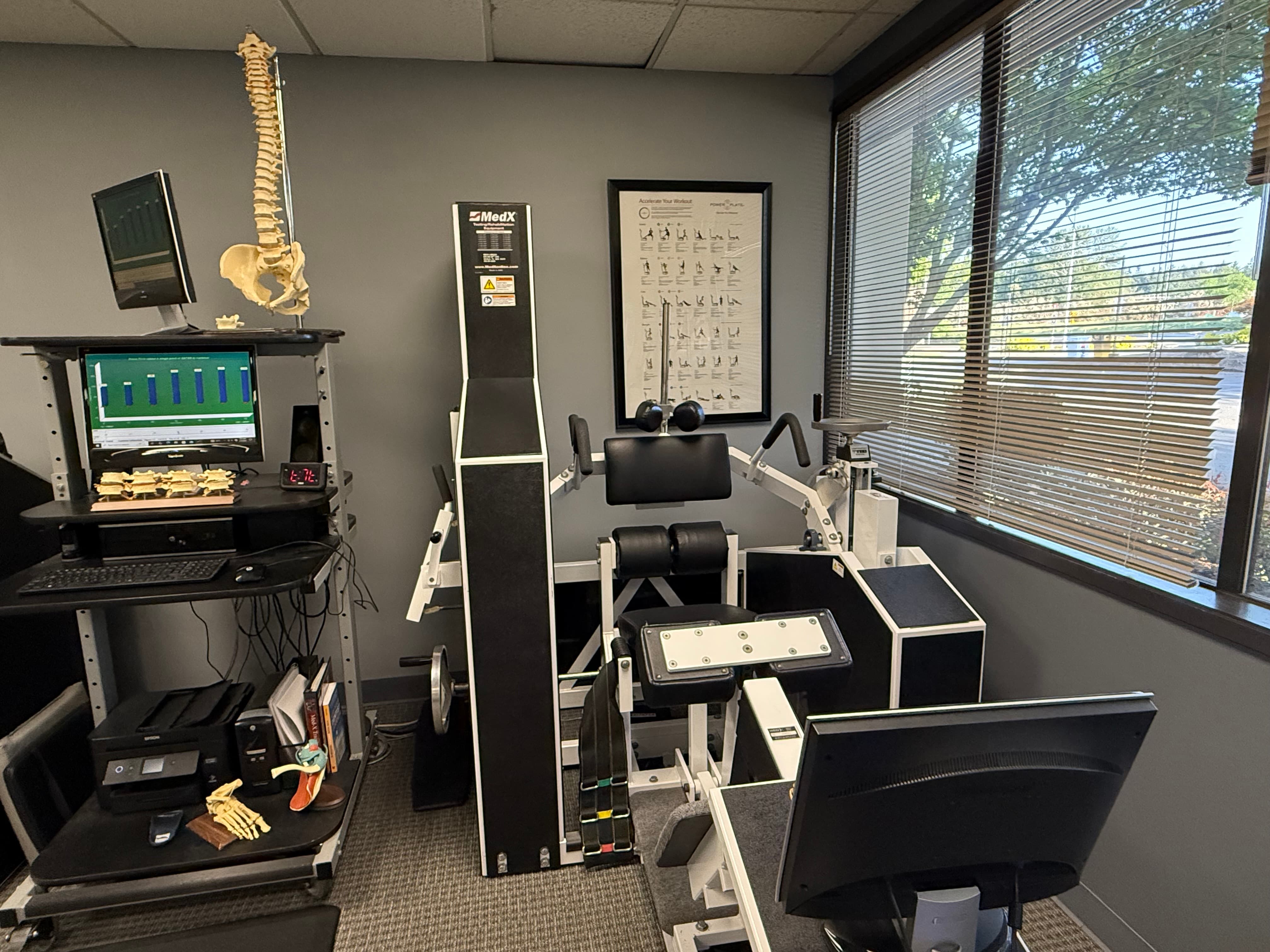
The MedX Lumbar Extension Machine — pelvic restraint isolates the lumbar extensors, progressive resistance builds true spinal strength.
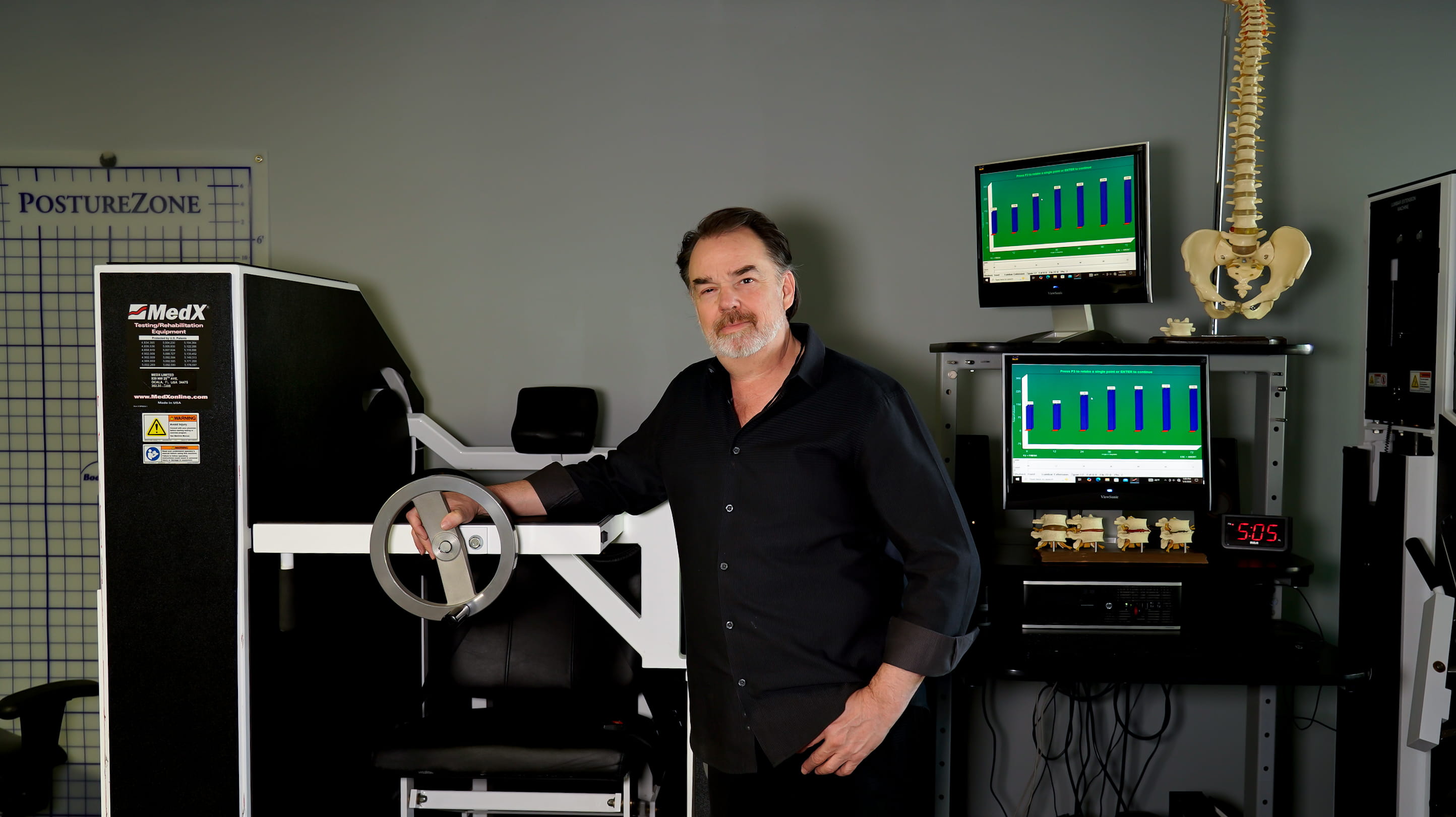
Trent at the MedX Cervical Extension Machine — measurement-driven cervical rehabilitation.
Precision Neck Strengthening
The MedX Cervical Extension Machine isolates neck muscles by stabilizing the torso and chest. Custom progressive resistance programs build strength and range of motion safely, making it ideal for chronic neck pain, cervicogenic headaches, and disc-related conditions.
- Builds isolated cervical extensor strength
- Enhances flexibility and range of motion
- Used for cervicogenic headache presentations
- Custom progressive resistance programs
Isolated cervical strengthening has published support, including Highland et al. (1992). (Highland et al., 1992) See the full research summary →
Ideal For Pre & Post-Op Rehab
In a randomized trial of 75 people after lumbar disc surgery, 87% of those who did isolated lumbar extension training returned to work within 4 months, versus 24% of those who did not (Choi et al., 2005).
Combine with red light therapy for enhanced recovery. Also ideal for youth athletes.
Client Experiences With MedX
MedX is the through-line in their stories — but the lives it gave back to them are entirely their own.
“I came in for neck pain that was making warehouse work harder every year. My chiropractor sent me. The MedX cervical program rebuilt strength I had lost — performance up 87 percent on the testing, range of motion back to full. Today I come in three times a week for the strength program and twice a month for maintenance. The work I do at the warehouse no longer hurts. This is part of how I stay on the job.”
“I am in my seventies. I still walk, I still hike, and I still play weekend golf. I have been seeing Trent for years and the program he keeps me on is what keeps me moving. From minor aches to the pains that come with the activities I love, he addresses what is actually going on, and I do the stretching and strengthening he gives me between visits. This is how I stay in the life I want to be living.”
“Windsurfing demands everything from your back and core, and after years of competing I had reached the point where the pain was deciding when I could sail. The MedX lumbar work rebuilt strength I did not know I had lost. The Piezowave addressed restrictions in places that had been chronic for years. Stamina is up, pain is down, and I am performing at a level I had not expected to see again.”
The Strength Test Is the First Step. Everything Else Follows From the Number.
Sixty to ninety minutes. Objective measurement. A clear picture of where your spine actually is — and what a program designed for your situation would look like.
425-758-4619Mon to Fri, 9:00 to 6:00 · Sat, 9:00 to 2:00 by appointment