Advanced Manual Therapy in Redmond, Serving the Eastside: Rehabilitation Beyond Basic Massage
What begins with massage therapy training becomes something far deeper over 35+ years of practice. Trent's expertise has evolved into advanced clinical bodywork, treating the muscular and neurological systems together through fascial release, deep tissue repair, and expert injury assessments.
Decades collaborating with physical therapists, orthopedic surgeons, and neurosurgeons have shaped a practice unlike any other, for committed clients seeking root-cause solutions.
More Than Massage: A Career Built on Advanced Training
Massage therapy is a foundation, but over 35 years of continuous learning and interdisciplinary collaboration, that foundation becomes something extraordinary. Trent's career has been shaped by working directly alongside physical therapists, orthopedic surgeons, neurosurgeons, and alternative medicine providers, absorbing knowledge from each discipline to build a comprehensive understanding of the human body's muscular and neurological systems.
This isn't relaxation massage. It's advanced clinical rehabilitation, drawing from traditional bodywork principles rooted in centuries of Eastern and Western manual healing, combined with modern medical-grade strength training like MedX. The result is a unique ability to assess, evaluate muscular dysfunction, and treat conditions that other practitioners simply can't reach. Every session integrates the knowledge gained from thousands of client cases and decades of provider collaboration.
What the research shows
A 2025 review of 10 randomized trials found that adding manual therapy to exercise improved short-term pain and disability in chronic low back pain more than exercise alone. This is why manual work here follows strengthening rather than replacing it. (Narenthiran et al., 2025)
Dissection studies confirm that muscles are joined end to end by connective tissue along several of the lines Thomas Myers described in Anatomy Trains, including the Superficial Back Line. (Wilke et al., 2016)
In people with long-term low back pain, the layers of fascia in the lower back slide about 20% less than in people without pain. (Langevin et al., 2011)
These are published study results, not a promise of results for any one person. Your plan is built after the first conversation.
See all the researchSeven Specialized Approaches Within Manual Therapy
What gets called manual therapy or massage covers an enormous range of distinct techniques, each with a specific clinical application. The ones below are the techniques Trent reaches for most often, and what each one is actually for. Most sessions integrate two or three of them depending on what the assessment reveals.
Fascial Release
Targets the connective tissue web that surrounds and connects every muscle, organ, and structure in the body. When this fascia tightens or restricts — through injury, prolonged posture, or scar tissue — it creates tension and dysfunction far from the original site. Released slowly and with sustained pressure, it transforms how the body moves.
Psoas Work
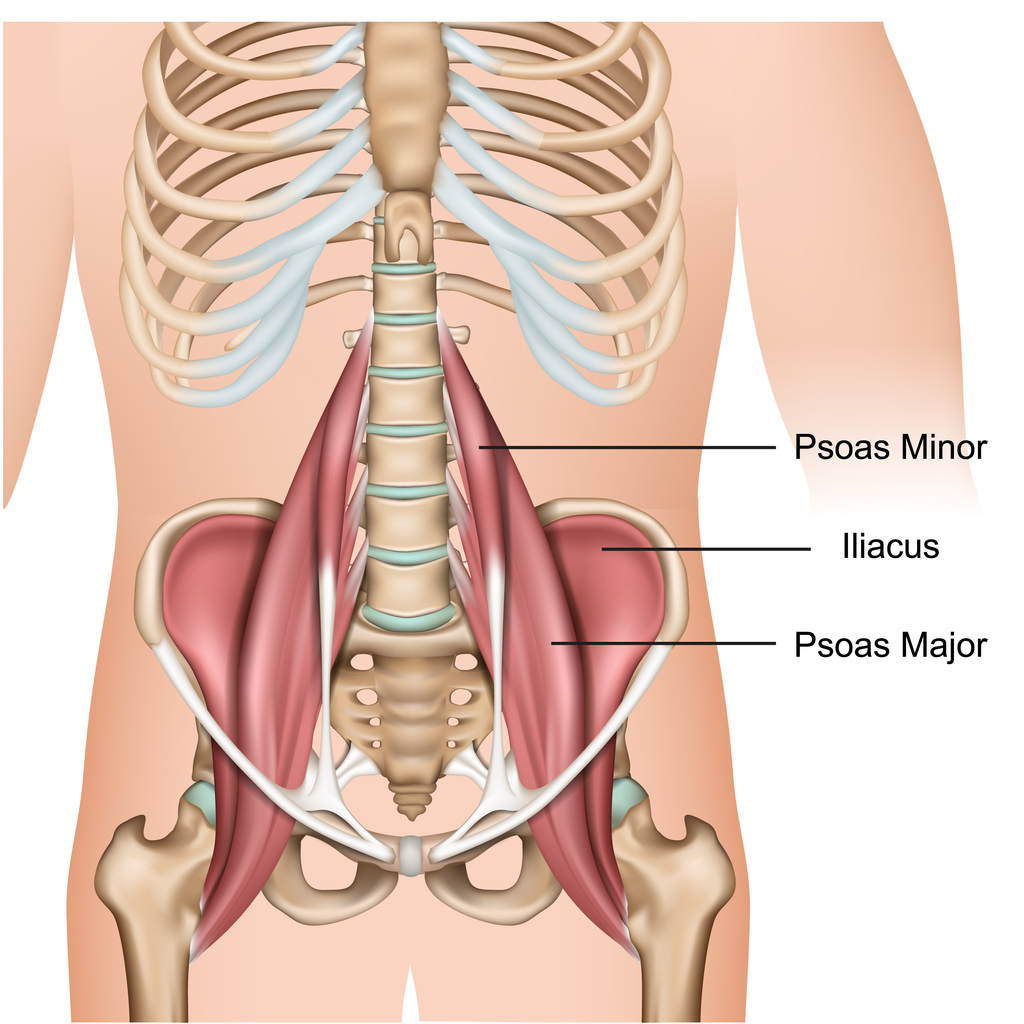
Specialized work on the deep hip flexor that connects your lumbar vertebrae to your femur. Often the missing piece in chronic low back pain. Requires anatomical knowledge, careful access, and consent — covered in detail in the section below.
Sports Massage
Focused work for athletes addressing performance and recovery — pre-event preparation, post-event flush, in-season maintenance, and rehabilitation of training-related strain patterns. Different goals than therapeutic bodywork, different techniques, different timing.
Realignment Through Soft Tissue
Manual soft tissue manipulation that addresses postural imbalance and structural misalignment without high-velocity adjustment. Works through the muscles, tendons, and connective tissue that hold the skeleton in its current pattern — releasing them lets the body return to better alignment naturally.
Mobilization
Passive movement of joints and surrounding tissue through their available range of motion. Restores motion in joints that have stiffened from injury, immobilization, or compensation patterns. Different from manipulation — slower, more controlled, used when high-velocity adjustment is not appropriate.
Trigger Point Therapy
Direct pressure on hyperirritable points within muscle tissue that refer pain to other areas of the body. Resolves both the local restriction and the referred pain pattern. Often the answer when pain is felt in one location but originates in another.
Neuromuscular Reeducation
Retraining the nervous system to recruit muscles in the right sequence and at the right intensity. After injury or chronic pain, the brain often develops protective patterns that outlive their usefulness. Neuromuscular reeducation breaks those patterns and restores normal function — bodywork at the level of the signal, not just the tissue.
Most clients do not need to know which technique is right for them — that is what the assessment is for. What matters is that the toolkit is large enough to address what is actually happening in your body.

Fascial Release (Myofascial Release)
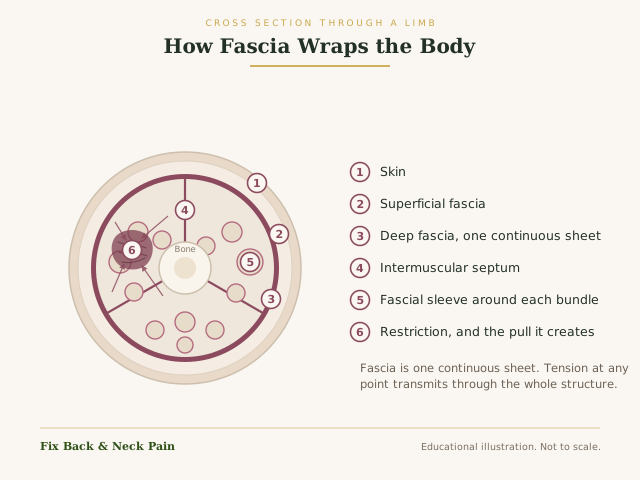
Fascia is the continuous web of connective tissue that surrounds every muscle, organ, and structure in your body. When it becomes restricted — through injury, prolonged posture, repetitive strain, or unresolved tension — it creates pulling forces that contribute to pain, stiffness, and reduced movement that don't always show up on imaging.
Fascial release (myofascial release) uses gentle, sustained pressure applied directly to these restrictions — not to the muscle itself, but to the connective tissue surrounding it. The approach is slower and more specific than conventional deep tissue massage, and the results are often more lasting. Clinical studies and meta-analyses support its effectiveness for reducing pain, improving lumbar range of motion, and restoring physical function in people with chronic low back pain.
In our practice, fascial release is always assessment-led. We identify where restrictions are creating downstream compensation patterns before any hands-on work begins, and we integrate it with MedX spinal strengthening to address both the soft tissue and the structural strength components of your condition.
The Psoas: A Muscle at the Center of Back Pain
One of the most clinically significant — and most overlooked — muscles in spinal rehabilitation.
What Is the Psoas?
The psoas (iliopsoas) is a deep muscle that connects your lumbar vertebrae directly to your thigh bone. It is the primary hip flexor, and it plays a central role in posture, pelvic alignment, and spinal stability. Because it attaches at both the spine and the leg, its tension — or lack of it — directly affects the shape and function of your lower back.
It is also one of the few muscles that cannot be effectively addressed through surface-level massage. Reaching it requires precise anatomical knowledge, a careful assessment, and a trained hand — which is why psoas work is a specialty within manual therapy, not a routine add-on.
How a Tight Psoas Drives Back Pain
Prolonged sitting, poor posture, compensatory movement patterns, and unresolved protective guarding can all cause the psoas to shorten and tighten over time. When it does, it pulls the lumbar spine forward — anteriorly tilting the pelvis, increasing lumbar lordosis, compressing discs and facet joints, and creating a persistent cycle of pain that stretching alone rarely resolves.
Common signs that the psoas may be involved:
- Chronic low back pain that persists despite rest or stretching
- Hip flexor tightness or groin discomfort
- Pain that worsens after prolonged sitting
- Anterior pelvic tilt or exaggerated lower back curve
- One-sided back pain with no clear structural cause
- Feeling like your lower back is always "locked up"
Our Approach to Psoas Release
We use gentle, sustained myofascial release techniques to address deep fascial adhesions around the psoas — working with the body's natural tissue response rather than forcing change. This is precise, deliberate work. It is performed only after thorough assessment and always within your comfort and tolerance. If a technique increases your pain, we stop.
Psoas release pairs exceptionally well with MedX Spinal Strengthening. The MedX protocol builds deep spinal extensor strength, restoring the anterior-posterior muscular balance that a chronically tight psoas has disrupted. Together, these two approaches address both sides of the imbalance — soft tissue restriction and structural weakness — in a way that neither can fully achieve alone.
Following sessions, we may provide guidance on the constructive rest position — a simple, supported posture that allows the psoas to passively release tension — so you can continue supporting your progress at home between appointments.

The Psoas and the Nervous System: What Some Clients Notice
The psoas has a unique relationship with the autonomic nervous system. Because of its proximity to the diaphragm and its role in the body's protective responses — the bracing, curling, guarding that occurs under stress or threat — it can hold a quality of chronic tension that goes beyond ordinary muscle tightness. Some researchers and clinicians describe it as a reservoir for accumulated physical and nervous system tension.
Many clients, following careful psoas release work, notice more than reduced pain and improved posture. They describe a sense of ease, lightness, or emotional release — a felt shift that is difficult to put into words. This is a recognized phenomenon within somatic rehabilitation, connected to the way the body stores and gradually releases held tension patterns when conditions of safety and skilled touch are present.
We approach this dimension of the work with care, professionalism, and full nervous-system awareness. We do not provide psychological therapy, and we make no claims about treating emotional or mental health conditions. What we offer is skilled, client-led bodywork in a setting that respects the whole person — and an honest acknowledgment that physical release sometimes opens a door people didn't know was there.
All manual therapy is client-directed and paced to your comfort. Results vary by individual. Professional assessment is essential prior to any deep work. We never apply pressure that increases your pain. This work does not replace psychological or psychiatric care.
When Pain Originates Somewhere Other Than Where You Feel It
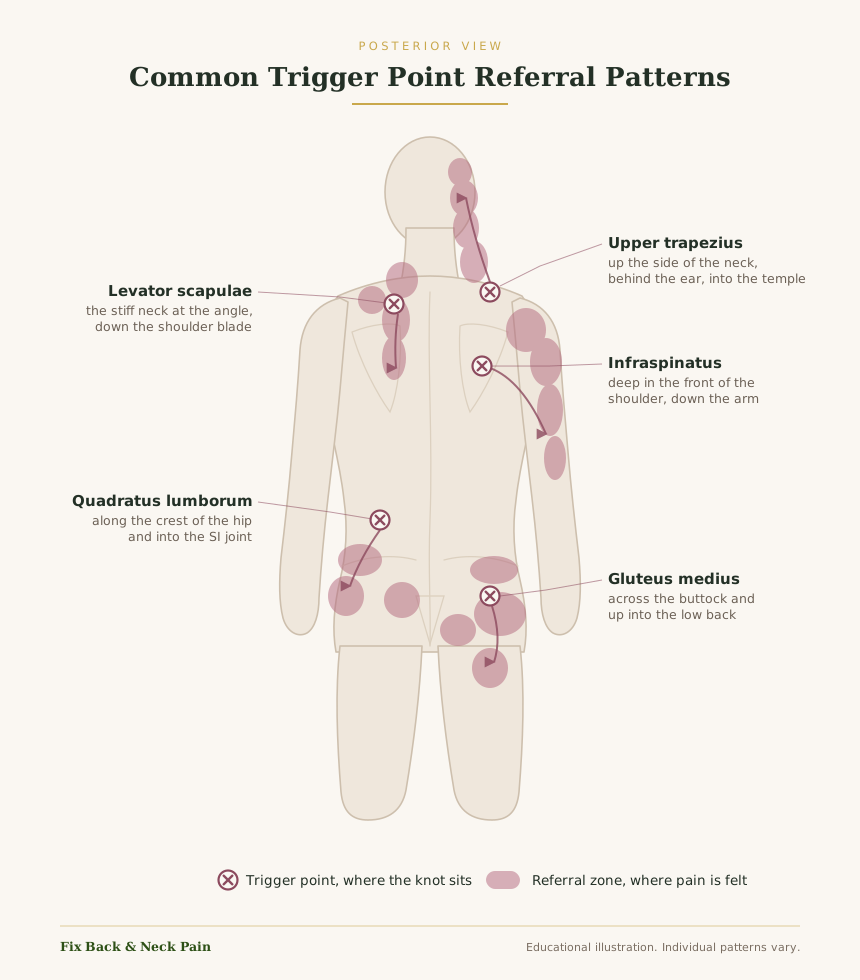
A trigger point is a hyperirritable knot within muscle tissue that refers pain — often to a location far from the actual source. The classic example is the client who describes pain in the front of their shoulder when the actual restriction is buried in the muscle behind it. Until the source is addressed, the referred pain keeps returning.
What Trigger Point Work Actually Does
We assess where pain is felt, then trace the referral pattern back to the originating muscle. Direct sustained pressure is applied to the trigger point until it releases — usually within 30 to 90 seconds — at which point both the local restriction and the referred pain pattern resolve.
The work is sometimes uncomfortable in the moment, but the relief that follows is often immediate and lasting. Clients are frequently surprised when shoulder pain resolves through work on the upper back, or hip pain resolves through work on the gluteal muscles. The body's referral patterns are predictable once you know what to look for.
Trigger point work is most effective when integrated with the structural strengthening that prevents the trigger points from returning. Resolved trigger points stay resolved when the muscle is given the strength to no longer need them.
Sports Massage and Rehabilitation Bodywork
Athletes need bodywork that does different things at different points in their training cycle. The same client needs something different the day before a competition than two days after. Sports massage at this practice is calibrated to where you are in your training arc — not delivered as a standardized routine.
Pre-Event
Light, fast-tempo work that primes the nervous system and warms tissue without creating fatigue. Typically 30 to 45 minutes, scheduled 24 to 48 hours before competition. Designed to leave you fresher, not drained.
Post-Event
Slower, more thorough work that supports recovery — flushing accumulated tension, addressing the patterns the event created, and accelerating the return to baseline. Scheduled within 24 to 72 hours after intense competition or training.
In-Season Maintenance
Regular bodywork that prevents the small restrictions from becoming the injury that ends a season. Most committed athletes settle into a 1-to-2-session-per-month rhythm during their training cycle.
For competitive athletes managing complex training loads, see our dedicated page for athletes →
Realignment, Mobilization, and Neuromuscular Reeducation
Three related techniques that work at the structural and neurological level — restoring how the body holds itself together and how the nervous system controls it. Often integrated within a single session depending on what the assessment reveals.
Realignment
Soft tissue work that addresses the muscles and connective tissue holding the skeleton in misalignment — releasing the structures that maintain the pattern, allowing the body to return to better alignment naturally. No high-velocity adjustment, no audible release. Works particularly well for clients who do not want or cannot tolerate chiropractic-style manipulation.
Joint Mobilization
Passive guided movement of stiff or restricted joints through their available range — slowly, deliberately, and within the client's tolerance. Used when joints have lost motion from injury, immobilization, or compensation. Restores movement that becomes the foundation for further strengthening work.
Neuromuscular Reeducation
Retraining how your nervous system recruits muscles in sequence. After injury, surgery, or chronic pain, the brain develops protective patterns that compensate for what hurts — and those patterns often outlive the original injury. Neuromuscular reeducation interrupts the protective pattern and rebuilds the correct firing sequence.
"Some people finish their sessions and notice something shifted that wasn't just physical."
If that has been your experience, Trent has built a separate platform for people ready to explore what the body holds beyond pain. It's called Viveka.Life.
Learn About the Deeper WorkKey Benefits
- Reduces chronic back and neck pain by correcting muscular imbalances
- Improves mobility, posture, and function through targeted rehabilitation
- Accelerates injury recovery with expert assessments and fascial release
- Prevents future issues by restoring natural body mechanics
- Goes beyond symptom relief to address underlying dysfunction
- Integrates seamlessly with MedX, laser, and other modalities
Ideal For
Skilled Hands Reach What Standard Treatment Cannot.
Tell us where the pain is, what you have tried, and what is still not resolved. We will tell you honestly whether targeted manual therapy is the missing piece — and whether the assessment makes sense for your situation.
425-758-4619Mon to Fri, 9:00 to 6:00 · Sat, 9:00 to 2:00 by appointment