
By Trent Shuford LMT, Cert. MedX Tech., University of Florida
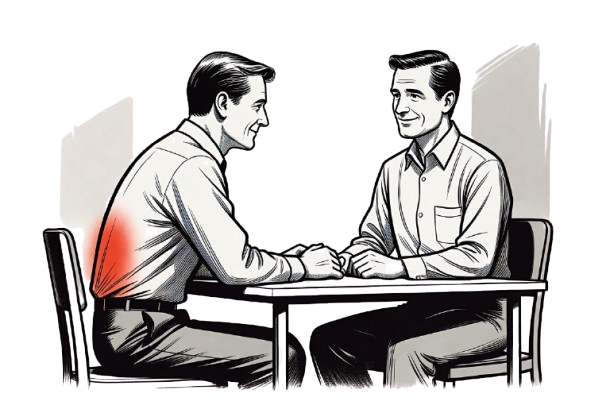
A woman in her early seventies comes in with two diagnoses. The first is low bone density in her lumbar spine, identified on a DEXA scan her primary care doctor ordered after a routine physical. The second is chronic low back pain she has been managing for the past decade. Two diagnoses. Two providers handling them. Two completely separate programs.
The DEXA result went to a referral for weight-bearing exercise, calcium, and vitamin D. The back pain went to a physical therapist who built a routine of walking and water aerobics. Both providers told her to "stay active." Neither asked whether the two diagnoses might be related.
In our clinic this is the most common pattern we see in older adults — bone density and back strength treated as separate problems, by separate providers, with interventions that address neither well.
Here is what nobody tells these clients: the same training that builds bone density in the lumbar spine is the training that rebuilds the muscular support that keeps the spine functional and pain-free. The two diagnoses are not adjacent problems. They are the same problem, expressed at different tissue levels, with the same solution.
The Two Diagnoses Nobody Connects
Bone density loss and lumbar muscle deconditioning happen in parallel. They share the same root mechanism. The spine is a mechanical system that responds to load, and when load disappears, both muscle and bone atrophy together.
In older adults, load typically disappears for several reasons that compound. Pain-avoidance behavior, accumulated over years, removes loading from the structures that hurt. Conventional medical advice to "be careful" reinforces it. Activities shift to lower-load options (walking, swimming, stationary cycling) that protect joints but spare the spine. Strength training, when it happens, focuses on hip, quadriceps, and balance: the femoral neck and hip-fracture prevention story.
The lumbar extensor system, the deep muscles that run alongside the spine and hold it upright under load, receives no specific loading in any of this. The muscle atrophies. The bone atrophies. Pain increases. Activity decreases further. The pattern compounds.
This is the cycle, and it cannot be broken by general activity recommendations.
What the Bone Density Research Actually Shows
The most direct evidence on this question comes from work done at the University of Florida Center for Exercise Science. Pollock and colleagues (1992) randomized 35 men and women aged 60 to 82 into three groups: aerobic training alone, aerobic training plus isolated lumbar extension, and sedentary control. After six months, the group that added isolated lumbar extension training showed significant increases in lumbar bone mineral density, and those BMD gains correlated strongly with the strength gains from the isolated lumbar work.
The mechanism is straightforward. Bone is a living tissue that responds to mechanical stress on the specific bone being loaded. Walking loads the long bones of the legs and the hip. Lumbar extension loads the lumbar vertebrae. Without isolated lumbar loading, the lumbar spine receives no signal to maintain bone density, regardless of how active the client is in other ways.
The strength side of the story tracks the same pattern. The original Pollock work in 1989 documented a 102% increase in lumbar extension strength in subjects who trained once per week for ten weeks using isolated, pelvic-stabilized loading. In a study targeting geriatric women with chronic low back pain, Vincent and colleagues documented a 77% increase in exercise weights over a 97-day treatment period: a population in which most providers assume strength gains are no longer possible.
These are not modest effect sizes. They reflect the difference between loading the specific muscle system that needs to be loaded, and loading something else.
Why Most Programs for Older Adults Miss This
Walking, swimming, yoga, and water aerobics have real value for cardiovascular health, mood, and general movement. They are not vehicles for lumbar bone density or lumbar extensor strength. They were never designed to be.
Most strength programs that do target older adults focus on the hip, the quadriceps, balance, and grip: the systems whose decline correlates with fall risk and hip fracture. This is reasonable. Hip fractures kill older adults at a rate that justifies the focus.
But spinal compression fractures from low-bone-density lumbar vertebrae are also a leading cause of disability and loss of independence in this population. And the lumbar extensor weakness that accompanies that bone density loss is itself a source of chronic pain that drives further deconditioning. Neither piece gets addressed by hip-focused strength programs.
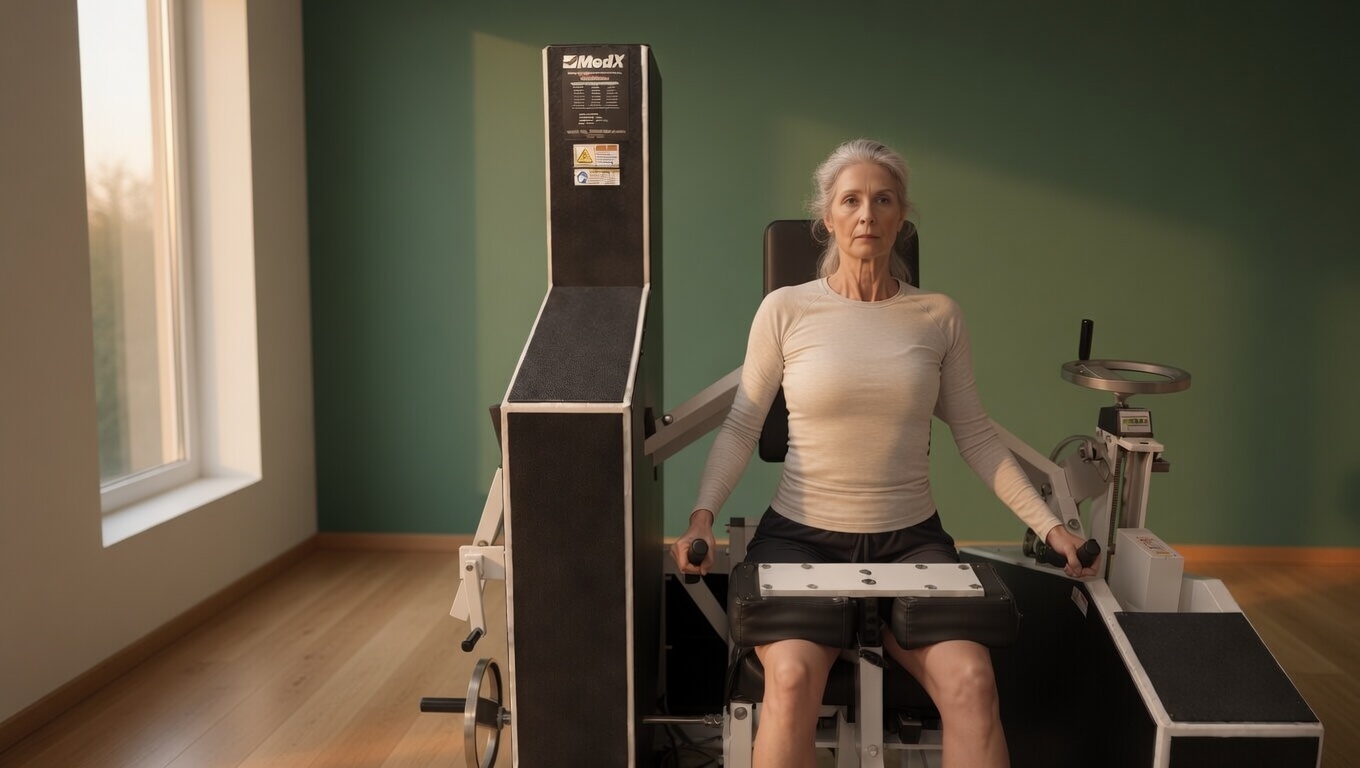
What we are describing is a specific clinical gap. The intervention that addresses it requires equipment that isolates the lumbar spine from hip movement, applies measured load through a defined range of motion, and produces objective measurement of strength changes. That equipment is the MedX Lumbar Extension Machine, designed by Arthur Jones (the same engineer who invented Nautilus) and validated through the research program at the University of Florida Center for Exercise Science. It is the equipment used in the Pollock studies cited above. There are very few of these machines still in active clinical use anywhere in the United States. Ours is the only one in the Pacific Northwest.
Still living around your pain?
Let's change that. Call us and describe what you're dealing with — we'll tell you honestly if we can help.
Call 425-758-4619
What an Assessment-First Program Looks Like
For an older adult client with both bone density loss and chronic low back pain, the first step is measurement. MedX strength testing produces objective torque values at seven angles through 72 degrees of lumbar flexion. Those values are compared against age-matched norms from healthy untrained subjects measured at the University of Florida Center for Exercise Science.
The baseline tells us where the client is. Most older adults with chronic low back pain show a substantial deficit relative to norm. The deficit is the training target.
The training itself is short and well-tolerated. One session per week is enough. The protocol is isolated and pelvically stabilized, which means the load goes to the lumbar extensors and nowhere else. Clients in their seventies and eighties tolerate the work the same way clients in their forties do, because the equipment matches resistance to current ability.
Strength gains happen on the same timeline they happen at any age. Bone density gains, in the Pollock data, follow over a six-month window of consistent training. Clients begin reporting that the back pain they had assumed was a permanent feature of getting older is, in fact, getting better.
When This Is Not the Right Fit
There are conditions where active lumbar loading is contraindicated and we will not take a client until they are cleared. Active compression fractures need to heal under medical management before loading can begin. Severe osteoporosis with a history of multiple vertebral fractures requires a modified protocol with physician sign-off. Active cancer involving the spine is outside our scope entirely.
We screen for these conditions before we begin. If we cannot help, we say so, and we direct the client to who can. This is the clinical position we take with every client, and it applies with particular care in this population.
For the much larger group of older adults who have osteopenia or mild osteoporosis without active fracture, chronic back pain without red flags, and a desire to remain functional into their seventies and eighties, isolated lumbar extension work is the most evidence-supported intervention available.
The Conversation Worth Having
For an older adult concerned about both spinal pain and bone density, the question is not which problem to address first. It is whether the program they are currently in addresses either of them at all. In our experience, most do not.
The lumbar spine responds to specific load. Without it, the bone thins, the muscle atrophies, and the pain compounds. With it, the trajectory reverses, on a timeline measured in months rather than years.
That is the conversation worth having.
Physicians evaluating this work for their patients will find our Clinical Toolkit on the provider pathway page.
Trent Shuford, LMT, Cert. MedX Tech.