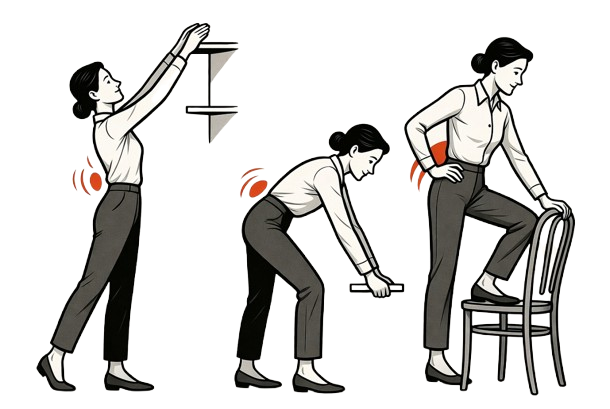
If you have back or neck pain, you have almost certainly been told that your posture is the problem. Sit up straight. Don't slouch. Keep your chin tucked. Shoulders back. This advice is everywhere — from physiotherapists to ergonomic consultants to well-meaning family members.
It is also largely ineffective. Not because posture is irrelevant, but because telling someone to correct their posture without addressing why their posture is poor in the first place is like telling someone with a broken leg to walk normally. The instruction is technically correct. The approach is wrong.
Posture is a downstream consequence of muscle strength, muscle length, joint mobility, and neurological motor patterns. When these upstream factors are dysfunctional, poor posture is the inevitable result — regardless of how much conscious effort the person applies to "sitting up straight."
Why You Can't Just Decide to Have Better Posture
Postural alignment is maintained by the constant, largely unconscious activation of postural muscles. The deep cervical flexors hold the head in alignment over the spine. The lumbar extensors maintain the natural lumbar curve. The thoracic extensors resist the forward collapse of the upper back. When these muscles are strong and appropriately activated, good posture is the path of least resistance — it's what the body naturally does.
When these muscles are weak or inhibited — which is the state most sedentary adults are in — maintaining good posture requires constant conscious effort that is simply not sustainable throughout a working day. The muscles fatigue, the body collapses into the position that requires the least muscular effort, and "bad posture" is the result.
This is why postural advice without strengthening is ineffective. The person trying to sit up straight is asking exhausted, weak muscles to sustain a position they don't have the capacity to maintain. The intervention needs to address the capacity, not the position.
Forward Head Posture — The Most Consequential Pattern
Forward head posture — where the head sits forward of its optimal position over the cervical spine — is perhaps the most clinically significant postural pattern in modern life. For every inch the head translates forward, the effective weight on the cervical spine increases dramatically. At two to three inches of forward translation — which is moderate by modern standards — the effective cervical load can approach 40 to 60 pounds.
This chronic overloading drives the progression of cervical degenerative changes, creates the persistent upper trapezius tension that most desk workers experience, and is a primary driver of cervicogenic headaches. It also cannot be corrected by posture advice alone — because the deep cervical flexors that should be holding the head in position are typically severely weakened in people with established forward head posture.
MedX cervical strengthening rebuilds these deep stabilizers with medical-grade precision — creating the muscular capacity for proper head position that postural advice alone can never achieve.
Still living around your pain?
Let's change that. Call us and describe what you're dealing with — we'll tell you honestly if we can help.
In the lower back, the equivalent pattern is anterior pelvic tilt — the pelvis rotating forward, increasing the lumbar lordosis and placing the lower back in chronic extension. This pattern is driven primarily by tight hip flexors — especially the psoas — and weak gluteal and abdominal muscles. It is almost universally present in people who spend significant time sitting.
Anterior pelvic tilt creates chronic compression of the lumbar facet joints, pre-loads the intervertebral discs in extension, and contributes significantly to the chronic low back pain that affects the majority of desk workers at some point. Telling these clients to "stand up straight" does nothing to lengthen the tight psoas or strengthen the inhibited gluteals. Those require specific targeted intervention.
The Real Solution — Address the Drivers
Effective postural correction requires addressing the specific muscular and fascial factors that are producing the dysfunctional pattern:
Targeted strengthening of the weakened postural muscles — deep cervical flexors, lumbar extensors, deep abdominal stabilizers
MedX lumbar and cervical strengthening to rebuild the specific deep stabilizers that postural alignment depends on
Movement retraining to establish new motor patterns once the capacity for those patterns has been restored
When these upstream factors are addressed, postural improvement follows — naturally, sustainably, and without constant conscious effort. The body assumes good posture because good posture has become the path of least resistance again.
What This Means for Your Pain
If your back or neck pain has been attributed to poor posture and treatment has focused on postural correction without meaningful improvement, the missing piece is almost certainly the upstream muscular and fascial factors that are driving the postural problem. A comprehensive assessment will identify exactly which factors are involved and what the most effective intervention approach looks like.
Trent Shuford, LMT, Cert. MedX Tech.
Not sure if this is right for you?
We put together a straightforward guide to help you decide before you call.