There is a muscle deep inside your abdomen that most people — including many healthcare providers — rarely think about. It sits too deep to feel from the surface, doesn't show up easily on standard imaging, and can't be reached by conventional massage. Yet for a significant number of people with chronic low back pain, hip pain, or persistent postural problems, this muscle is at the center of the problem.
It's called the psoas — or more precisely, the iliopsoas — and understanding it may change how you think about your pain.
What the Psoas Is and What It Does
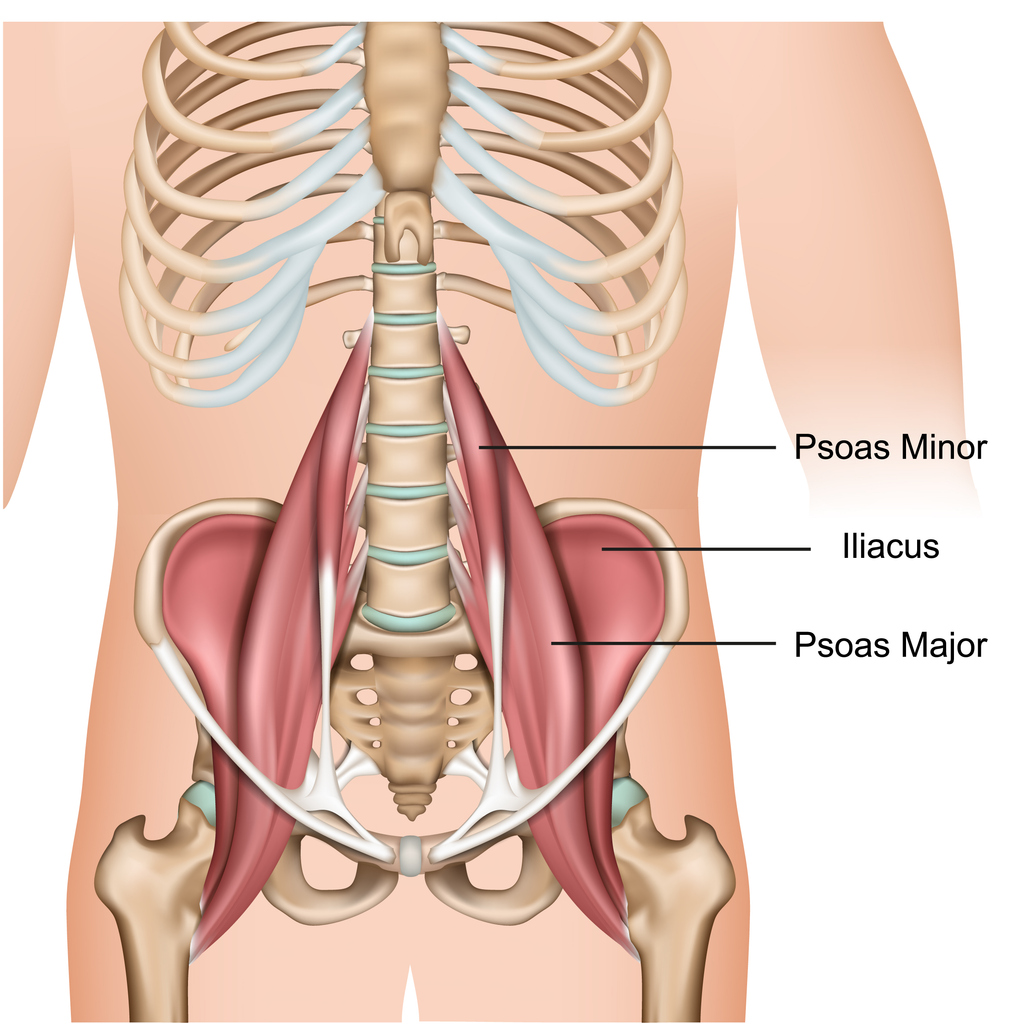
The psoas major originates at the lumbar vertebrae — specifically at the transverse processes and bodies of L1 through L5 — and runs diagonally through the pelvis to attach at the lesser trochanter of the femur, or thigh bone. It is the primary hip flexor of the body, responsible for lifting the thigh toward the torso during walking, running, and climbing.
Because it attaches directly to the lumbar spine, the psoas also plays a critical role in spinal stability and pelvic alignment. When it functions correctly — with appropriate length and tone — it helps maintain the natural curve of the lumbar spine and supports balanced movement through the hips.
When it doesn't function correctly, almost everything downstream is affected.
Why the Psoas Gets Tight
The psoas is a hip flexor. Prolonged hip flexion — sitting — causes it to adaptively shorten. This is why psoas tightness is so extraordinarily common in modern life. Most people spend the majority of their waking hours in a seated position: at a desk, in a car, on a couch. Over weeks, months, and years, the psoas adapts to that shortened position and loses its ability to fully lengthen.
Other contributors to psoas tightness include:
Protective guarding following a back injury
Compensatory patterns from hip or knee problems
Poor postural habits during standing and walking
High-volume repetitive hip flexion in athletes (runners, cyclists, soccer players)
Chronic stress and nervous system activation — more on this below
Still living around your pain?
Let's change that. Call us and describe what you're dealing with — we'll tell you honestly if we can help.
When the psoas shortens and tightens, it pulls on its attachment points. At the top, it pulls the lumbar vertebrae forward and downward. At the bottom, it pulls the femur upward and inward. The result is a cascade of mechanical changes:
The pelvis tilts anteriorly — rotating forward at the top and backward at the bottom. This increases the lumbar lordosis — the inward curve of the lower back — beyond its optimal range. The facet joints at the back of the vertebrae are compressed. The intervertebral discs are loaded asymmetrically. The surrounding musculature — the gluteals, the hamstrings, the lumbar extensors — attempts to compensate and develops its own tension and dysfunction.
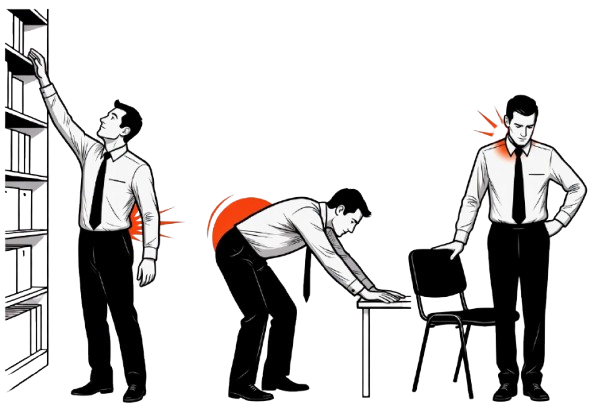
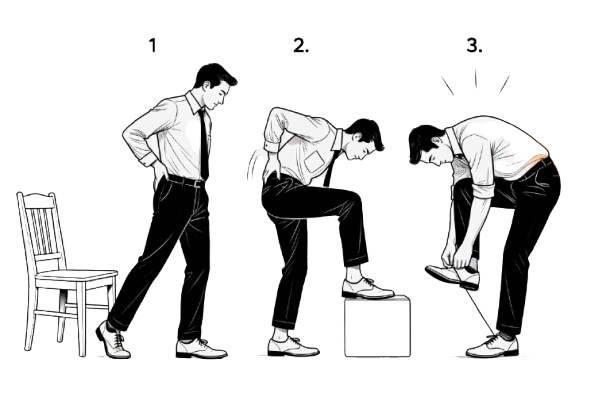
The pain that results can manifest in multiple ways: central low back aching, one-sided back pain, hip flexor tightness, groin discomfort, or a feeling that the lower back is perpetually locked up. It often worsens after prolonged sitting and improves temporarily with movement — only to return.
Common Signs the Psoas May Be Involved
Chronic low back pain that persists despite rest or conventional stretching
Pain or tightness in the front of the hip or groin
Low back pain that is worse after sitting for extended periods
Visible anterior pelvic tilt — a forward-tilting pelvis and exaggerated lumbar curve
One-sided low back pain with no clear structural cause on imaging
A persistent feeling that the lower back is braced or locked
Pain that radiates into the upper thigh but doesn't follow a classic nerve pattern
Why Stretching Alone Doesn't Resolve It
The standard recommendation for a tight psoas is to stretch it — typically with a lunge position that extends the hip. And while hip flexor stretching has its place, it rarely resolves established psoas dysfunction for a straightforward reason: the restriction is not simply in the muscle belly itself. It's in the fascial tissue surrounding and binding the muscle, in the neural tension that keeps the muscle in a guarded state, and in the compensatory patterns that have developed throughout the kinetic chain.
Stretching addresses the muscle. Myofascial release addresses the tissue. These are different things — and the distinction matters enormously for treatment outcomes.
You've tried other things.
This is different. Our approach addresses the structural deficit most treatments miss entirely.
Our Approach: Myofascial Release and MedX Integration
At Fix Back & Neck Pain, we address the psoas through gentle, sustained myofascial release — a specialized manual technique that works with the fascial tissue surrounding the muscle rather than forcing it through range of motion. This approach is precise, slow, and requires detailed anatomical knowledge and a trained hand. It is performed only after thorough assessment and always within your comfort and tolerance.
Psoas release in isolation, however, addresses only one side of the problem. A tight psoas pulls the spine forward — but what allows it to maintain that pull is the weakness of the opposing spinal extensors. This is why we integrate psoas release with MedX spinal strengthening. The MedX protocol rebuilds the deep lumbar extensor strength that restores anterior-posterior balance — addressing both the restriction and the structural deficit simultaneously.
Following sessions, we often guide clients through the constructive rest position — a supported lying position that allows the psoas to passively release tension over time — so that the work of the session continues at home.
The Psoas and the Nervous System
There is one more dimension of psoas function worth understanding — particularly for clients who have noticed that their back pain has an emotional or stress-related quality to it.
The psoas is anatomically connected to the diaphragm through shared fascial tissue, and it lies adjacent to the sympathetic nerve chain — the part of the autonomic nervous system responsible for the body's stress response. Because of this proximity, the psoas is exquisitely responsive to states of threat, stress, and protective activation. In the fetal position — the body's instinctive protective posture — the psoas is fully contracted.
For people who have lived with chronic stress, anxiety, or unresolved tension, the psoas may carry a quality of holding that goes beyond ordinary muscle tightness. Many clients following careful psoas release describe not only reduced physical pain but a sense of ease or release that they didn't anticipate.
We approach this dimension of the work with care and professionalism. The physical and the nervous system dimensions of psoas function are real and clinically recognized — and we hold space for both without overstepping into territory that belongs to mental health professionals.
Is Psoas Work Right for You?
If you have chronic low back pain that hasn't responded to conventional treatment, if you spend significant time sitting, if you notice the signs described in this article — psoas involvement is worth investigating. A thorough assessment will tell us quickly whether the psoas is a primary contributor to your pain pattern and whether myofascial release is an appropriate part of your treatment plan.
Call us and describe what you're dealing with. We'll tell you honestly whether this approach makes sense for your situation.
Trent Shuford, LMT, Cert. MedX Tech.
Not sure if this is right for you?
We put together a straightforward guide to help you decide before you call.