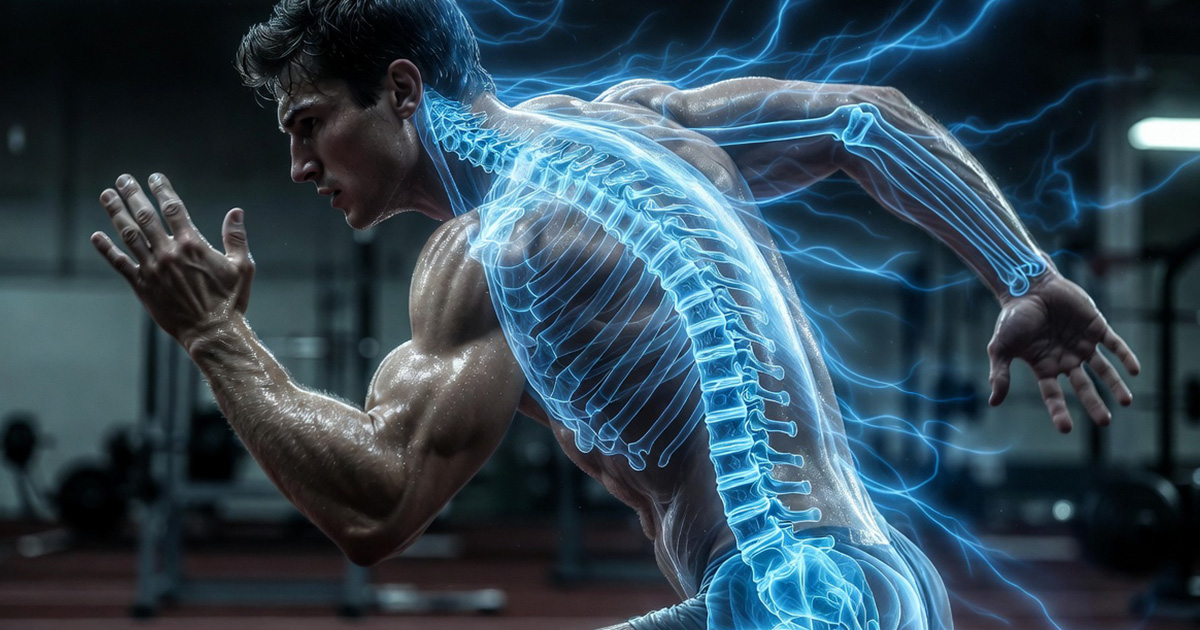
For most people, the spine is a structure they think about when it hurts. For serious athletes, the spine is a performance organ — the central axis around which all power generation, force transfer, and movement coordination occurs. The difference in how you think about it determines the difference in how you treat it.
Standard sports medicine approaches — rest, ice, anti-inflammatory medication, basic physical therapy — are designed to return athletes to pain-free function. For recreational athletes this is often sufficient. For serious competitors, returning to pain-free function is only the beginning. The goal is returning to optimal spinal performance — and that requires a different approach entirely.
What Athletic Loading Does to the Spine
High-level athletic training imposes cumulative spinal loading that has no equivalent in everyday life. Repeated sprint acceleration, heavy resistance training, contact sport impacts, gymnastics and dance compression loads, throwing and rotational sports — each of these generates forces through the lumbar and cervical spine that exceed what the structure was designed to handle without specific preparation.
The adaptations that protect the spine under these loads are primarily muscular. The deep lumbar extensors, the multifidus, the cervical stabilizers — these muscles are the shock absorbers and stabilizers that make high-level athletic loading safe. When they are undertrained relative to the demands being placed on the spine, injury becomes predictable. Not possible — predictable.
The Strength Gap Most Athletes Don't Know They Have
Here's the counterintuitive reality: many highly trained athletes have undertrained spinal stabilizers. A sprinter may have exceptional hamstring and glute strength. A rower may have extraordinary pulling capacity. A gymnast may have remarkable flexibility and body control. But none of these qualities specifically trains the deep lumbar extensors — the muscles that stabilize the vertebrae themselves during movement.
Because these muscles cannot be effectively isolated through conventional training, they are systematically undertrained in most athletic populations. The result is a performance ceiling imposed by spinal instability — and a vulnerability to injury that no amount of conventional strength training resolves.
MedX lumbar and cervical strengthening targets these specific muscles with medical-grade precision. For athletes who have never properly trained their spinal stabilizers, the strength gains from a focused protocol are often dramatic — and the performance implications are significant.
Still living around your pain?
Let's change that. Call us and describe what you're dealing with — we'll tell you honestly if we can help.
Managing Athletic Spine Injuries Without Losing Conditioning
One of the most important clinical challenges in treating athletic spine injuries is managing the injury without allowing deconditioning of the surrounding musculature. Rest-based approaches — while sometimes necessary — allow the spinal stabilizers to weaken during the recovery period, creating a secondary vulnerability that makes re-injury more likely when training resumes.
Our approach prioritizes maintaining and building spinal strength throughout the rehabilitation process — not after it. MedX equipment allows targeted loading of the injured segment's supporting musculature even when the athlete cannot return to sport-specific training. This means athletes often return to competition stronger than they were before the injury, not just recovered to their pre-injury baseline.
Piezowave for Athletic Soft Tissue Injuries
Athletes accumulate soft tissue injuries — tendinopathies, fascial adhesions, scar tissue from previous injuries — at rates that exceed the general population. These injuries often plateau under conventional treatment, leaving athletes managing chronic pain rather than resolving it.
Piezowave acoustic shockwave therapy breaks down the underlying tissue pathology — stimulating neovascularization, collagen remodeling, and calcification breakdown — in a way that allows genuine healing rather than symptom management. For athletic tendinopathies that have stopped responding to rest and conventional physical therapy, Piezowave is often the missing intervention.
Red Light Therapy for Athletic Recovery
Full-body LED red light therapy has emerged as one of the most evidence-supported recovery modalities available to serious athletes. Photobiomodulation at therapeutic wavelengths accelerates cellular repair, reduces training-induced inflammation, improves mitochondrial function, and enhances tissue healing between sessions.
For athletes training at high volumes — where recovery capacity is as important as training capacity — red light therapy provides a meaningful edge. Sessions are comfortable, require no downtime, and can be integrated into an existing training schedule without disruption.
You've tried other things.
This is different. Our approach addresses the structural deficit most treatments miss entirely.
We work with competitive athletes across a wide range of sports — including golf, tennis, swimming, track and field, CrossFit, and team sports. We also work with coaches and athletic trainers who want to integrate spinal assessment and strengthening into their athletes' programming. If you are serious about your sport and serious about your longevity in it, we'd welcome the opportunity to assess where your spinal performance currently stands.
Trent Shuford, LMT, Cert. MedX Tech.
Not sure if this is right for you?
We put together a straightforward guide to help you decide before you call.