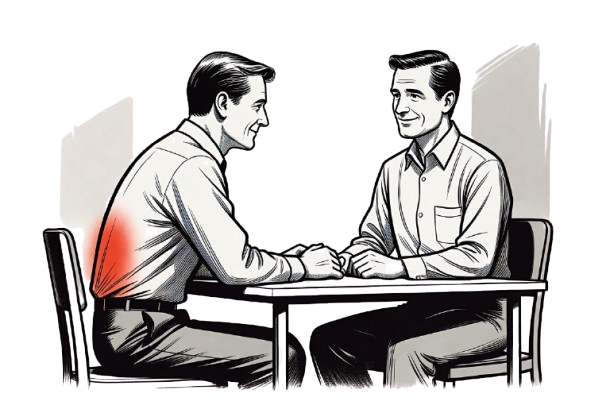

A client came into the clinic last month who could deadlift more than most men half his age. He had a strong back by every gym-floor measure: erector spinae like cables, a six-pack he could bounce a quarter off, hip strength to spare. And he was in my office because his low back gave out picking up a laundry basket.
This is the misconception I correct almost weekly: that a strong back is a big back. It is not. Buried underneath the erector spinae, segment by segment along the spine, sits a small muscle called the multifidus. It does not show up in the mirror. It does not respond to squats, deadlifts, or planks the way people assume it should. And when it is weak, everything built on top of it is standing on a cracked foundation.
The Muscle That Does Not Get Trained by Accident
The multifidus is a deep spinal stabilizer that runs segment to segment, attaching one vertebra to the next. Its job is not to move the spine through a big range of motion. Its job is to control the small, segmental motion between individual vertebrae, the kind of stability that keeps one level from shearing forward while the level above it extends. The big muscles, erector spinae, lats, glutes, generate force and produce visible movement. The multifidus does something quieter and arguably more important: it keeps each joint in the chain from moving more than it should while that force is being generated.
Here is the mechanical problem. Global movers like the erector spinae can get strong from generic exercise. Deadlifts, rows, extensions all load them directly. The multifidus does not respond the same way, because generic loading does not challenge segmental control specifically. Graves' 1994 research found that isolated lumbar strength improved only when pelvic stabilization was used during training, with a 23.5% strength gain in the stabilized group versus a 1.2% loss in the unstabilized group. Same client population, same general exercise, radically different outcome depending on whether the pelvis was locked down to isolate the target muscle. That is not a small detail. It is the entire explanation for why some people train for years and still have an unstable segment waiting to fail.
Strong on the Outside, Unstable Multifidus on the Inside
This is why a client can pass every strength test a trainer throws at him and still herniate a disc reaching for a coffee mug. The big movers were never the weak link. The segment-by-segment control was. When the multifidus atrophies, which it reliably does after even a single significant low back injury, the vertebrae above and below the weak segment lose their fine control. The bigger muscles compensate by bracing harder, which feels like strength but is actually the nervous system working around a gap. Eventually that gap shows up as a flare-up, often from something mundane, because mundane movements are exactly when the deep stabilizers are supposed to be doing quiet, unnoticed work.
San Juan's 2005 research measured this directly with EMG and found multifidus activation was 51% greater when pelvic stabilization was used during training, compared to unstabilized movement patterns. The muscle can be reached. It just is not reached by accident, and it is not reached by the exercises most people assume are "core work."
Why Bracing Is Not the Same as Stabilizing
A lot of clients tell me they already do core work: planks, dead bugs, bird dogs. These are reasonable exercises. But bracing the abdominal wall and stabilizing a specific spinal segment are not the same skill, and the difference matters clinically. Bracing is a whole-trunk strategy. It stiffens everything at once, which is useful for lifting something heavy off the floor. Segmental stabilization is precise. It requires the nervous system to control one joint level without recruiting the whole trunk to do it, and that precision is exactly what generic core training does not teach.
This is the piece that gets missed in gyms and in a lot of physical therapy protocols too. You cannot out-brace a segmental control deficit. You can mask it for a while with a strong enough core, right up until fatigue, a bad angle, or an unguarded moment removes the mask.
Why Core Workouts Alone Do Not Fix Back Pain
Still living around your pain?
Let's change that. Call us and describe what you're dealing with — we'll tell you honestly if we can help.
Call 425-758-4619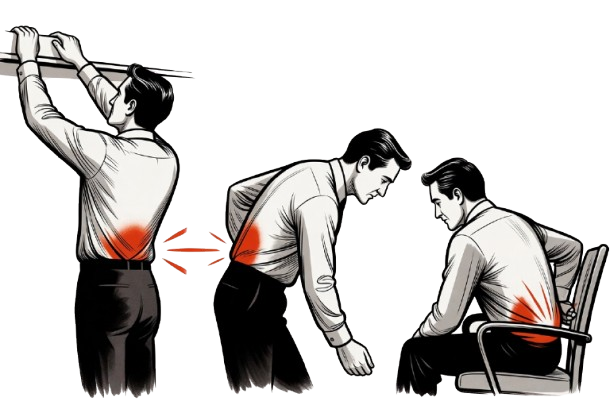
What Rebuilding Segmental Control Actually Requires
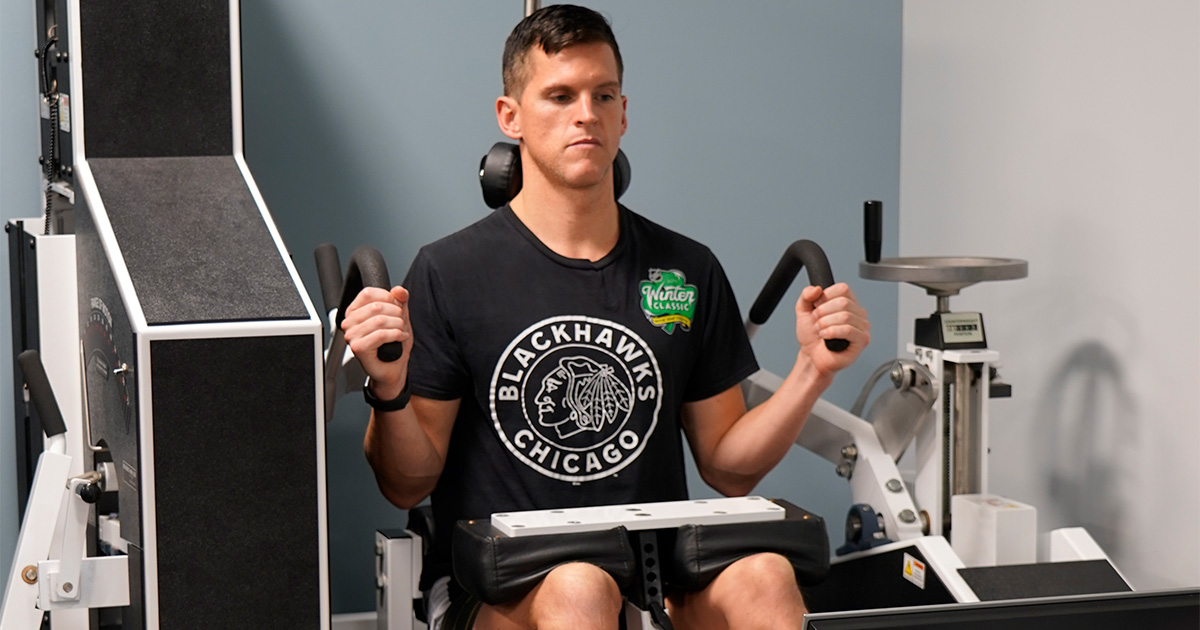
Rebuilding the multifidus requires isolating the lumbar spine so it, and only it, is doing the work, which is the entire premise behind MedX spinal strengthening. The pelvis is stabilized, the hips and legs are taken out of the equation, and the load is applied directly to the segment that needs to relearn how to control itself. Pollock's 1989 research found a 102% increase in lumbar extensor strength at 0 degrees of flexion after ten weeks of once-weekly training in healthy subjects, a strength gain finding, not a patient pain outcome, but it establishes how responsive this muscle group is once it is actually isolated and loaded correctly.
Why MedX Spinal Strengthening Works
In my own practice, of clients who arrived with spinal surgery already scheduled, 86.5% avoided surgery. That is not a clinical trial statistic. It is a pattern I have watched repeat in this clinic, and segmental stabilization work is very often the piece that had been missing from everything they tried before walking through the door.
Manual and muscular therapy has a role here too, particularly early, when the surrounding tissue is guarded and inflamed and the client cannot yet tolerate loaded isolation work. Spinal traction and decompression can create the space needed to calm an acute segment down before it is ready to be strengthened. But therapy and traction manage the symptom. Only direct, isolated loading rebuilds the control the segment lost.
The Hard Truth About Being "Strong"
A strong deadlift says nothing about whether L4-L5 can control itself under an ordinary, unremarkable load. Big muscle strength and segmental stability are different systems, trained by different methods, and one does not substitute for the other. The client who threw out his back on a laundry basket was not weak. He was strong everywhere except the one place that mattered most, and no amount of general strength training was ever going to reach it.
You don't have to live with this. Backs and necks can get stronger, pain can ease, and the body is more capable of recovery than most people are told. This blog is here to give you honest, practical information about what actually helps. As we learn more, we'll keep sharing what works. If something here spoke to you, that's a good reason to reach out and start the first conversation.
Trent Shuford, LMT, Cert. MedX Tech.