
The Problem With Most Back Pain Treatment
If you've had chronic back pain for more than a few months, you've probably tried something. Physical therapy. Chiropractic. Injections. Anti-inflammatory medication. Maybe stretching or yoga. Some of these things helped — temporarily. But the pain came back.
This isn't a failure of effort or commitment. It's a failure of targeting. Most back pain treatments address the symptom — the pain, the inflammation, the reduced range of motion — without addressing the structural deficit that's allowing the problem to persist in the first place.
That deficit, in the vast majority of chronic low back pain cases, is muscular weakness in the deep spinal extensors.
The Muscles Nobody Trains
Your lumbar spine is held upright and stable by a group of deep muscles that run along either side of the vertebrae. These muscles — the multifidus, the lumbar extensors — are responsible for maintaining the spine's position under load. When they are strong and functional, the spine is supported. When they are weak or inhibited, every disc, facet joint, and ligament in the lower back takes on load it was never designed to handle.
Here's the problem: these muscles cannot be meaningfully strengthened through conventional exercise. Deadlifts, back extensions, even most physical therapy exercises recruit the larger, more superficial muscles — the glutes, the hamstrings, the thoracic extensors — and allow the deep lumbar stabilizers to remain dormant. You can spend years in the gym and never once properly load the muscles that matter most for spinal health.
This is not a flaw in effort. It's a biomechanical reality. Without specialized equipment that isolates the lumbar extensors by stabilizing the pelvis, those muscles cannot be selectively targeted.
What MedX Changes
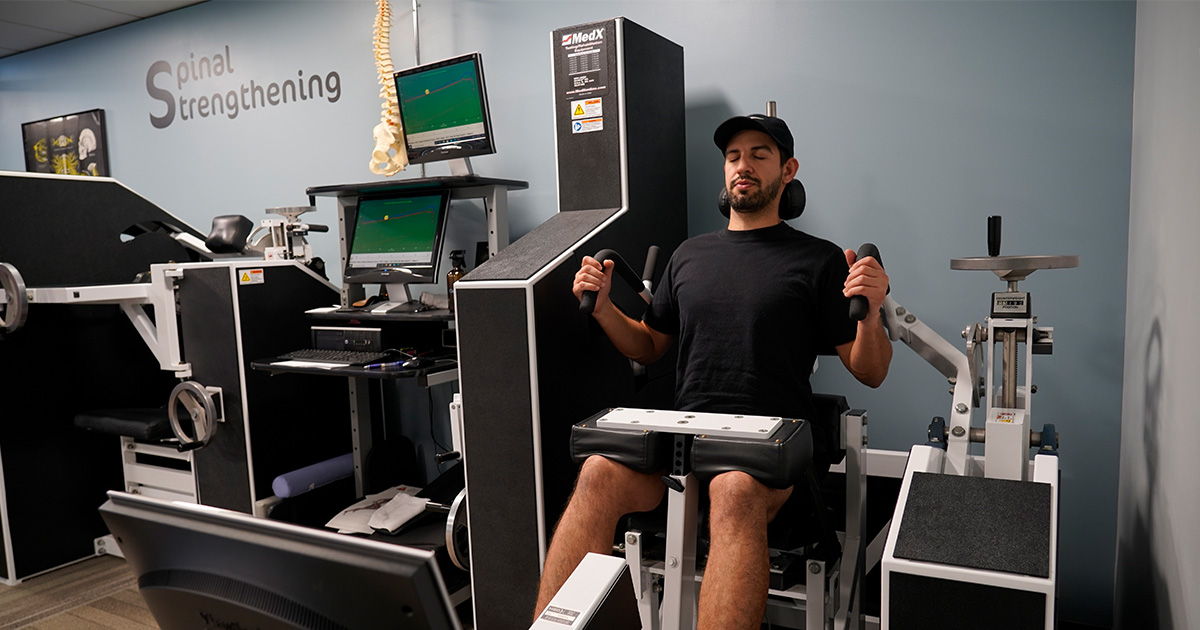
MedX medical equipment was developed specifically to solve this problem. The lumbar extension machine uses a patented pelvic restraint system that locks the pelvis in place during movement. This eliminates the ability of the hips and glutes to compensate — forcing the lumbar extensors to do the work alone, through their full range of motion, under controlled resistance.
The result is something that simply cannot be replicated with conventional exercise: genuine, isolated strengthening of the deep spinal musculature.
The research behind this is substantial. More than 75 peer-reviewed studies support the efficacy of isolated lumbar extension training for chronic low back pain. Outcomes consistently show significant reductions in pain, improvements in strength, and lasting functional gains — including in populations who had previously failed conservative care.
One landmark study followed surgery-scheduled patients through a course of MedX lumbar strengthening. Of those who completed the protocol, 86.5% avoided surgery entirely. That number has remained consistent across multiple replications.
Still living around your pain?
Let's change that. Call us and describe what you're dealing with — we'll tell you honestly if we can help.
Call 425-758-4619
What a MedX Protocol Looks Like
At Fix Back & Neck Pain, every client begins with a comprehensive assessment before touching the equipment. We evaluate posture, range of motion, muscle strength asymmetries, and the specific nature of your pain pattern. This tells us exactly where the deficit is and how to address it.
The MedX protocol itself is progressive and precise. Sessions are typically twice weekly. The resistance is carefully calibrated to your current capacity and increased systematically as strength develops. Most clients notice meaningful improvement within six to eight sessions. Full protocols typically run twelve to twenty sessions depending on the severity of the deficit and the nature of the underlying condition.
Critically, MedX is not used in isolation. We integrate it with manual therapy, fascial release, and where appropriate, spinal traction and other modalities — addressing both the structural weakness and the soft tissue restrictions that accompany it.
Who Benefits Most From MedX
MedX is particularly effective for clients with:
- Chronic axial low back pain that has not responded to conventional PT
- Degenerative disc disease and lumbar stenosis
- Spondylolisthesis and facet joint syndrome
- Post-surgical rehabilitation (once cleared by the surgeon)
- Pre-surgical conditioning to improve operative outcomes
- Herniated discs being managed non-surgically
- Recurrent back pain despite previous treatment
The cervical version of the MedX protocol addresses the same deficit in the neck — deep cervical extensor weakness that underlies chronic neck pain, cervicogenic headaches, and the postural breakdown that follows most whiplash injuries.
A Note for Healthcare Providers
If you are a physician, physical therapist, chiropractor, or neurologist reading this, the MedX protocol is designed to complement your care — not replace it. We receive referrals from orthopedic surgeons, pain management specialists, and primary care physicians who recognize that muscular insufficiency is a root contributor to their patients' persistent symptoms.
We communicate outcomes back to referring providers at key milestones, and patients can typically be seen within days of referral with no prior authorization required. The referral process is simple — call us or use the referral form on our physicians page.
You've tried other things.
This is different. Our approach addresses the structural deficit most treatments miss entirely.
Call 425-758-4619
The Bottom Line
Chronic back pain is rarely a mystery. In most cases, the spine is structurally unsupported because the muscles responsible for that support have never been properly trained. MedX is the most evidence-supported tool available for correcting that deficit — and for many clients, it represents the first time in years that their pain has genuinely improved rather than temporarily quieted.
If you have tried other approaches and are still in pain, this may be the piece that has been missing.
Trent Shuford, LMT, Cert. MedX Tech.