
The Question I Get After Every Marathon Expo
A client came in last month after a sports massage session left her hamstring more irritated than before. She wasn't confused about massage in general. She was confused about why a treatment that felt good in the moment didn't touch the deeper ache that had been running down the back of her leg for three weeks. That's the conversation that keeps repeating in this clinic, in different words, from runners, cyclists, weekend golfers, and desk workers who picked up a gym habit. They assume massage is massage. It isn't.
The Misconception That Costs People Months
Here is the belief I need to correct early: that sports massage and clinical muscular therapy are the same service with different marketing names, and that whichever one is more available or cheaper will do the job. That belief is understandable. Both involve hands on tissue. Both can reduce soreness. Both feel like "bodywork." But the goal, the assessment behind it, and the mechanical target are different enough that choosing the wrong one can leave a real problem untreated for months while the person feels temporarily better after every session.
Sports massage is built around performance and recovery cycles. It is typically applied before or after an event, uses broad strokes, effleurage, and general compression to increase circulation, reduce perceived muscle soreness, and prepare tissue for activity or ease it down afterward. It is not built to diagnose why a specific muscle group has been guarding for three weeks, or why one side of the spine is doing twice the work of the other.
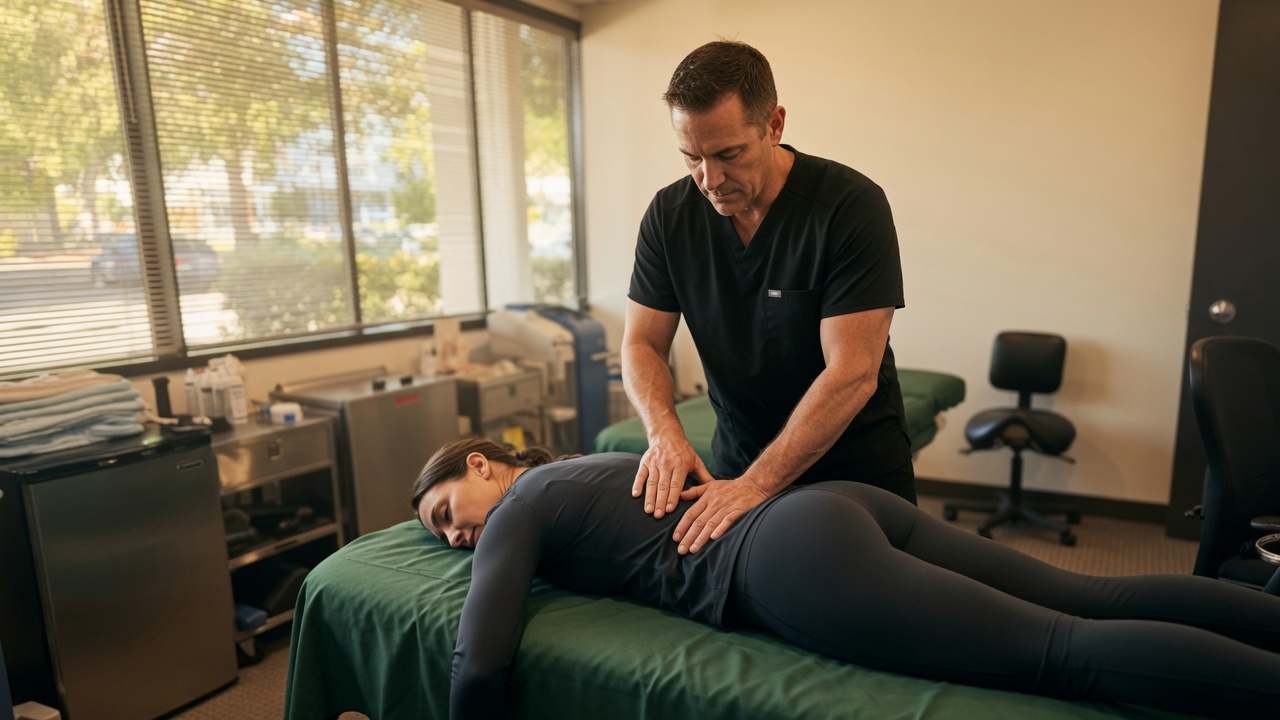
Clinical muscular therapy starts somewhere else entirely. It starts with a question: what is this muscle compensating for. The work is localized, assessment-driven, and tied to a mechanical hypothesis about why a tissue is behaving the way it is. It looks for the muscle that has been substituting for a joint that won't stabilize, or the guarding pattern protecting an irritated nerve root, or the fascial restriction pulling a shoulder forward every time someone reaches for a keyboard.
Why the Same Hands Can Do Two Different Jobs
The distinction matters mechanically, not just philosophically. Muscle tissue responds differently depending on what created the tension in the first place. General soreness from exercise, the kind sports massage addresses well, comes from a fairly uniform mechanical stress across a muscle group: eccentric loading, repetitive contraction, mild fiber-level micro-trauma. Broad, rhythmic work increases local blood flow and helps clear the byproducts of that kind of stress. It's a reasonable, evidence-supported use of manual technique for that specific problem.
But chronic pain patterns are rarely uniform. A muscle that has been compensating for months develops asymmetric tension, adhered fascial layers, and trigger points that refer pain to locations far from the muscle itself. That kind of tissue does not respond the same way to broad strokes that it does to sustained, targeted pressure applied at a specific depth, angle, and duration matched to what the assessment found. This is the work described in more detail in the post on this site about why trigger points keep coming back, and it is also why one general massage session rarely resolves a pattern that took months to develop.
There's a structural piece too. The muscles most often involved in chronic low back and neck pain, the psoas, the multifidus, the deep cervical stabilizers, sit close to the spine and interact directly with how load moves through the joints above and below them. A hidden driver of chronic low back pain like a shortened or guarding psoas doesn't reveal itself through a general full-body massage protocol. It requires someone assessing gait, hip position, and lumbar curve alongside the muscle itself, then treating it as one piece of a mechanical system rather than an isolated sore spot.
What Clinical Muscular Therapy Actually Involves Here
In this practice, manual and muscular therapy is one of six specific modalities, and it is never used as a stand-alone relaxation service. It's paired with an assessment of how the spine is loading, and often layered with other tools depending on what's found: spinal traction and decompression if a disc is involved, Piezowave shockwave therapy if there's a chronic tendinopathy or persistent trigger point that hasn't resolved with manual work alone, MedX spinal strengthening once the acute guarding has calmed down enough that the person can load the muscle without protective tension interfering with the movement.
That sequencing matters. Manual therapy on a muscle that is guarding to protect an unstable joint will bring temporary relief and then the tension returns, sometimes within days, because the underlying instability hasn't changed. This is the same reasoning behind why core workouts alone do not fix back pain: isolated technique, whether it's a massage stroke or an exercise, applied without addressing the mechanical reason the muscle is behaving that way, produces a result that doesn't hold.
35 years of hands-on clinical experience.
Ready to work on your problem. Call us and describe what you're dealing with.
Call 425-758-4619
Where Sports Massage Still Has a Real Place
None of this makes sports massage the wrong choice for what it's designed to do. An athlete in a training cycle who needs recovery support between sessions, who has no red flag symptoms, no radiating pain, no numbness, and no progressive weakness, is a reasonable candidate for regular sports massage as part of a broader training plan. It has a role. The distinction is knowing which problem you actually have.
Radiating pain down an arm or leg, numbness, dizziness with neck movement, or any sign of progressive weakness is not a sports massage question. Those symptoms need a clinical evaluation before any manual technique is applied, because they can indicate nerve root involvement or other issues that a general recovery treatment will not address and could, in some cases, aggravate if handled without an accurate read on what's happening structurally.
The Hard Part of This Conversation
The honest version of this comparison is not that one modality is superior to the other in every circumstance. It's that they are answering different questions, and most people walking into a massage studio with a three-month-old ache are asking the wrong provider the right question. Sports massage will not fail them because it's a poor technique. It will fail them because it was never built to investigate why a muscle has been guarding since spring. That distinction, more than any technique detail, is the one worth understanding before booking the next session.
You don't have to live with this. Backs and necks can get stronger, pain can ease, and the body is more capable of recovery than most people are told. This blog is here to give you honest, practical information about what actually helps. As we learn more, we'll keep sharing what works. If something here spoke to you, that's a good reason to reach out and start the first conversation.
Trent Shuford, LMT, Cert. MedX Tech.