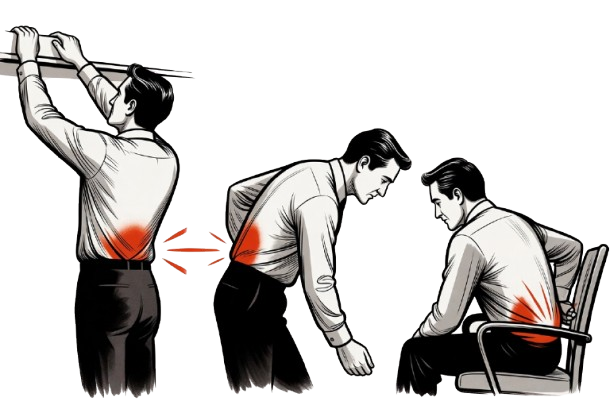
Back pain is not a diagnosis — it's a symptom. The structures that can produce back pain include muscles, fascia, intervertebral discs, facet joints, nerve roots, ligaments, and bones. Different structures produce pain through different mechanisms and respond to different treatments.
Treating muscular back pain with the interventions designed for structural problems — or vice versa — produces limited results at best and can delay appropriate care at worst. This is one of the most common reasons people cycle through multiple practitioners without lasting improvement: they are receiving treatment appropriate for one category of problem when they actually have another.
Characteristics of Muscular Back Pain
Muscular back pain — including myofascial pain from trigger points and fascial restrictions — tends to have certain characteristic features that distinguish it from structural pain:
Pain that is diffuse rather than sharply localized — it covers an area rather than pinpointing a specific spot
Pain that is reproducible with direct pressure on specific muscle areas
Pain that changes significantly with position and movement — better with some positions, worse with others
Pain that is typically worse after prolonged static postures and improves with gentle movement
Absence of neurological symptoms — no numbness, tingling, or weakness in the limbs
Pain that does not follow a specific nerve distribution pattern
Muscular back pain responds well to manual therapy, fascial release, therapeutic exercise, and — critically — addressing the muscular weakness and imbalances that allow the pain-generating patterns to persist.
Characteristics of Structural Back Pain
Structural back pain — from disc, facet joint, or nerve root involvement — tends to present differently:
Pain that is more sharply localized to a specific spinal level
Pain that radiates in a specific pattern — down the leg following a nerve distribution in disc-related pain, or referring in a more diffuse pattern in facet pain
Pain that is consistently worse with specific movements — usually flexion for disc-related pain, extension for facet or stenotic pain
Associated neurological symptoms — numbness, tingling, or weakness in a specific distribution
Pain that may be reproduced by spinal loading maneuvers
Pain that has a more consistent relationship to position and load
Still living around your pain?
Let's change that. Call us and describe what you're dealing with — we'll tell you honestly if we can help.
Here's the clinical reality that makes back pain assessment genuinely complex: most chronic back pain has both muscular and structural components. A disc herniation creates nerve root irritation — that's structural. It also creates protective muscle guarding, inhibition of the deep stabilizers, and compensatory fascial restrictions — those are muscular. Treating only the structural component leaves the muscular contributors unaddressed. Treating only the muscular component doesn't address the underlying disc pathology.
This is why our approach integrates multiple modalities — MedX strengthening for the structural stabilization deficit, manual therapy and fascial release for the soft tissue components, and spinal traction or other modalities for the structural decompression when indicated. The components of the problem are addressed together rather than sequentially.
What Assessment Actually Involves
Distinguishing muscular from structural pain — and identifying the specific contributors in each category — requires a comprehensive clinical assessment. This is not something that can be done from an MRI alone. Imaging shows structural changes but cannot tell you which changes are producing pain or how much of the pain is structural versus muscular in origin.
Our assessment evaluates posture, range of motion, movement quality, muscle strength and activation patterns, neurological integrity, and the specific pain reproduction patterns that indicate which structures are involved. Combined with a detailed history of the pain pattern, this gives us a clear picture of what we are dealing with — and what treatment approach is most likely to produce lasting improvement.
Getting the Right Answer
If you have been treated for back pain without lasting improvement, the most valuable question to ask is whether the treatment you received was matched to the actual source of your pain. Many clients who have undergone extensive physical therapy for presumed muscular pain turn out to have significant structural deficits that were never addressed — and vice versa.
A fresh comprehensive assessment often reveals contributors that previous treatment missed. Call us and describe your situation — we'll tell you honestly what we think is driving your pain and whether our approach is likely to help.
Trent Shuford, LMT, Cert. MedX Tech.
Not sure if this is right for you?
We put together a straightforward guide to help you decide before you call.