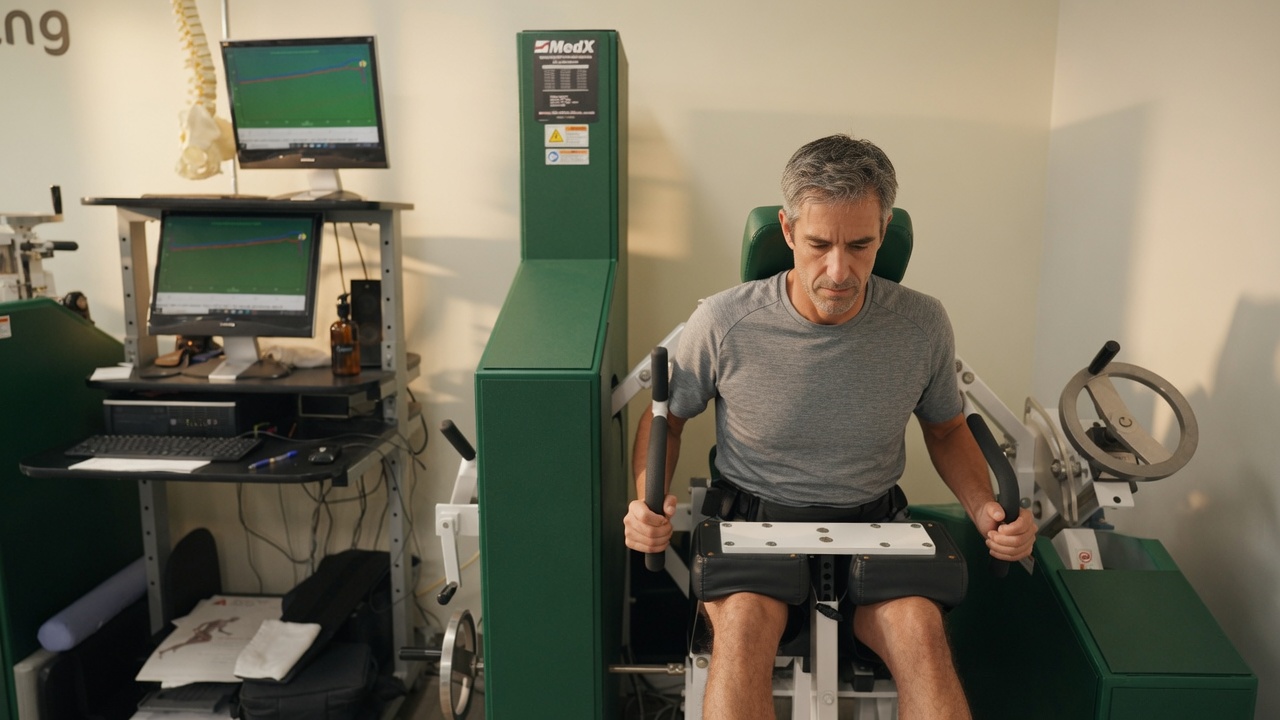

You are six weeks out from back surgery. The discectomy is done, and the leg pain that drove you to it is gone, or nearly. The incision has healed. Your surgeon has told you things look good. And yet the back itself feels untrustworthy, weak in a way you cannot quite describe, as if it might give out if you reach for the wrong thing. Nobody warned you about this part.
This is the gap almost no one explains before surgery. The operation addressed the disc. It did not address the muscles that hold the spine steady, and those muscles are now weaker than they were before you ever felt a symptom.
The surgery fixed the disc, not the support
A discectomy removes the fragment of disc material pressing on a nerve. It is good at that. What it does not do is rebuild the deep muscles along the spine that had already been deconditioning through the months of pain, guarding, and reduced movement that led up to the operation.
Pain makes people stop using the muscles that hurt. By the time someone reaches surgery, the lumbar extensors, the muscles that run alongside the spine and control how the segment moves, have often been offline for a long time. Surgery does nothing to reverse that. In some cases the surgical approach itself adds to the deconditioning. So the person leaves the OR with the disc problem resolved and the support structure still absent. The back feels unreliable because, mechanically, it is.
What the evidence actually shows
This is not a theory built on a single clinic's experience. It has been tested directly. Choi 2005 followed 75 people recovering from lumbar discectomy. Beginning six weeks after surgery, half were placed in a 12-week isolated lumbar extension program. The other half received standard care without it.
The difference was not small. The strengthening group built lumbar extensor power by 51.67 percent, compared with 17.55 percent in the control group. They reported lower pain, a 2.51 on a standard visual analog scale against 4.30 in the controls. And the outcome that tends to matter most to people trying to get their lives back: 87 percent of the strengthening group returned to work within four months, against 24 percent of those who did not strengthen.
The reason this works is the same reason recovery stalls without it. In chronic low back pain more broadly, Risch 1993 found that isolated lumbar strengthening produced real gains in strength and significant reductions in reported pain and dysfunction in people with ongoing back pain. That study was not a post-surgical group, so its numbers describe chronic pain rather than recovery from an operation. But the principle holds across both. When you rebuild the muscles that stabilize the segment, the segment behaves better and hurts less.
Why generic exercise misses the target
Here is where most post-surgical recovery goes wrong. People are told to "strengthen the core," and they do sit-ups, or planks, or whatever a video suggested. The lumbar extensors stay offline anyway, because stronger surrounding muscles quietly take over the work.
Graves 1994 demonstrated this cleanly. When the pelvis was held stationary so the lumbar extensors could not hand the load to the hips and hamstrings, strength in those muscles improved by 23.5 percent. When the pelvis was free to move, as it is in nearly every conventional exercise, the same muscles showed essentially no change, a slight decline of 1.2 percent. That was a study of healthy adults, so it tells us about how these muscles are trained, not about pain. But the lesson for recovery is direct. Without isolation, you can exercise for months and never reach the muscles that actually needed the work.
This is why isolated, measured strengthening is the foundation of recovery here rather than an add-on. MedX spinal strengthening stabilizes the pelvis precisely so the lumbar extensors have to do their own work. That is the mechanism behind how MedX strengthening works, and after surgery it is the difference between movement that looks like exercise and movement that rebuilds the spine.
Most people have never trained the muscles that actually support the spine.
You can. MedX isolates and strengthens the deep spinal extensors that conventional exercise can't reach.
Call 425-758-4619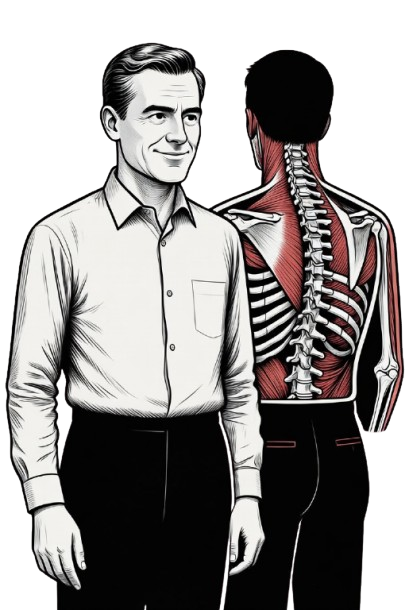
What recovery should look like
Done properly, post-surgical strengthening is unhurried and specific. It begins when the surgical site has healed enough to tolerate load, which in the Choi trial was around six weeks, though the right starting point is a clinical decision made with your surgeon, not a date on a calendar. It isolates the right muscles. It progresses by measured resistance rather than by how a session happened to feel. And it treats the months after surgery as the part of recovery that decides the result, not as an afterthought once the "real" treatment is over. In 35 years of clinical work, the clients who recover most fully are almost never the ones who pushed hardest, but the ones who strengthened the right muscles in the right order.
Much of this mirrors the case for conditioning before surgery, where the strength you carry into an operation shapes what you carry out of it. The same logic applies on the other side of the incision. The recovery is where the spine is actually rebuilt.
When this is not the right fit
Strengthening is not the first thing to do, and it is not for everyone at every moment. In the early weeks after surgery, the priority is healing, and load applied too soon works against you. Anyone still experiencing new or worsening leg weakness, numbness, or loss of bladder or bowel control needs to be evaluated by a physician without delay, not enrolled in an exercise program. And the decision to begin always belongs with your surgical team as much as with us.
If your situation is straightforward and your surgeon agrees you are ready, this is exactly the kind of recovery we are built for. If it is more complicated, the honest answer is sometimes that the timing is not right yet, and we will tell you so.
A discectomy can take the pressure off the nerve. It cannot put strength back into a spine that lost it. That part is recovery, and recovery is work that has to be done on purpose. If you understand what your MRI actually means and what the surgery did and did not change, the path forward stops being mysterious. The disc was one chapter. The muscles are the rest of the book.
Trent Shuford, LMT, Cert. MedX Tech.