
If you have chronic back pain, you have almost certainly been told to strengthen your core. It is one of the most common pieces of advice in fitness and rehab, and it is not wrong. It is just incomplete. Plenty of people do planks, crunches, and bird dogs faithfully for months and still hurt. The reason is usually not a lack of discipline. It is that the exercises most people call core work do not load the muscles that actually fail in chronic back pain.
What "core" usually means
When most people say core, they mean the abdominal wall and the obliques, plus whatever a plank or a sit-up happens to work. Those muscles matter for general fitness and for how you carry load through a day. But the muscles that stabilize each segment of the lower spine sit deeper. The lumbar multifidus and the lumbar extensors run close to the spine itself, and in people with long-standing back pain they are commonly weak and underused. Researchers who study this population describe these deep extensors as underloaded, and hard to reach through conventional exercise. That is the gap most core routines never close.
Why conventional core work leaves the key muscles underloaded
The problem is leverage. When the pelvis is free to move, the large, strong muscles at the hips take over the motion, and the small deep lumbar extensors get only a fraction of the load. Researchers have shown this directly. In a 12-week training study of healthy adults, isolated lumbar extension strength improved only when the pelvis was locked in place, a gain of 23.5 percent. Without pelvic stabilization, strength did not meaningfully change, a 1.2 percent decrease (Graves 1994). A separate study measured muscle activity and found lumbar multifidus activation was 51 percent greater when the pelvis was stabilized than when it was free (San Juan 2005). In plain terms, unless the pelvis is held still, the muscles you are trying to strengthen barely participate. Most core exercises, by design, let the pelvis and hips move.
What actually builds the muscles that stabilize the spine
When those deep extensors are isolated and loaded, they respond quickly. In a study of healthy adults training just once per week, isolated lumbar extension strength rose 102 percent at full extension over 10 weeks (Pollock 1989). That once-a-week finding has held up across several later studies (Carpenter 1991; Graves 1990). And in people who actually had chronic low back pain, the change carries through to how they feel. In a study of 895 people with chronic low back pain treated with intensive, specific exercise using firm pelvic stabilization, 76 percent of those who completed the program reached a good or excellent outcome, and 94 percent of that group still held their improvement one year later (Nelson 1995).
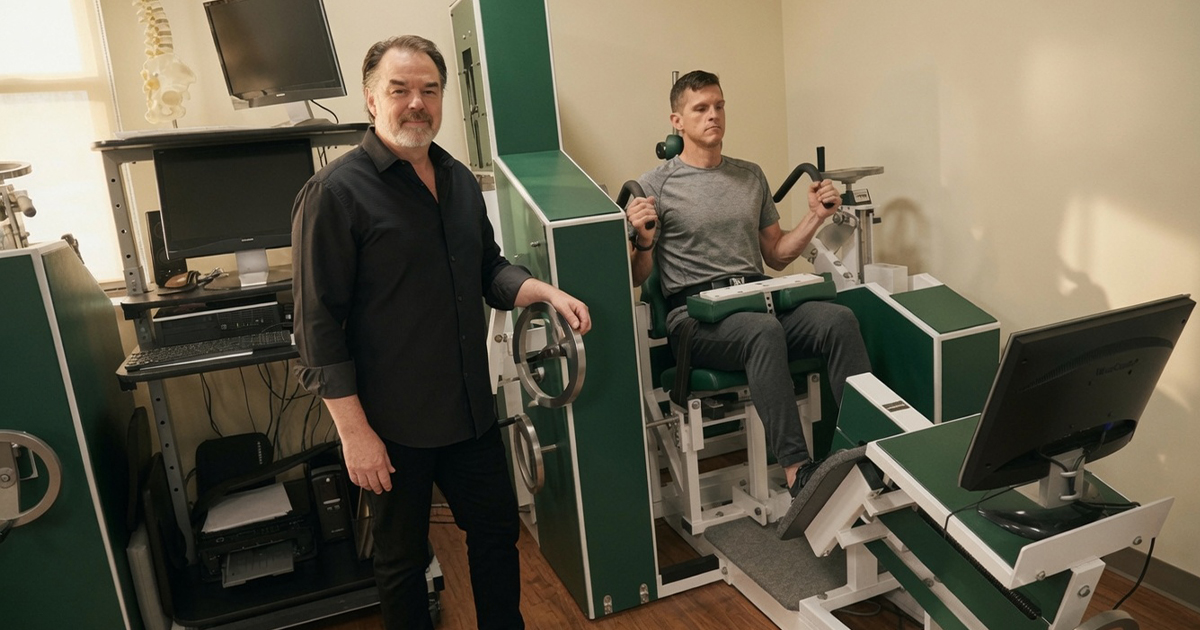
This is the kind of targeted loading we build our programs around, using MedX spinal strengthening. The MedX equipment uses a pelvic restraint to isolate the lumbar extensors and measures strength at several angles, so progress is objective rather than a guess. If you want the longer version of why this approach reaches muscles that general exercise misses, we cover it in why targeted MedX strengthening works when other approaches have not.
Still living around your pain?
Let's change that. Call us and describe what you're dealing with — we'll tell you honestly if we can help.
Call 425-758-4619
How the strength is actually measured
One reason this gap goes unnoticed is that most settings never measure the deep extensors at all. On the MedX equipment, strength is tested at seven fixed positions through a 72 degree range of lumbar motion, with the pelvis stabilized so the reading reflects the lumbar extensors themselves rather than the hips and hamstrings borrowing the load. Testing this way, at set angles and without momentum, removes much of the noise that makes ordinary gym numbers hard to trust, and the result is compared against values from healthy, symptom-free adults. The point is simple: instead of guessing whether your back is weak, you get a real measurement of where it is strong and where it is not, and the program is built around the actual weak point.
So where does core work fit?
Not the trash. Abdominal and trunk conditioning has real value for general fitness, movement control, and daily durability. The point is narrower and more useful than "core work is a waste." Core work is a complement, not the fix. If the deep lumbar extensors are the weak link, abdominal training will not strengthen them, because those exercises do not load them. Reaching the weak link takes exercise that isolates it.
What to do if core work has not been enough
If you have done the planks and the bridges and still hurt, that is useful information, not a personal failure. It usually means the training never reached the muscles that needed it. The honest first step is to find out whether your lumbar extensors are actually weak, which is something that can be measured rather than assumed. From there, a program can be built around what your spine actually needs. If that is where you are, the first conversation is the place to start.
Trent Shuford, LMT, Cert. MedX Tech.