When clients prepare for spinal surgery, the conversation typically focuses on the procedure itself — what the surgeon will do, what the recovery timeline looks like, what the expected outcome is. Rarely does the conversation address what the client can do before surgery to meaningfully improve every one of those outcomes.
The research on this is consistent and compelling: preoperative physical condition is one of the strongest predictors of surgical outcomes. Patients who enter surgery with stronger spinal musculature, better cardiovascular fitness, and optimized tissue quality demonstrate faster recovery, reduced complication rates, shorter hospital stays, and better long-term functional outcomes than patients who arrive in a deconditioned state.
Pre-surgical conditioning is not a luxury. For appropriate candidates, it is standard of care — and it is remarkably underutilized.
Why Spinal Muscle Strength Matters Before Surgery
Spinal surgery — whether disc replacement, fusion, laminectomy, or other procedures — creates a period of enforced reduced activity during which the spinal musculature inevitably weakens. The stronger these muscles are entering surgery, the more capacity remains after the initial recovery period. This matters for several reasons:
First, stronger surrounding musculature reduces the mechanical stress on the surgical site during the early recovery phase — when the repair is most vulnerable. Second, it shortens the time required to return to full functional activity, because the baseline from which recovery begins is higher. Third, it reduces the risk of adjacent segment problems — a known long-term complication of spinal fusion that is partly driven by insufficient muscular support of the non-fused levels.
The MedX Pre-Surgical Protocol
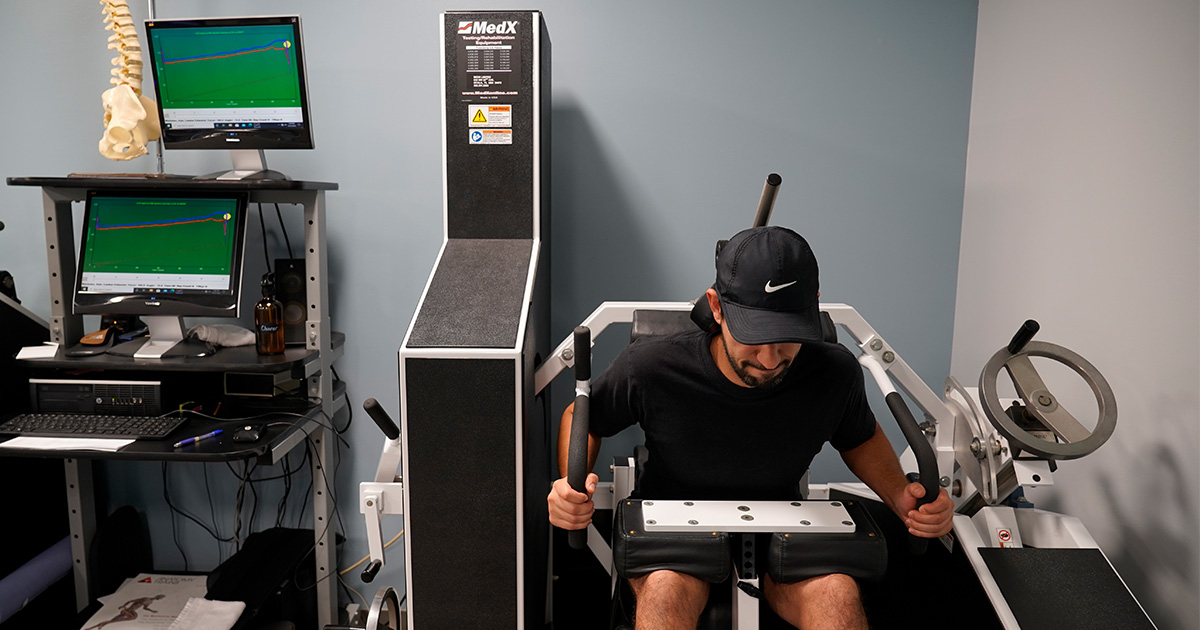
Our pre-surgical conditioning protocol uses MedX lumbar and cervical strengthening equipment to specifically target the deep spinal stabilizers that support the surgical site. This is not general fitness training — it is precise, isolated strengthening of the muscles most directly relevant to surgical outcome.
The protocol typically runs four to eight weeks prior to the scheduled procedure, with twice-weekly sessions. Progress is measurable — we assess strength before and after the protocol — and the gains are significant. Most clients complete the protocol meaningfully stronger than they began, with direct benefits for their surgical outcome.
We coordinate with the referring surgeon throughout the process, providing progress notes and adjusting the protocol based on surgical timeline and any specific pre-operative restrictions.
Recovery isn't a mystery.
It's a process. Let's start yours with a thorough assessment and an honest conversation about what's possible.
Pre-surgical manual therapy and fascial release serves a different but complementary purpose. Reducing soft tissue restrictions and muscle guarding before surgery improves tissue quality at the surgical site, reduces the protective tension that can complicate surgical approach, and addresses compensatory patterns in surrounding structures that may otherwise become problematic during recovery.
Clients who receive pre-surgical manual therapy frequently report that their post-surgical rehabilitation feels more productive — as if the tissue is more responsive to treatment — compared to clients who arrive at rehabilitation without this preparation.
Nutritional and Lifestyle Preparation
While our clinical focus is on physical preparation, we also provide guidance on the lifestyle factors that significantly influence surgical outcomes: sleep quality, hydration, anti-inflammatory nutrition, and smoking cessation. These factors affect tissue healing capacity at the cellular level and deserve attention in the weeks before any surgical procedure.
Who Should Consider Pre-Surgical Conditioning
Any client scheduled for elective spinal surgery who has four or more weeks before their procedure date is a candidate for pre-surgical conditioning. The longer the preparation window, the greater the potential benefit — but even two to three weeks of focused strengthening produces measurable gains.
Clients who are particularly likely to benefit include those who have been relatively inactive due to pain, those with significant deconditioning from previous treatment, those undergoing fusion procedures where adjacent segment protection is important, and those with longer anticipated recovery timelines.
Still living around your pain?
Let's change that. Call us and describe what you're dealing with — we'll tell you honestly if we can help.
If you are scheduled for spinal surgery and your surgeon has not discussed pre-surgical conditioning, we encourage you to raise it directly. Most surgeons are supportive — and many actively encourage it. We are happy to communicate with your surgical team to coordinate the protocol with your specific procedure and timeline.
Call us and describe your situation. If pre-surgical conditioning is appropriate for you, we'll tell you honestly what a protocol might look like and what it can realistically achieve in the time available before your procedure.
Trent Shuford, LMT, Cert. MedX Tech.
Not sure if this is right for you?
We put together a straightforward guide to help you decide before you call.