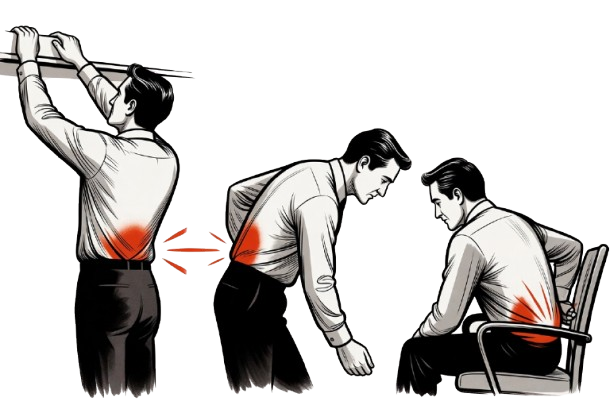
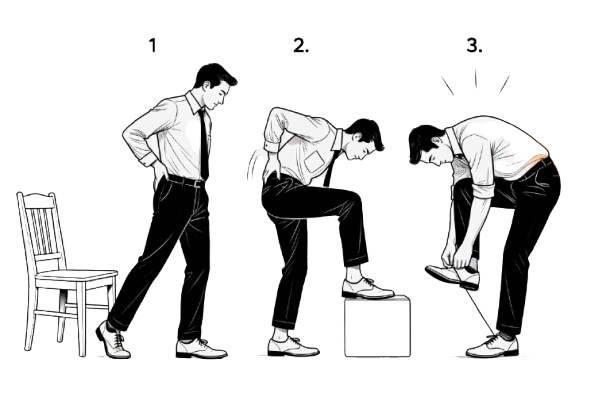
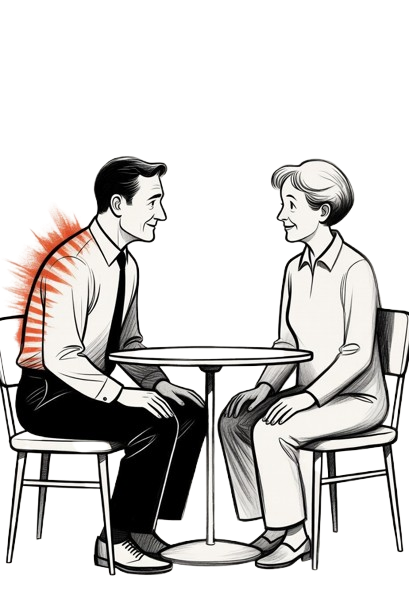
Every golf swing generates significant rotational force through the lumbar and thoracic spine. In a single drive, the lumbar spine rotates, laterally flexes, and extends — often in rapid succession — under loads that can reach several times body weight. Over 18 holes, that force accumulates. Over a season, it compounds.
This is why back pain is the most common injury in golf — affecting an estimated 35% of amateur golfers and up to 55% of professionals at some point in their career. It's not bad luck. It's biomechanics. And understanding the mechanics is the first step to fixing the problem.
Why Most Golfers Keep Getting Hurt
The majority of golf-related back injuries share a common root cause: the lumbar spine is being asked to generate rotation that should be coming from the thoracic spine and hips. When the thoracic spine is stiff — which is nearly universal in golfers who spend significant time at a desk — the lumbar spine compensates. When the hip flexors are tight — also nearly universal in people who sit — the pelvis can't rotate freely, and the lower back takes on the movement instead.
The result is a swing that looks functional on the surface but is loading the wrong structures with every shot. Pain is eventually inevitable — it's just a matter of when.
The Lumbar Extensor Problem in Golfers
There's a second layer to golf-related back pain that most treatment approaches miss entirely. The deep lumbar extensor muscles — the multifidus, the lumbar erectors — are the primary stabilizers of the spine during rotation. When these muscles are weak, the spine has no structural anchor during the swing. Every rotation becomes a destabilizing event rather than a controlled one.
Strengthening these muscles requires isolated, full-range loading with a stabilized pelvis — exactly what MedX lumbar extension equipment provides. This is not something that can be replicated through conventional gym training, Pilates, or standard physical therapy exercises. The deep lumbar stabilizers require specific equipment to train effectively, and most golfers have never once properly loaded these muscles in their lives.
Still living around your pain?
Let's change that. Call us and describe what you're dealing with — we'll tell you honestly if we can help.
The psoas muscle — the primary hip flexor — plays a significant and often overlooked role in golf mechanics. A tight psoas anteriorly tilts the pelvis, increases lumbar lordosis, and restricts hip rotation. All three of these effects directly compromise the golf swing: reduced hip turn forces compensatory lumbar rotation, increased lordosis pre-loads the facet joints before the swing even begins, and pelvic tilt changes the spine angle at address.
Golfers with chronic low back pain or persistent hip tightness frequently have significant psoas involvement. Myofascial release targeting the psoas and surrounding fascial tissue — combined with MedX lumbar strengthening to restore anterior-posterior balance — addresses both sides of this problem in a way that stretching alone never will.
What Our Golf Program Addresses
At Fix Back & Neck Pain, we work with golfers at every level — from weekend players who want to stay on the course pain-free to competitive players looking to improve performance through structural resilience. Our approach covers:
Comprehensive spinal assessment identifying the specific deficits driving your pain or limiting your swing
MedX lumbar and cervical strengthening to build the structural foundation the golf swing demands
Myofascial release targeting the psoas, thoracolumbar fascia, and hip rotators
Spinal traction for golfers managing disc-related pain or nerve compression
Piezowave therapy for golfer's elbow, wrist tendinopathy, and other swing-related soft tissue injuries
Home care guidance including our on-course stretch protocol
What Better Spinal Function Does for Your Game
The benefits of proper spinal rehabilitation extend beyond pain relief for golfers. When the lumbar extensors are strong and the psoas is at appropriate length, the pelvis can rotate freely and the spine can coil and uncoil through its full range without compensation. The result is typically improved rotation, better weight transfer, and more consistent ball striking — in addition to the absence of pain.
Many of our golf clients report not only relief from their back pain but measurable improvements in their swing mechanics and distance. A spine that moves well is a spine that performs well.
You've tried other things.
This is different. Our approach addresses the structural deficit most treatments miss entirely.
For golfers who want to maintain mobility between sessions, we've developed a simple six-stretch on-course protocol that can be performed between holes using only a golf club. It addresses thoracic rotation, hip flexor length, hip internal rotation, and cervical mobility — the four most common contributors to golf-related spinal stress. Ask about our downloadable stretch guide at your next appointment.
When to Seek Assessment
If you experience back pain during or after golf, if your swing feels restricted or asymmetrical, if you've had a previous back injury that limits your game, or if you're simply committed to playing well into your later years — a comprehensive assessment is the right starting point. We'll tell you honestly what we find and what a realistic course of care looks like.
Trent Shuford, LMT, Cert. MedX Tech.
Not sure if this is right for you?
We put together a straightforward guide to help you decide before you call.