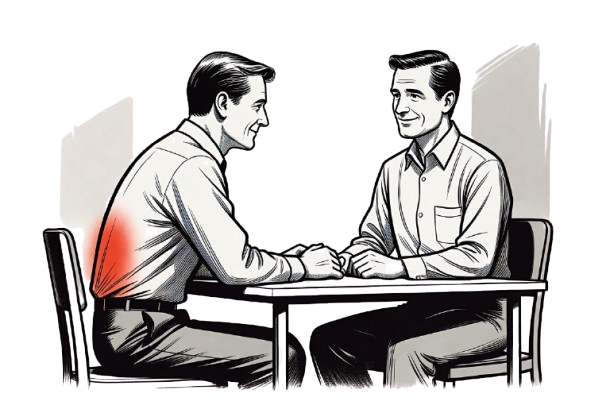

A client of mine drives to Spokane twice a month for work, and the back pain that greets him by the time he arrives is predictable. He cannot stand up straight for the first few minutes out of the car. He had already bought a lumbar cushion, a seat wedge, and a back brace from an auto parts store. None of it touched the problem, because none of it was the problem.
Why a Better Seat Cushion Rarely Fixes Long Drive Back Pain
The instinct is to treat the seat. Buy a cushion, adjust the lumbar dial, recline two more degrees. Sometimes that helps a little. Mostly it does not, because the seat is not generating the pain. Your spine is loaded by gravity and by your own posture, not by the foam underneath you. A cushion can change where pressure sits for a few minutes. It cannot change the fact that your spinal extensors are isometrically holding a seated posture for two, four, or six hours straight.
Think about what an isometric hold does to any muscle. Hold a plank for five minutes and your core will burn and fatigue regardless of the surface you are on. The lumbar extensors on a long drive are doing the same kind of static work, just quieter and slower, so you do not notice the fatigue building until the muscle gives out and the disc and facet joints start absorbing load they were not built to carry alone. The cushion was never going to prevent that. Strength and endurance in those extensor muscles is what delays it.
What Is Actually Fatiguing During a Long Drive
Seated posture flattens the natural lumbar lordosis for most people, especially in bucket seats designed more for crash safety than spinal geometry. A flattened lower back shifts more compressive load onto the anterior discs and reduces the shock-absorbing curve the spine depends on. At the same time, the hip flexors, particularly the psoas, stay shortened for the entire drive. A shortened psoas pulls on the lumbar spine from the front, which adds to the load the extensors have to resist from behind.
So you have two things happening at once: the muscles meant to hold you upright are fatiguing under sustained isometric work, and the muscles in front are pulling the spine out of its ideal position the whole time. That combination is why pain during a long drive tends to build gradually and then spike, rather than hurting from mile one. It is cumulative fatigue, not a single bad movement.
Why the 15-Minute Rule Exists and Why Most People Ignore It
Most driving guidance recommends a break every two hours. Almost everyone treats that as optional once they are making good time. It is not optional if you have a back that is already compromised. A static muscle contraction does not recover while you keep contracting it. You need an actual change in position, ideally walking, which reverses the psoas shortening and gives the lumbar extensors a chance to rest and reperfuse with blood.
A 90-second stop to switch drivers does not count. The muscle needs more like five full minutes of upright walking to meaningfully unload. I tell clients to treat the break like resetting a stopwatch: if you only stood for a minute, the fatigue clock barely moved.
Still living around your pain?
Let's change that. Call us and describe what you're dealing with — we'll tell you honestly if we can help.
Call 425-758-4619
Seat Position Details That Actually Matter
A few adjustments do make a measurable difference, just not the ones sold in gas station checkout lines.
Seat height relative to the pedals matters more than lumbar support does. If your knees sit higher than your hips, the pelvis rotates posteriorly and flattens the lumbar curve immediately. Raise the seat until your hips are level with or slightly above your knees.
Distance from the pedals matters too. If you have to reach for the pedals, your pelvis slides forward in the seat and you lose contact with whatever lumbar support exists. Move the seat closer so your knees stay softly bent, and let your back make full contact with the seat back.
Mirrors, not posture, should be your indicator of a straight back. Set your mirrors for an upright, head-against-headrest position. If you catch yourself craning forward to see them later, that is your body telling you it already slouched.
None of these adjustments eliminate the need for breaks or for strengthening the extensors that are doing the actual holding. They just make the baseline less hostile.
Why Strength Is the Only Durable Answer for Frequent Long Drives
If long drives are a regular part of your work, you are asking your lumbar extensors to perform sustained isometric endurance work on a schedule, repeatedly, for years. Endurance is trainable. A 1989 study by Pollock found a 102% increase in lumbar extensor strength at 0 degrees after ten weeks of training once per week, in healthy subjects measuring strength gain rather than a pain outcome, using isolated lumbar extension equipment that controls for pelvic movement so the target muscle actually does the work. That kind of isolated loading is difficult to replicate with general core exercise, because without pelvic stabilization, the surrounding muscles compensate and the lumbar extensors never get properly trained. A 1994 study by Graves found isolated lumbar strength improved only with pelvic stabilization, at +23.5% versus -1.2% without it.
A back that can hold a seated isometric position for an hour without fatiguing is a back that tolerates a long drive without pain building toward a spike. That is a conditioning problem, not a cushion problem, and cushions were never going to solve it.
You don't have to live with this. Backs and necks can get stronger, pain can ease, and the body is more capable of recovery than most people are told. This blog is here to give you honest, practical information about what actually helps. As we learn more, we'll keep sharing what works. If something here spoke to you, that's a good reason to reach out and start the first conversation.
Trent Shuford, LMT, Cert. MedX Tech.