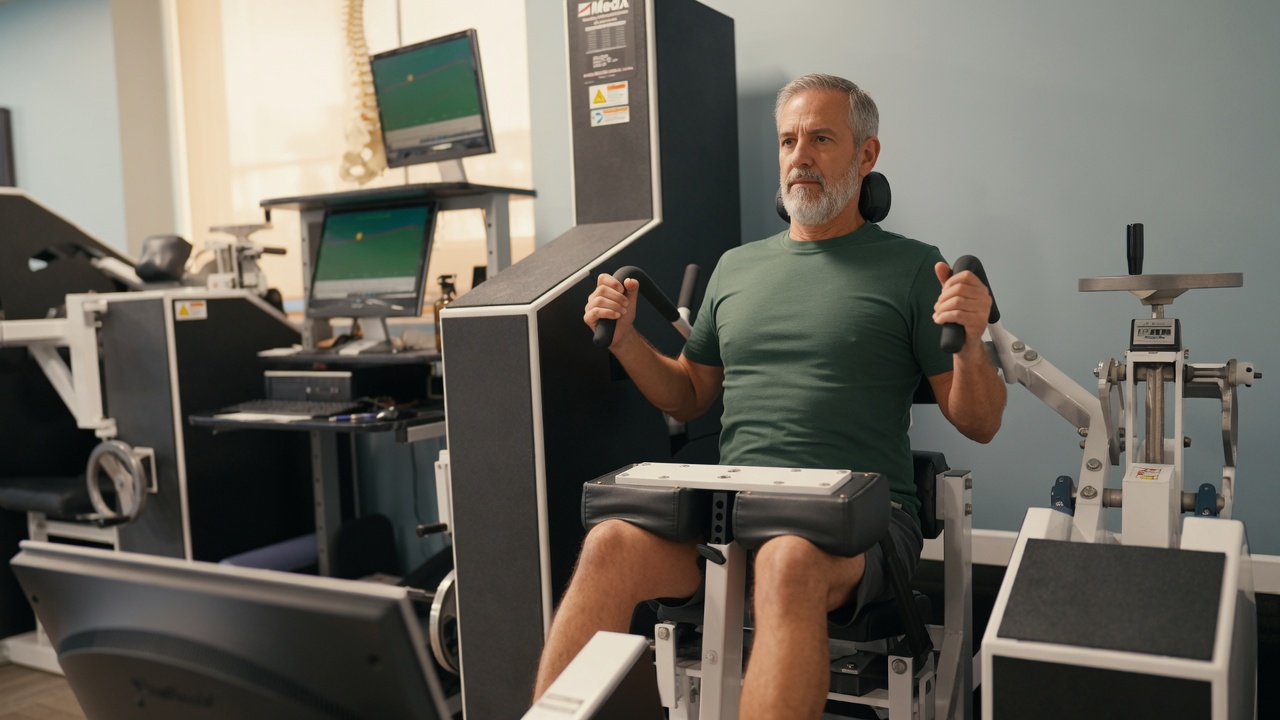

Most people who live with chronic back pain assume that getting stronger means more time in the gym: more sessions, more sets, more hours they do not have. It is the single most common reason people tell me they cannot commit to a strengthening program. Here is the part that surprises them. For the muscles that stabilize and extend your spine, training once a week, done correctly, builds strength about as well as training two or three times. The barrier to results is not hours. It is method.
What the research actually shows
This is not an opinion. It is one of the better-replicated findings in spinal exercise research. In a 1989 study in the American Journal of Sports Medicine, Pollock and colleagues had adults train their lumbar extensors once a week for ten weeks on equipment that isolates the low back with the pelvis held still. Isometric strength rose at every angle tested, including a 102 percent increase at full extension. Once a week.
Two studies pushed directly on the frequency question. In 1990, Graves and colleagues, writing in Spine, trained 114 people at frequencies ranging from once every two weeks up to three times a week. Every dynamic training group got significantly stronger, and there was no meaningful difference between them: once a week was an effective stimulus. A 1991 study by Carpenter and colleagues in Physical Therapy compared training frequencies over twelve and twenty weeks and found the same result. Once a week was as effective as twice or three times.
Why once a week is enough
A muscle grows stronger in response to the right stimulus followed by enough recovery to adapt, not in response to sheer volume. When a session genuinely loads the lumbar extensors through their full range, that is a strong enough signal to drive adaptation, and the days in between are when the muscle actually gets stronger. Adding more sessions does not add more signal. It mostly adds more fatigue.
The catch is that the session has to reach the right muscles. In most exercise, the powerful muscles of the hips and thighs take over and the deep spinal extensors barely work. In a 1994 study in Archives of Physical Medicine and Rehabilitation, Graves and colleagues showed this plainly: lumbar extension strength improved only when the pelvis was locked down to isolate the spine, a 23.5 percent gain, and did not meaningfully change without it. That is why isolating the lumbar extensors is what makes strengthening work, and it is the reason a single well-designed weekly session can do what scattered general exercise cannot.
Method is the variable, not time
Put those findings together and the picture is clear. If the method is right, the pelvis is stabilized, the movement covers the full range, and the load is measured, once a week works. If the method is wrong, no amount of frequency fixes it, because the muscles that need the work are never really being trained. This is good news for anyone who has felt they could not fit rehabilitation into a full life. The problem was never that you did not have three days a week. It was that the work was not specific.
It also reframes what progress should look like. Because the low back is often not the only driver of stubborn pain, and the deep hip flexor behind a lot of chronic low back pain is a common example, a good program measures where you actually are and trains what is actually weak, rather than piling on generic volume.
Most people have never trained the muscles that actually support the spine.
You can. MedX isolates and strengthens the deep spinal extensors that conventional exercise can't reach.
Call 425-758-4619
What this means for you
If time has been your reason for putting off getting stronger, this removes it. One focused, measured session a week, on equipment built to isolate the spine, is a legitimate path to lasting strength and less pain. It is not a shortcut. It is simply what the research has shown for more than thirty years.
If you are dealing with chronic back or neck pain and want to know whether this approach fits your situation, the best next step is a conversation. Call the office at 425-758-4619 and tell us what you are dealing with. We will give you an honest read on whether measured, once-a-week strengthening is right for you.
Trent Shuford, LMT, Cert. MedX Tech.