The appointment helps. You leave with less neck pain and more movement, less ache across the top of your shoulders. For a few days, sometimes a week, it holds. And then, quietly, the familiar stiffness returns. The same spot. The same pattern.
Most people who have been in this cycle long enough stop asking why it keeps coming back. They book the next appointment. They manage.
That's understandable. But the recurrence is information, and it deserves a real answer.
Why Neck Pain Recurs So Reliably
Cohen's 2015 review in the Mayo Clinic Proceedings is one of the most comprehensive epidemiological summaries of neck pain published in the last decade. The numbers are sobering. Neck pain is the fourth leading cause of disability globally, with an annual prevalence exceeding 30 percent. And roughly half of people who develop neck pain continue to have ongoing pain or recurrence over time (Cohen 2015, PMID 25659245).
That recurrence figure is not a marginal footnote. It describes the lived experience of a substantial portion of the people who walk through the door here. They have been treated. The treatment worked, in the immediate sense. And then the pain came back.
Understanding why requires making a distinction that most treatment models do not make clearly: the difference between temporary relief and a durable physical change.
Soft tissue work relaxes guarded muscle. Manipulation restores joint mobility. Both have genuine clinical value, and neither is wrong as an intervention. The problem is that relief of that kind is borrowing against a structural deficit that has not been addressed. When the deficit remains, the tissue returns to where it was. The cycle repeats.
The question is what the deficit actually is.
The Pattern Most Chronic Neck Pain Clients Share
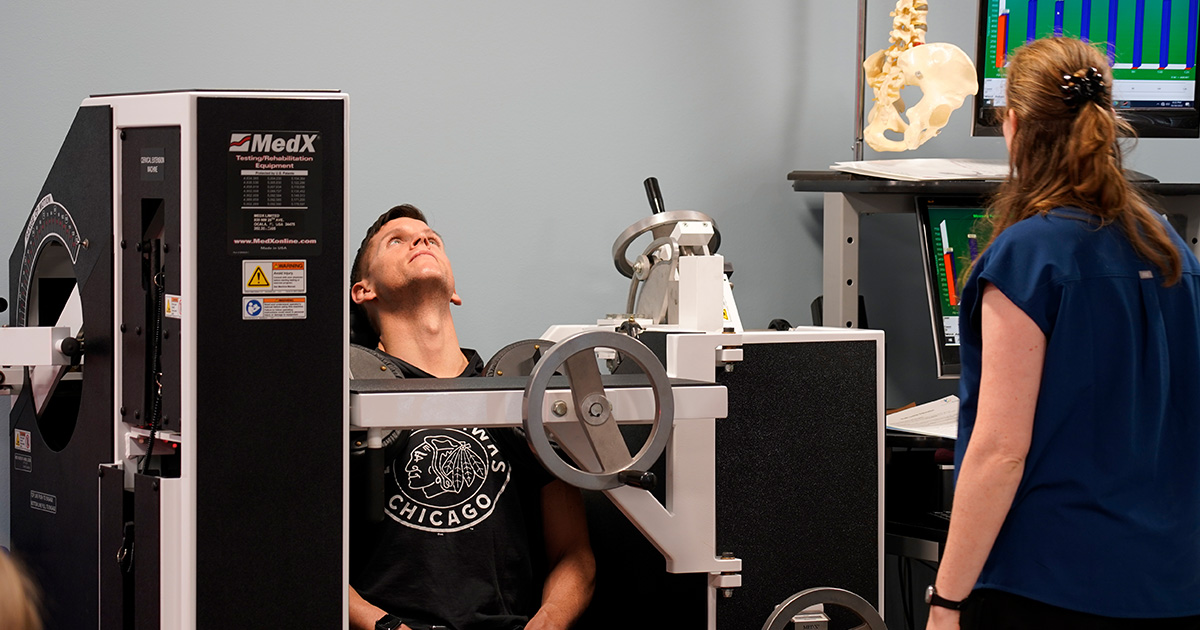
The neck holds up a head that weighs ten to twelve pounds. The cervical extensors, the deep muscles running along the back of the neck, are doing that work every waking hour. They manage posture, resist forward pull, and absorb the mechanical demands of sustained positions, sustained loads, and sustained attention.
When those muscles are deconditioned, the neck does not have adequate structural support. The joints and discs absorb load the musculature should be managing. Movement becomes restricted. The neck fatigues quickly. Stiffness develops not because something is mechanically locked but because the system does not have the capacity to sustain what is being asked of it.
Forward head posture amplifies this. Shifting the head forward of the center of gravity substantially increases the load the cervical extensors must manage, compounding the burden on muscles that may already be struggling.
What is almost never tested in the standard care pathway is whether those muscles are actually strong enough to do their job. The research on what happens when they are trained directly is consistent, and it reframes the recurrence question considerably.
Neck pain that keeps coming back has a reason.
Let's find it. A thorough assessment tells us exactly what's driving your symptoms.
Call 425-758-4619
What the Research Shows About Strengthening and Durability
Highland and colleagues published a 1992 clinical study of 90 patients with cervical pain. The population was not athletes or healthy volunteers. It included patients with degenerative disc disease, herniated disc, and cervical strain. After eight weeks of targeted cervical rehabilitation, participants showed significant gains in isometric cervical extension strength and range of motion, alongside significantly reduced perceived pain (Highland 1992, PMID 1631723).
Strength improved. Range of motion improved. Pain decreased. These were patients in pain, not a training study conducted under ideal conditions.
The longer view comes from Evans and colleagues in 2002, a randomized clinical trial involving 191 patients with chronic neck pain. Participants were assigned to spinal manipulation alone, spinal manipulation combined with low-tech rehabilitative exercise, or MedX rehabilitative exercise. Over two years of follow-up, patient-rated pain favored the two exercise groups over manipulation alone. The advantage of exercise held at the two-year mark (Evans 2002, PMID 12438988).
Two years is a meaningful follow-up horizon. It suggests that the benefit of genuine strength training is not simply a temporary effect that fades when the program ends. A real strength adaptation is a lasting physical change. Passive relief tends to fade as the underlying deficit reasserts itself; a durable increase in the capacity of the cervical extensors is qualitatively different.
The broadest synthesis comes from a 2023 umbrella review by Rasmussen-Barr and colleagues, covering 25 systematic reviews and 17,321 participants. Across exercise types, including resistance training, short-term positive effects on pain were found versus non-exercise controls (Rasmussen-Barr 2023, PMID 37828488). Cohen's review reaches the same plain conclusion: exercise treatment appears to be beneficial in patients with neck pain (Cohen 2015, PMID 25659245).
This is not a claim that strengthening the cervical extensors prevents recurrence. The research does not provide a recurrence-prevention trial, and it would be dishonest to frame it as one. What it supports is a different framing: a genuine strength adaptation addresses the structural deficit that passive treatment cannot. Whether that durability helps break an individual's recurrence cycle is a reasonable clinical rationale, not a guarantee.
The recurrence problem, at its core, is that most neck pain treatment has not addressed why the pain keeps coming back. Strengthening the muscles that are failing to support the neck is the most direct response to that question.
The Difference Between Temporary Easing and Structural Change
Here is the honest version of what happens in most chronic neck pain treatment:
A session of soft tissue work relaxes the guarded musculature. The joints move better. The client feels relief. That relief is real. But the cervical extensors, if they were weak before the session, are still weak after it. The forward head posture, if it was driving the load problem, is still present. The structural deficit that allowed the pain pattern to develop in the first place has not changed.
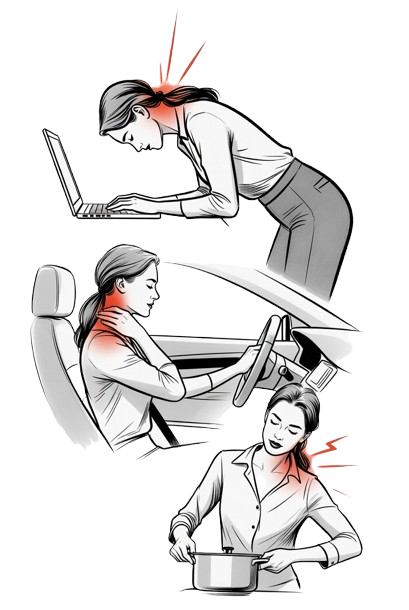
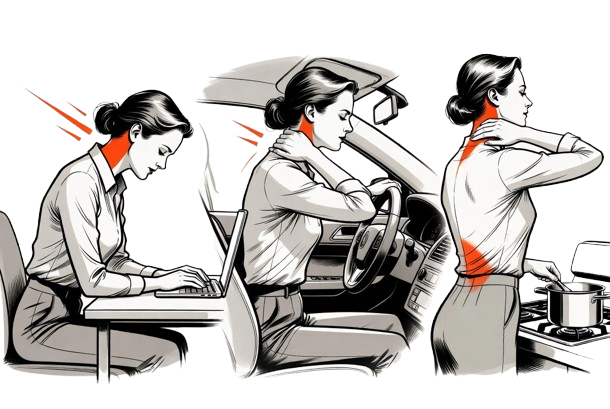
The next mechanical demand, whether it is a long drive, a day at a desk, or simply holding the head upright for several hours, triggers the same compensation pattern. The muscles guard. The stiffness returns. The client books the next appointment.
What Leggett and colleagues documented in 1991 is instructive here. They tested 73 subjects at eight angles through a 126-degree range of cervical flexion and found that isometric cervical extension strength is measurable with high between-day reliability (r = 0.90 to 0.96). A separate training cohort improved strength at six of eight angles after ten weeks of once-weekly training, while controls showed no change (Leggett 1991, PMID 1781507).
That training result matters clinically. It means the cervical extensors respond to training. The deficit is not fixed. It is trainable. And a trained adaptation, unlike a manual release, does not reverse when the session ends.
The companion post Cervical Strength: The Neck Pain Factor No One Tests covers how that measurement is actually done, what the testing protocol involves, and what objective cervical extensor data reveals about a client's structural situation. This post is concerned with the prior question: why the recurrence keeps happening, and what class of intervention addresses the underlying reason.
Preparing the Tissue Before Strengthening Begins
One thing that confuses people about the program we build here is that manual work is often part of it, even though the argument above is about the limits of manual work alone.
That is not a contradiction. Manual and muscular therapy serves a specific role in the sequence: it prepares the tissue for the strengthening work to follow. When muscle is guarded, tender, or restricted by fascial adhesion, the quality of the training that follows is diminished. The nervous system will not fully recruit a muscle it is protecting. Soft tissue preparation can restore the access that strengthening requires.
What manual therapy alone cannot do is replace the strengthening. Releasing a muscle does not build the capacity of that muscle. Those are different physiological events. The program at this practice uses both because both have a role, in order, with clear purpose.
The strengthening is what addresses the structural deficit. The manual work is what makes it possible to get there cleanly.
Your neck shouldn't be something you manage.
It should be something you solve. Call us and let's talk about what's possible.
Call 425-758-4619
When This Is Not the Right First Step
Not every neck pain presentation is appropriate for a strengthening program, and we say so clearly when that is the case.
There are symptoms that require medical evaluation before any rehabilitation protocol begins. If you are experiencing any of the following, the first step is a clinician visit, not a training program:
Radiating pain, numbness, or tingling into the arm or hand. These symptoms suggest possible cervical radiculopathy, nerve involvement from a compressed or irritated root. This requires clinical evaluation, often including imaging, to determine the cause and appropriate management path.
Arm weakness. New or progressive weakness in the arm or hand warrants prompt evaluation. This is not a soft tissue problem to work around.
Dizziness. Dizziness has a wide differential. Cervicogenic dizziness is a diagnosis of exclusion, meaning it can only be attributed to cervical causes after other causes have been ruled out by appropriate workup. Do not assume dizziness is a neck muscle problem without evaluation.
Gait or balance disturbance, hand clumsiness, or bilateral neurological symptoms. These can indicate cervical myelopathy, involvement of the spinal cord rather than a peripheral nerve. This is a serious finding. Per Cohen 2015, myelopathy and other serious pathologies, including atlantoaxial subluxation and metastases, are possibilities that neck pain examination must be attentive to (Cohen 2015, PMID 25659245). Warm, not alarmist, but these symptoms need a physician first, not a strengthening program.
Bowel or bladder changes in the context of neck symptoms. Route urgently to evaluation.
If any of these are present, we will tell you directly that this is not the right first step at this practice. We are glad to be a resource once the clinical picture is clearer. But the clarity matters more than the intake.
If the Cycle Has Been Going Long Enough
The clients who find this practice after years of managing chronic neck pain share a common thread. They have had good treatment. The treatment worked. The pain came back.
When we sit down for a first conversation, one of the earliest questions is whether the cervical extensors have ever been tested objectively, not inferred from how the neck moves or feels to palpation, but measured, at standardized angles, against documented normative values. For most people who have been in the recurrence cycle for years, the answer is no.
That measurement, and the training program built from it, is covered in detail in the companion piece Cervical Strength: The Neck Pain Factor No One Tests. It explains the testing protocol, what the data shows, and what a cervical extensor strength profile reveals that nothing in the standard care pathway typically captures.
If the recurrence cycle description fits, the question worth asking is whether anyone has yet addressed the structural deficit driving it. If the honest answer is no, that is where the conversation starts.
Reach us at 425-758-4619. The first conversation costs nothing. Continuing to wait costs more than most people realize.
Trent Shuford, LMT, Cert. MedX Tech.