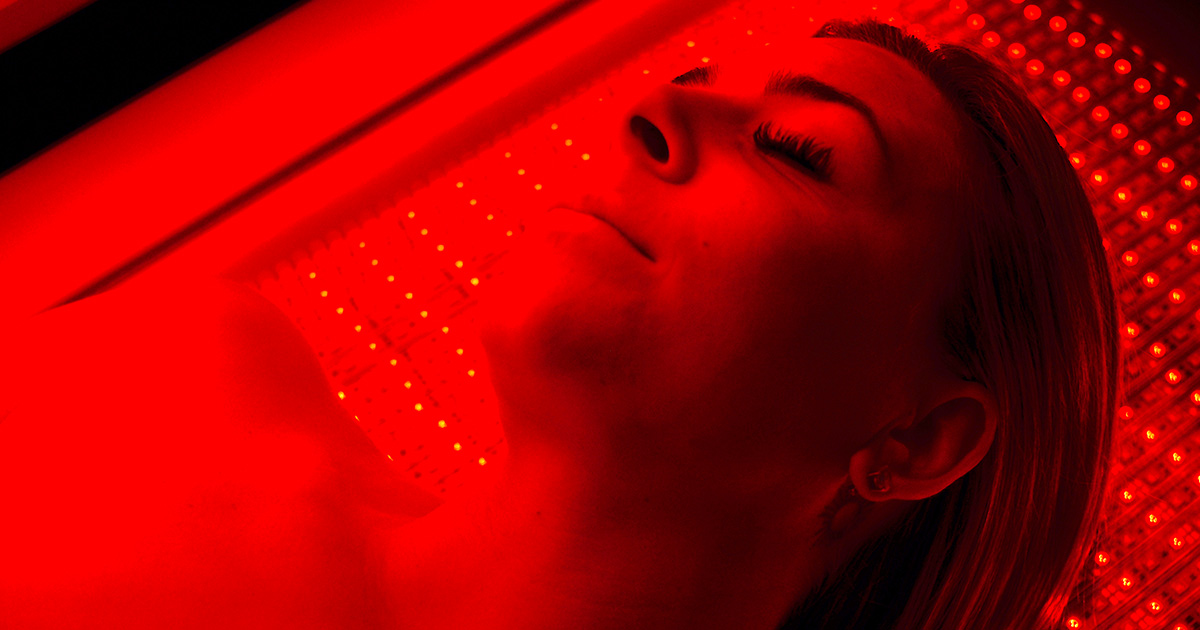
A client on the table last week asked me whether red light actually heals anything. Fair question. The marketing around red light says yes, loudly. The research says something more modest, and more useful.
What Red Light Therapy Is
The clinical term is photobiomodulation. Red and near-infrared light is absorbed by cells, and the leading explanation is that it acts on the mitochondria, the part of the cell that produces energy. That mechanism is reasonably well described in the lab. Whether it produces a meaningful change in your pain is a separate question, and that is the one that matters to you.
Laser and LED Are Not the Same Evidence
Most of the stronger research on light therapy for pain used low level laser, aimed at a specific spot. Our table is a full-body LED panel. The two are related, but results from laser studies do not automatically carry over to LED, or from a small treatment spot to the whole body. A lot of red light marketing quietly borrows laser results. We would rather keep them separate.
What the Research Supports
Neck pain (laser). A Lancet meta-analysis of 16 randomized trials with 820 people found low level laser reduced neck pain. In chronic neck pain, relief lasted up to 22 weeks after treatment, and side effects were no different from placebo. (Chow et al., 2009)
Muscle performance (laser and LED). A review of 13 randomized trials found that light applied before exercise added about 5 repetitions and about 4 seconds to time to exhaustion compared with placebo. Small, but measurable. (Leal-Junior et al., 2013)
Full-body panels. Research on whole-body systems is newer and thinner. In a triple-blinded trial of 42 people with fibromyalgia, 12 whole-body sessions over four weeks reduced pain and improved quality of life compared with placebo light. Two of the four authors work for the company that makes the device, and the trial was small. (Navarro-Ledesma et al., 2022) In another trial of 48 healthy adults, 20 minutes of whole-body light before hard cycling did not improve performance at all, though heart rate variability the next morning was better. (Forsey et al., 2023)
Recovery isn't a mystery.
It's a process. Let's start yours with a thorough assessment and an honest conversation about what's possible.
This is the part most clinics leave out. A 2020 review of 12 randomized trials with 1,046 people looked at light therapy, both laser and LED, for non-specific low back pain. Compared with sham light, the effect on pain and disability was too small to matter. The authors concluded the evidence does not support light therapy for that purpose. (Tomazoni et al., 2020)
If you are coming in with low back pain, that is a direct answer: red light is not what will change it. For chronic low back pain, the strongest evidence is for exercise, and in our clinic that means isolated strengthening of the lumbar extensors on MedX.
How We Use the Table
Red light is a supporting therapy here, not a treatment on its own. It sits alongside MedX strengthening and manual therapy, which do the structural work. Some clients use it on the recovery side of a strengthening program. Some add hydrogen during the same session, and we have written separately about what the hydrogen evidence does and does not show.
We assess before we treat. If light makes sense for what we find, we will say so. If it does not, we will tell you that too.
You don't have to live with this. Backs and necks can get stronger, pain can ease, and the body is more capable of recovery than most people are told. This blog is here to give you honest, practical information about what actually helps. If something here spoke to you, that's a good reason to reach out and start the first conversation.
Trent Shuford, LMT, Cert. MedX Tech.
Not sure if this is right for you?
We put together a straightforward guide to help you decide before you call.