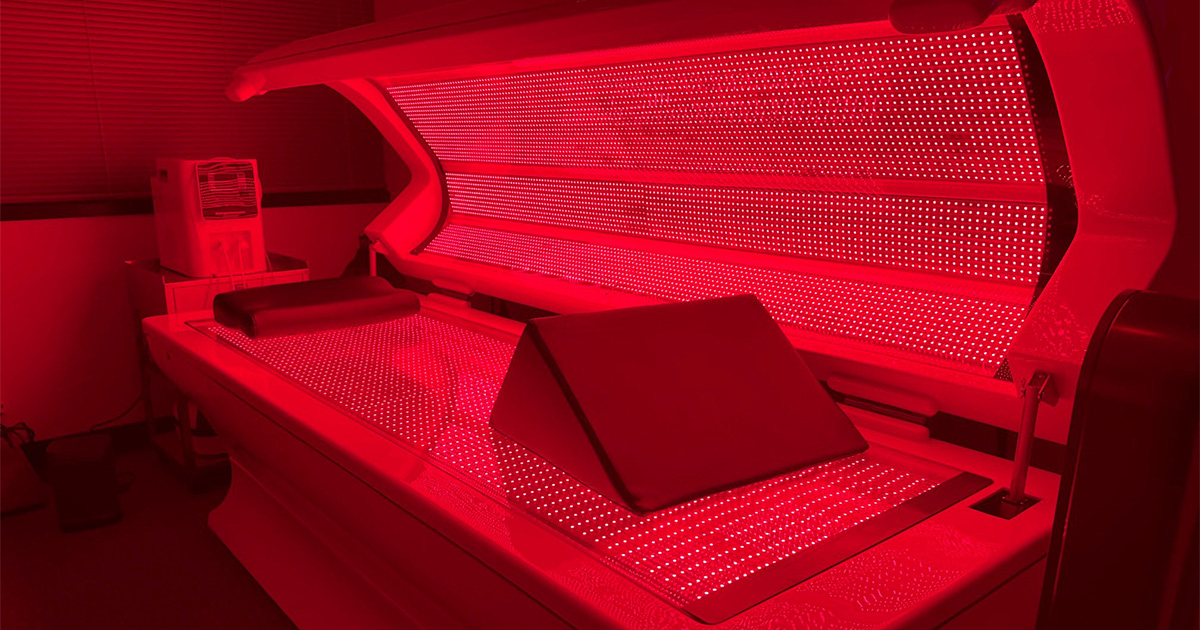
A client on the Red LED table last month pointed at the hydrogen cannula and asked the right question: "What is that actually doing, and is there anything behind it?"
That deserves a straight answer. Hydrogen is having a moment in recovery marketing, and the claims being made for it run a long way past what the published research supports. What follows is what hydrogen gas is, what the studies actually measured, where the evidence runs out, and why we offer it alongside red light rather than as a treatment of its own.
What Hydrogen Gas Is, and What It Is Not
Molecular hydrogen is the smallest molecule there is. Breathed through a nasal cannula at low concentration, it moves into tissue easily, and the proposed mechanism is selective antioxidant activity. The idea is that it neutralizes the most damaging reactive oxygen species while leaving alone the ones your body uses for signaling. That selectivity matters, because blunt antioxidant supplementation can actually interfere with the training adaptations you are trying to produce.
What it is not is a treatment for a mechanical problem. Hydrogen does nothing for a weak lumbar extensor, a restricted facet joint, or a disc under load. If your back hurts because the muscles that hold your spine have deconditioned, no gas you breathe will change that. MedX spinal strengthening changes that. Hydrogen is a recovery input, not a correction.
Why It Is Paired With the Red LED Table
Both work on the same part of the problem, from different directions. Full-body red light therapy acts on mitochondrial function at the cellular level. Hydrogen acts on the oxidative load those same cells are dealing with. Neither one is doing mechanical work, which is exactly why they sit together comfortably in the same session rather than competing for time.
Practically, it also costs nothing in session time. You are already lying on the table for the light. Adding the cannula does not extend the appointment or displace the strengthening and manual therapy that do the structural work.
What the Research Actually Shows
Two randomized controlled trials are worth knowing about. Both used inhaled hydrogen rather than hydrogen water, and both studied trained men.
In a 2020 double-blind crossover study in Medical Gas Research, eight physically active men inhaled a hydrogen-rich gas mixture through a nasal cannula during a 60 minute recovery period following hard treadmill running and squat jumps. Compared with placebo, the hydrogen condition produced a smaller rise in urinary 8-hydroxydeoxyguanosine, a marker of DNA oxidation, and less loss of countermovement jump height. The authors also reported that the other performance measures and the blood markers of oxidative stress and muscle damage showed no difference at all. (Shibayama et al., 2020)
In a 2024 randomized, placebo-controlled, double-blind crossover trial in PeerJ, professional rugby players inhaled hydrogen for a week ahead of daily high-intensity training. Nitric oxide and its synthesis precursors stayed higher than placebo both after exercise and after 24 hours of rest, while interleukin 6 and 8-hydroxydeoxyguanosine came in lower and total antioxidant levels came in higher. (Zhao et al., 2024)
Read plainly, that is a real signal: inhaled hydrogen measurably changed oxidative stress and inflammatory markers after hard exercise, and in one trial partially protected a single performance measure.
Recovery isn't a mystery.
It's a process. Let's start yours with a thorough assessment and an honest conversation about what's possible.
The first study had eight participants. Eight. That is a pilot, not proof. Both trials recruited trained athletes performing strenuous exercise, which is a different population from someone carrying a ten year history of low back pain. Both measured biochemistry and short-term performance rather than pain.
And the honest headline: no published trial has tested hydrogen inhalation for back or neck pain. Not one. Anyone telling you hydrogen treats spinal pain is running ahead of the evidence, and that includes anyone selling it to you.
This is the same standard we apply to every modality in the building. The research on red light is considerably deeper than the research on hydrogen, and we say so rather than flattening the two into one marketing claim.
Where It Sits in What We Do
Hydrogen is an option, not a protocol. It is available to clients already using the Red LED table, and it is offered on that basis rather than sold as a standalone service.
Where it makes the most sense is the recovery side of a strengthening program. Clients working through progressive loading on MedX are producing exactly the kind of oxidative and inflammatory response these studies examined. If you are trying to tell ordinary training response apart from something that needs attention, that distinction is worth understanding on its own: soreness and nerve pain are not the same signal.
What This Means if You Are Considering It
If you came looking for hydrogen specifically, the useful thing to know is that it will not be the reason you get better. The assessment comes first, the strengthening and manual work do the structural correction, and recovery inputs like red light and hydrogen support that process at the margins.
We assess before we treat. Every client goes through objective evaluation before any modality is introduced, and recovery tools get added when the findings suggest they will help, not because they are on a menu.
You don't have to live with this. Backs and necks can get stronger, pain can ease, and the body is more capable of recovery than most people are told. This blog is here to give you honest, practical information about what actually helps. As we learn more, we'll keep sharing what works. If something here spoke to you, that's a good reason to reach out and start the first conversation.
Trent Shuford, LMT, Cert. MedX Tech.
Not sure if this is right for you?
We put together a straightforward guide to help you decide before you call.