

You play golf because you love it. Maybe you play on weekends and what you want, honestly, is to walk 18 holes without your back seizing up on the back nine. Maybe you track your handicap and your body is part of the equipment — and you are trying to find distance you should have, given how much time you put into this game.
Either way, you have probably heard the usual prescription: stretch more, rotate more, work on flexibility. Buy the training aid. Film your swing.
None of that is wrong. But it is incomplete in a way that matters for performance. Clubhead speed, which is the primary mechanical driver of distance, is not determined by how flexible you are. Two independent research teams, working separately and reaching the same conclusion, have made that clear. What actually drives clubhead speed is strength and power. And the strength most commonly missing in golfers is in the lumbar extensor chain.
What Actually Drives Clubhead Speed
Two meta-analyses — Brennan et al. (2024) in Sports Medicine, and Ehlert (2020) in the European Journal of Sport Science — examined the physical characteristics associated with faster clubhead speed across a combined pool of studies.
The findings are consistent and worth stating plainly.
Lower-body strength was significantly associated with clubhead speed in both analyses (Brennan: z = 0.47; Ehlert: r = 0.46). Upper-body strength showed similar associations (z = 0.48; r = 0.41). Upper-body explosive power showed the strongest association of all measured physical characteristics (z = 0.67; r = 0.51).
Flexibility? Brennan found a non-significant association (z = −0.04). Ehlert found a trivial one (r = 0.03). Two independent meta-analyses, both landing in the same place: flexibility does not meaningfully explain who swings faster.
This is not a knock on stretching. Flexibility has value for injury prevention and movement quality. But if your goal is more clubhead speed, the research points in a different direction. It points toward building physical capacity — strength and power — not unlocking range of motion you probably already have.
The Role of the Lumbar Extensors in the Swing
The golf swing is a full-body movement, but its anchor is the lumbar spine. Every phase of the swing asks the lumbar extensors to do something: stabilize under rotation, transmit force from the lower body to the upper body, absorb the shear and compressive load at impact, and protect the discs and facets through hundreds of repetitions over a season.
The extensor chain runs from the hip extensors through the glutes and into the deep lumbar stabilizers — the multifidus, the lumbar paraspinals, the iliocostalis and longissimus at the lumbar level. These muscles are what generate and transfer power through the trunk during the downswing. When they are strong and properly loaded, they support the x-factor — the separation between shoulder rotation and hip rotation that research consistently links to clubhead speed.
Here is the finding that often surprises people: Suhara et al. (2023), studying 28 elite golfers in the Journal of Strength and Conditioning Research, found that concentric trunk-rotator strength did NOT correlate with clubhead speed. What did correlate was hip-extension peak torque (r = 0.67 in males) and explosive power measures. The rotational muscles are working during the swing, but they are not the speed driver. The extensor chain is.
This distinction matters for how you train. Spending the majority of your effort on rotation-specific exercises, when the evidence points toward extension strength and power as the performance variables, is working on the wrong axis.
Where Back Pain Enters the Picture
Back pain is golf's most commonly reported musculoskeletal complaint. A systematic review of the risk factors for golf-related back pain (Smith et al., 2018) found that the strongest predictor of future episodes is a previous history of back pain — which is one reason it is worth addressing the underlying capacity sooner rather than waiting for the next flare. That pattern is not surprising to anyone who understands what the swing asks of the lumbar spine: compressive forces, shear load at impact, rotational and bending stresses repeated across a full round. The demands are real, and they accumulate.
What clinical observation consistently suggests — and what is plausible given the load pattern — is that golfers who develop back pain tend to show weakness in the trunk musculature, particularly in the deep lumbar extensors. Meira and Brumitt (2010), in a narrative review published in Sports Health, note that low back pain is golf's primary sport-related malady, and they note that strength training is commonly recommended as part of injury-risk management. Weishaupt et al. (2000) found in a small cross-sectional study that golfers showed muscular imbalance in lateral flexors and rotators relative to their lumbar extension strength, and suggested that more balanced strengthening may help.
These are not controlled trials. The evidence does not allow a clean causal claim that strengthening prevents golf-related low back pain. What it supports is a reasonable clinical position: the swing places high, repeated demands on the lumbar extensor chain; golfers who have stronger, better-conditioned lumbar extensors may be better positioned to tolerate those demands. That is not the same as a guarantee. But it is a rationale worth taking seriously, especially if your back has already been talking to you.
If you are dealing with back pain that has become a consistent feature of your game, Golf and Back Pain: Why Your Spine Is the Most Important Club in Your Bag covers the mechanical picture in more detail.
Most people have never trained the muscles that actually support the spine.
You can. MedX isolates and strengthens the deep spinal extensors that conventional exercise can't reach.
Call 425-758-4619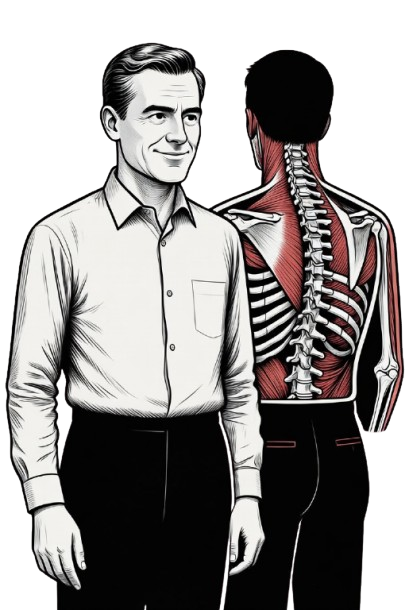
The MedX Approach: Two Machines, Two Jobs
The MedX equipment we use here was developed by Arthur Jones — the engineer behind Nautilus — and validated through the University of Florida's Center for Exercise Science. Two machines are relevant for golfers, and they do different things.
The MedX Lumbar Extension Machine isolates the deep lumbar extensors through full pelvic restraint. This is the mechanical distinction that makes MedX different from a back extension on a Roman chair or a cable row: without pelvic stabilization, the hip flexors and hamstrings contribute to the movement and the true lumbar extensors are never fully recruited. With the pelvis locked, the loading is isolated. The machine tests isometric strength at seven angles through a 72-degree range of motion, producing objective measurement — not a therapist's estimate, not a subjective pain score, but force output at each angle compared against age-matched normative values. That is what training then builds.
This is the extensor-chain work the research links to clubhead speed.
The MedX Low Back Rotational Machine is different in purpose. It conditions the trunk for the rotational demands the swing places on the spine. The swing's rotational loading is real and sustained across a round, and the trunk needs to be conditioned to tolerate it. But based on what Suhara 2023 found, this machine's job is resilience and load tolerance, not speed generation. We are not claiming it makes you swing faster. We are saying the swing asks a lot of your rotational structures, and an unconditioned trunk is a vulnerability.
Both machines fall under MedX spinal strengthening, one of six modalities we offer. In golfer programming, they work together: extension strength provides the performance substrate; rotational conditioning builds the structural support the swing demands session after session, round after round.
For a fuller explanation of why MedX produces what conventional exercise cannot replicate, Why MedX Spinal Strengthening Works When Everything Else Has Failed walks through the pelvic stabilization science in detail.
What the Assessment Reveals
We do not build a program from a conversation about symptoms. We start with objective measurement.
The MedX Strength Test establishes your lumbar extension strength profile at each of the seven angles, compares it to the age-matched normative database, and reveals where the deficits actually are. Most golfers who come in expecting to be strong in their backs are surprised by what the numbers show. The lumbar extensors are consistently undertested, underloaded, and weaker than people assume. The assessment does not confirm a narrative. It produces data.
From there, a program is built around what the numbers say. Training frequency is typically once per week on the lumbar extension machine. The research supporting MedX strengthening is clear that once-weekly training produces significant and durable strength gains, and adding sessions does not meaningfully improve the result (Carpenter et al., 1991; Graves et al., 1990).
If training can improve clubhead speed in golfers who undertake structured physical programs — and Robinson et al. (2023) found a significant within-group improvement in female players who did — the more precise question is what kind of training moves the needle. The evidence available points toward the strength and power variables, not the flexibility ones.
We also look at what is showing up in the tissues. If the assessment reveals restriction, guarded patterns, or soft tissue involvement that would limit what the MedX machines can do, we address that first. The program is built on what the assessment reveals, not on a template applied to everyone.
Five Signs Your Back Pain Needs More Than Rest and Stretching covers some of the patterns worth paying attention to before the swing gets to the assessment.
When This Is Not the Right Fit
MedX spinal strengthening is specific work. The pelvic restraint system requires reasonable hip mobility and the ability to produce effort in a controlled, sustained way. Golfers with acute disc involvement, recent spinal surgery, or structural instability may not be appropriate candidates for lumbar extension loading — at least not immediately. The assessment tells us this. If you are in the wrong window, we will say so, and we will tell you what the right next step is.
We turn away golfers who are not appropriate candidates because our outcomes depend on working with people the program can actually help.
If performance is the goal, the physical variable most supported by the research is the one least commonly trained: deep lumbar extension strength. That is what drives the extensor chain. That is what the meta-analyses point to. That is what the MedX equipment is built to build.
If back pain is part of the picture, it belongs in the assessment too — not because we promise to resolve it through a golf program, but because a spine that is absorbing the swing's load without adequate structural support is a problem that tends to get louder over time, not quieter.
The assessment tells us what we are working with. That is the right place to start.
To book your assessment, call us at 425-758-4619 or visit the contact page. If you want to talk through whether this is the right fit before committing to a visit, that conversation costs nothing. It is the easiest part.
Trent Shuford, LMT, Cert. MedX Tech.