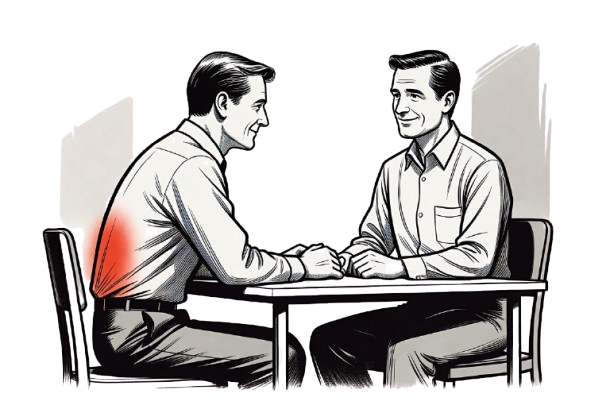

A client told me last month that his morning stiffness was just part of getting older. He was 34. He woke up every day feeling like his low back had been poured in concrete, needed twenty minutes to loosen up, and assumed that was simply the cost of admission for a desk job and a few birthdays. That assumption is the problem I want to take apart here, because morning stiffness is not one thing. It is a symptom with several very different mechanical and medical explanations, and mixing them up delays the right care.
The Common Version: Mechanical Stiffness That Resolves With Movement
Most morning back stiffness is mechanical. During sleep, the spine sits still for six to nine hours. Discs imbibe fluid overnight and swell slightly. Muscles that stabilize the spine go quiet. Connective tissue around the joints loses some of its pliability without movement cycling through it. When you stand up, you are asking tissue that has been static all night to suddenly load and move, and it resists for a while.
This version of stiffness has a signature. It is worse right at waking, improves steadily over 15 to 45 minutes of normal movement, and does not come with significant swelling, fever, or night pain severe enough to wake you repeatedly. It tends to track with how a person slept, what mattress they used, and how much they sat the day before. This is the stiffness that responds to mechanical correction: better movement patterns, muscular support for the spine, and manual work to restore tissue pliability. It does not require imaging or a rheumatology referral. It requires better mechanics.
The Pattern That Should Not Be Ignored
Here is where I want to be direct, because this is the part people skip past. If morning stiffness lasts longer than 45 minutes to an hour, every single day, and that pattern has been stable or worsening for more than a few weeks, that is not normal mechanical stiffness anymore. That duration threshold is a recognized clinical flag for inflammatory back pain, which includes conditions like ankylosing spondylitis and other spondyloarthropathies. These are not musculoskeletal strain patterns. They are systemic inflammatory processes that happen to show up in the spine first.
The distinguishing features are worth knowing plainly:
Inflammatory stiffness tends to improve with activity and worsen with rest, the opposite of a simple muscle strain, which usually worsens with activity. It often starts before age 40. It frequently comes with stiffness or pain that wakes a person in the second half of the night. It can appear alongside other signals: eye inflammation, psoriasis, inflammatory bowel symptoms, or a family history of these conditions. None of these are things manual therapy, traction, or strengthening will resolve, because the driver is not mechanical. It is immunological.
I am not a physician and I do not diagnose inflammatory disease. But I have been doing spinal rehabilitation long enough to know the difference between stiffness that is asking for better mechanics and stiffness that is asking for a rheumatologist. When a client describes the pattern above, the correct next step is a referral, not a treatment plan. Mechanical tools do not fix inflammatory disease, and pretending otherwise wastes time a client does not have.
Why the Duration Matters More Than the Intensity
People tend to rate their stiffness by how bad it feels. That is the wrong metric. A mild ache that lasts two hours every morning is medically more significant than a sharp, unpleasant stiffness that clears in fifteen minutes. Intensity reflects irritation level. Duration reflects the underlying process. Mechanical stiffness clears fast because once the tissue is moving and the discs have redistributed fluid under normal loading, the irritant is gone. Inflammatory stiffness persists because the inflammatory mediators driving it do not resolve simply because you walked to the kitchen and poured coffee.
This is why intake conversations in my clinic always include a specific question: how many minutes, not how bad. A client who cannot answer that question has usually never tracked it, because nobody has ever asked them to look at their stiffness that way. Once they start paying attention, the pattern usually declares itself within a week.
Still living around your pain?
Let's change that. Call us and describe what you're dealing with — we'll tell you honestly if we can help.
Call 425-758-4619
What Mechanical Morning Stiffness Actually Needs
Assuming the pattern checks out as mechanical, which is the large majority of cases, the fix is not stretching harder in the first five minutes after waking. Stretching cold, under-supported spinal tissue first thing in the morning is a common way people aggravate a disc that is still rehydrated and more vulnerable to shear forces. The better approach addresses the actual deficits: weak deep spinal extensors that cannot hold the spine in good position through the night, poor pelvic stabilization that lets compensating muscles overwork and stiffen, and connective tissue that has lost pliability from years of under-conditioning.
Graves' 1994 research is directly relevant here. Isolated lumbar extensor strength improved by 23.5% when training included proper pelvic stabilization, compared to a 1.2% decline without it. That is not a small gap. It tells you that generic core exercise, the kind most people are already doing and still waking up stiff despite, is not reaching the muscles responsible for holding spinal position overnight. Why Core Workouts Alone Will Not Fix Your Back Pain goes deeper into why generic core training misses these deep stabilizers. San Juan's 2005 research found multifidus activation 51% greater with pelvic stabilization than without it, which is the muscle most directly responsible for segmental control at each level of the spine. If that muscle is not engaging properly, the spine has no choice but to rely on larger, less precise muscles to hold position through the night, and those muscles stiffen.
This is also where manual and muscular therapy earns its place, not as a stretch session but as targeted work to restore pliability to tissue that has adapted to years of poor loading. MedX spinal strengthening builds the capacity those stabilizing muscles need to actually hold the spine in good alignment overnight instead of compensating. Why MedX Spinal Strengthening Works When Everything Else Has Failed covers this in more depth for people who have tried generic strengthening without results. Spinal traction and decompression can relieve some of the disc-related pressure that contributes to morning stiffness in people with more significant disc involvement. None of these replace a rheumatology workup when the pattern calls for one. But for the mechanical majority, they address the actual deficit instead of masking it with a hot shower and ten minutes of stretching that buys you nothing structural.
The Honest Dividing Line
Morning stiffness that clears in under 45 minutes and tracks with your day is a mechanical problem, and it responds to mechanical solutions. Morning stiffness that persists longer, worsens with rest, started before 40, or comes bundled with other systemic symptoms is not something any clinic offering manual therapy or strengthening should try to treat without a referral first. Knowing which one you have determines everything that comes next, and guessing wrong costs months.
You don't have to live with this. Backs and necks can get stronger, pain can ease, and the body is more capable of recovery than most people are told. This blog is here to give you honest, practical information about what actually helps. As we learn more, we'll keep sharing what works. If something here spoke to you, that's a good reason to reach out and start the first conversation.
Trent Shuford, LMT, Cert. MedX Tech.