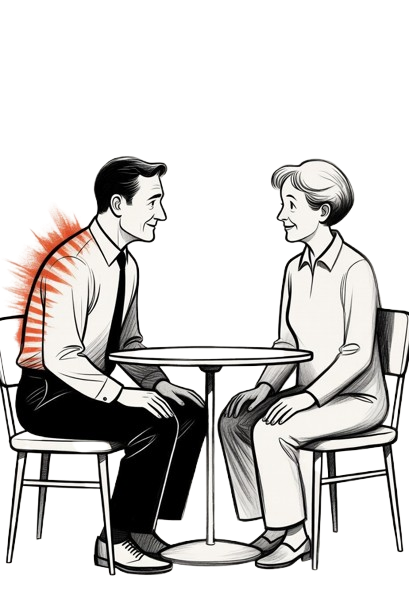

A client called last month before booking anything. Her neck had been tight for weeks, and now the room spun every time she turned her head to check her blind spot while driving. She wanted to know if manual therapy would help. My answer was not the one she expected: not yet, not until she saw her physician first.
That surprises people. Most assume a bodyworker or rehab clinician should be the first stop for any neck complaint. For plain stiffness or a pulled muscle, that is often true. But when dizziness, lightheadedness, visual disturbance, or a sense of the room tilting shows up alongside neck pain, the order of operations changes. Treatment that is appropriate for mechanical neck pain can be inappropriate, even risky, before certain medical causes are ruled out.
Why Neck Pain and Dizziness Together Change the Plan
Neck pain alone is usually a mechanical problem: joint restriction, muscle guarding, disc irritation, or load patterns that have built up over months. Dizziness alone has its own wide differential, from inner ear disorders to blood pressure issues to medication side effects. When the two show up together, the overlap narrows the possibilities but does not simplify them. Cervicogenic dizziness exists and is real. So are vestibular conditions that merely coexist with unrelated neck tightness. So, in rarer cases, are vascular issues involving the arteries that run through the cervical spine to supply the brain.
A clinician without imaging or a medical workup cannot reliably tell these apart from symptoms alone. That is not false modesty. It is an honest description of the limits of hands-on assessment. Palpation tells you about tissue. It does not tell you about blood flow, inner ear function, or the structural status of a vertebral artery. Treating first and asking diagnostic questions later reverses the correct order when red flags are present.
The Red Flags That Mean Stop and Call a Physician
Some symptom combinations warrant an immediate medical evaluation before any manual therapy, traction, or exercise-based rehabilitation is considered. These include dizziness with any of the following: double vision or visual field loss, slurred speech, difficulty swallowing, numbness or weakness on one side of the body, drop attacks where the legs suddenly give out, or a severe headache unlike any the person has had before. Dizziness that is positional in a very specific way, worse with neck extension and rotation held for several seconds, also belongs in front of a physician rather than on a treatment table, because that pattern can overlap with vertebrobasilar insufficiency.
None of this means every client with neck pain and dizziness has something dangerous. Most do not. Most have a mechanical neck problem with a vestibular or cervicogenic dizziness component that responds well to conservative care once serious causes are excluded. But "most do not" is exactly why the screening step exists. The whole point of ruling out the rare dangerous cause is so the common, treatable cause can be addressed without hesitation or hedging.
What Happens After Medical Clearance
Once a physician has evaluated the case and ruled out vascular or neurological causes, the picture usually simplifies considerably. If the dizziness tracks with neck position and improves temporarily with manual traction, that is useful diagnostic information pointing toward a cervicogenic or mechanical contribution. At that point, the five core modalities we use become appropriate: manual and muscular therapy to address the soft tissue restriction feeding the joint irritation, spinal traction and decompression to unload compressed cervical segments, and MedX cervical strengthening once acute symptoms have settled enough to load the neck safely. Piezowave shockwave therapy can address stubborn fascial adhesions in the upper trapezius and suboccipital region that often accompany this presentation. LED red light therapy at 660nm supports local tissue recovery as a complement to the mechanical work, not a substitute for it.
The mechanical reasoning matters here, not just the sequence of modalities. The suboccipital muscles at the base of the skull are densely packed with proprioceptive nerve endings that feed information to the vestibular system about head position. When those muscles are chronically shortened or in spasm, the proprioceptive signal they send can become distorted, and the brain can misinterpret that distorted signal as a sense of movement that is not actually happening. This is one plausible mechanical pathway for cervicogenic dizziness, and it is exactly the kind of tissue restriction that manual therapy and targeted strengthening are built to address. But that mechanism only becomes the working explanation after the dangerous ones have been excluded, never before. For more on how this suboccipital tension builds and recurs, see Why Trigger Points Keep Coming Back.
Neck pain that keeps coming back has a reason.
Let's find it. A thorough assessment tells us exactly what's driving your symptoms.
Call 425-758-4619
Why Clinics Sometimes Skip This Step
There is a commercial pressure that pushes some practices toward treating first and asking questions later. A client in pain wants relief now, and a clinic that says "come back after you have seen your doctor" risks losing that client to someone less careful. It is a real incentive, and it is also exactly backward from what the client needs. A clinic that treats neck pain with dizziness as routine, without first confirming there is no vascular or neurological driver, is gambling with a presentation that occasionally is not routine at all.
This is also why intake conversations at Fix Back & Neck Pain ask specifically about dizziness, visual changes, and other neurological symptoms whenever someone presents with neck pain. It is not paperwork for its own sake. It is the screening question that determines whether the next step is a treatment plan or a referral.
The Hard Truth About Screening
Careful screening sometimes means telling a client in discomfort to wait, to call their physician, to get imaging, before any hands-on work begins. That is a harder message to deliver than "come on in, we can help." But it is the honest one. The modalities that work well for mechanical neck pain, manual therapy, traction, MedX strengthening, Piezowave, and red light, are not diagnostic tools. They are treatment tools. Using them before the diagnosis is settled is not caution, it is guesswork, and guesswork has no place when the symptom list includes dizziness. Once cleared, MedX cervical strengthening is one of the tools that helps build lasting resilience; see MedX Spinal Strengthening for how that works once symptoms have settled.
You don't have to live with this. Backs and necks can get stronger, pain can ease, and the body is more capable of recovery than most people are told. This blog is here to give you honest, practical information about what actually helps. As we learn more, we'll keep sharing what works. If something here spoke to you, that's a good reason to reach out and start the first conversation.
Trent Shuford, LMT, Cert. MedX Tech.