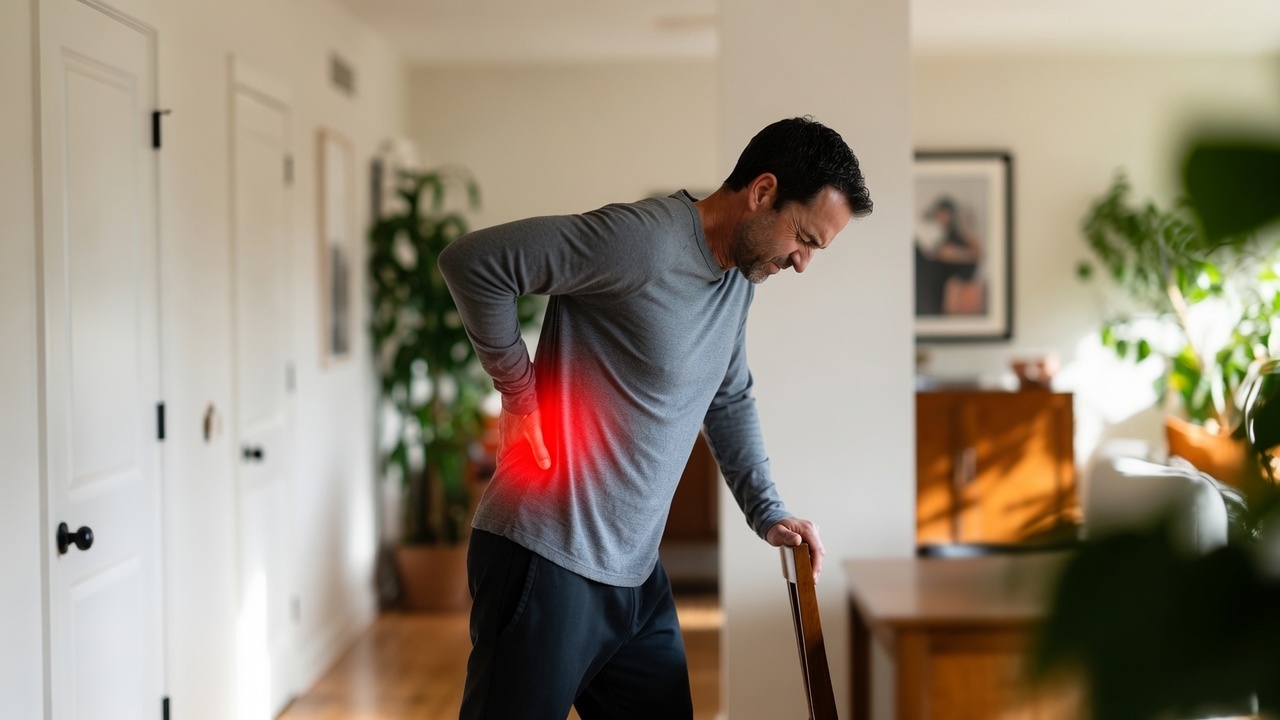

When your back goes out, the sequence is almost always the same. You bend to pick something up, or you twist to grab something from the back seat, or you stand up from a chair and feel that sharp, sudden seizing that stops you where you are. And then you spend the next several minutes, maybe the next several hours, trying to figure out exactly how badly you have hurt yourself.
The fear that comes with it is real. Something that painful, that sudden, feels serious. It feels like damage.
Most of the time, it is not what you think.
What Is Actually Happening When Your Back Goes Out
The phrase itself is part of the problem. "Going out" implies something has moved that should not have: a disc that has slipped, a vertebra that has shifted out of position. Clients arrive describing it exactly that way. "I threw my back out." "Something went." The imagery is of a structure that left its place.
That is not what is happening. Your discs do not slip. Your vertebrae do not slide out of alignment in the way people picture. What you are experiencing in that first terrible moment, and in the hours that follow, is almost always a muscle guarding response.
The deep and superficial muscles of the lumbar spine have thrown themselves into protective spasm. This is not a malfunction. It is the spine's emergency braking system. When the nervous system detects a threat to the structure, whether from an actual tissue injury or from a sudden load that exceeded what the supporting musculature could absorb, it responds by locking the area down. The muscles contract hard and stay contracted. Movement becomes limited and intensely painful. Every shift sends a warning signal: do not do that again.
The guarding is the thing that makes it feel like something structural has gone wrong. It mimics the severity of a significant injury. It can be debilitating within minutes. But in most acute low back episodes without other symptoms, the primary event is muscular, not structural.
This distinction matters enormously for what you do next. If you want to understand the full framework for telling the two apart, the post How to Know If Your Back Pain Is Muscular or Structural covers it in detail. But in the acute phase, the initial approach is largely the same either way.
What Helps in the First 24 to 48 Hours
The old advice was bed rest. Several days of it, flat on your back, moving as little as possible. That advice has been revised significantly, and for good reason. Prolonged rest allows the muscles to remain in their contracted, guarded state. It delays recovery. It can make the episode last longer than it needs to.
Gentle, controlled movement is better. Not exercise. Not a workout. Not pushing through the pain to see what you can tolerate. Controlled, unhurried movement that takes your spine through small, pain-guided ranges.
Walking is usually the best option. Short, slow, flat-surface walking. Not because it treats anything specific, but because it keeps the musculature cycling gently, which is meaningfully better than holding still. Start with five minutes. Go as long as feels manageable without increasing your pain.
Positions of relief matter. For most people in a lumbar spasm, lying on their back with knees bent and feet flat is more comfortable than lying completely flat. Some people find lying on one side with a pillow between the knees helpful. Find the position that reduces your pain and use it as your resting posture, not as a permanent state.
Heat or ice. In the acute phase, with genuine muscle spasm, heat works better than ice for most people. Ice is best suited for acute swelling and bruising after a clear traumatic event. Muscle spasm generally responds better to warmth, which encourages the tissue to release rather than tighten further. A heating pad on a low setting for 15 to 20 minutes can provide meaningful relief. If ice feels better to you, use ice. Your body's preference here is a reasonable guide.
What to avoid in the first 48 hours: deep, aggressive stretching (which can increase the protective response), heavy lifting of any kind, extended sitting without movement breaks, and sleeping curled tightly on your side with the lumbar spine in sustained flexion.
Anti-inflammatories can take the edge off the acute phase. If you are on other medications or have reasons to avoid NSAIDs, talk to your physician. These are pain management tools, not a resolution.
When the Situation Calls for Urgent Evaluation
Most acute back episodes, even the severe ones, are self-limiting with sensible management. They are miserable and disruptive, but they are not emergencies.
Some situations are different. The following symptoms warrant same-day evaluation, not a wait-and-see approach.
Saddle-area numbness. Numbness or altered sensation in the inner thighs, perineum, or genitals is a neurological sign that needs attention today.
Bowel or bladder changes. Incontinence, retention, or a new inability to sense the normal urge is a clinical red flag. This points to possible involvement of the nerve roots at the base of the spinal cord, a situation that cannot wait.
Progressive leg weakness. A weak leg after a back episode is worth noting. Weakness that is increasing, rather than holding steady or gradually improving, is a different and more urgent signal.
Significant trauma. A fall from height, a motor vehicle accident, or a direct impact before the episode changes the picture entirely. Fracture is a real possibility in trauma cases and needs to be ruled out with imaging.
Fever with back pain. Back pain accompanied by fever, especially with chills, points to a possible infectious process. This has nothing to do with muscle guarding and everything to do with your physician.
These are not reasons to be alarmed about every back episode. They are reasons to know the difference between an episode that needs time and one that needs evaluation today. The post Five Signs Your Back Pain Needs More Than Rest and Stretching covers additional warning signs worth knowing.
Still living around your pain?
Let's change that. Call us and describe what you're dealing with — we'll tell you honestly if we can help.
Call 425-758-4619
When to Come In Versus Manage at Home
If you have no red-flag symptoms and this is an acute episode without neurological involvement, the first 48 to 72 hours of sensible home management are reasonable. Walk gently. Use heat. Rest in positions of relief. Let the acute guarding settle.
If you have pain that radiates down one leg, especially below the knee, that is worth a conversation sooner rather than later. Radiating leg pain during a back flare often signals that a nerve root is involved. It may come from disc pressure, from swelling, or from a structural factor the episode has aggravated. The post on Sciatica: What It Actually Is, What Causes It, and What Resolves It explains how to read those symptoms and what the presence of leg pain typically means for the trajectory of recovery.
If your pain is not improving after three to five days of reasonable home management, that is a signal. If this is not your first episode, and if the episodes are coming more frequently or recovering more slowly than they used to, that is a clearer signal still.
The conversation about what is driving your back pain is worth having before you are in crisis. Waiting until the third or fourth episode, or until the guarding is so severe you cannot sit, generally means a longer road back.
The Episode Ends. The Cause Does Not.
Here is the part that most acute-phase care misses.
The spasm calms. The guarding resolves. You go back to your life. And two or three months later, in some unremarkable moment, it happens again. Same back. Same seizure. Possibly the same side.
People accept this as part of getting older, or as simply the way their back is. They manage each episode and move on.
What most of those recurrences represent is an unaddressed weakness in the deep stabilizing muscles of the lumbar spine. The muscles designed to support and control the spine under load, the lumbar extensors and the deep segmental stabilizers, are not doing their share of the work. So the spine is perpetually one unguarded moment away from another episode. The triggering event changes: a different lift, a different twist. The underlying vulnerability does not.
This is what clinical rehabilitation addresses. Not the acute episode itself, but the structural deficit that made the episode likely in the first place. At Fix Back & Neck Pain, the assessment we do starts with objective measurement of lumbar extensor strength. That data shows us what the capacity gap actually looks like. From there, a program built around MedX spinal strengthening targets the deep extensors specifically, with pelvic stabilization that directs the loading where it belongs.
The goal is not to manage the next episode better. The goal is to make it less likely.
When the acute phase has settled and you are ready to understand what is driving the pattern, that is what the first conversation is for. Call 425-758-4619 or send your details through the website. We will tell you honestly whether what we do is the right fit for what you are dealing with.
Trent Shuford, LMT, Cert. MedX Tech.