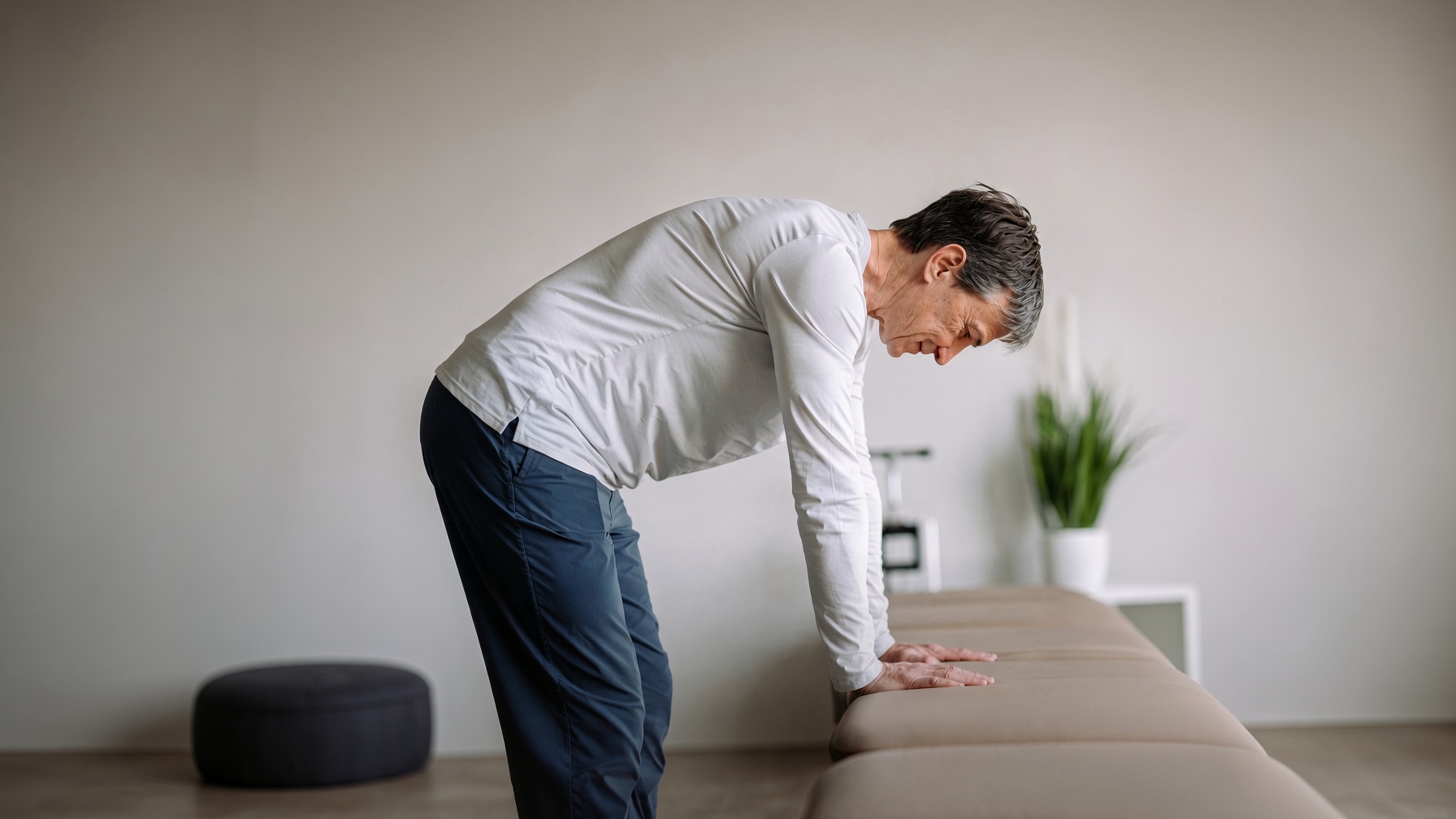

A client came into the clinic last month who had not tied his own shoes standing up in eight months. He crouched on one knee every morning, braced on the bathroom counter, and called it a system. His back pain had actually resolved weeks earlier. What remained was the bend itself. His spine had healed. His nervous system had not gotten the memo.
This is one of the most common problems I see in Redmond, and almost nobody talks about it directly. We talk about disc herniations, muscle strains, sciatica. We rarely talk about what happens after the tissue settles down, when a person is still afraid to bend, still flinching at the idea of reaching into a low cabinet or picking up a grocery bag off the floor. The pain is gone. The fear is not. And fear changes how a spine moves just as much as an actual injury does.
The Misconception That Bending Is Dangerous
Somewhere along the way, a lot of people were taught that bending at the waist is inherently bad for the back, full stop. Lift with your legs, never your back. Keep your spine rigid like a board at all times. This advice is not entirely wrong, but it has been oversimplified into something closer to a phobia than a guideline.
The human lumbar spine is built to flex. Intervertebral discs are designed to tolerate compression and bending load, and the surrounding musculature is designed to control that motion, not prevent it outright. A spine that never bends is not a protected spine. It is a deconditioned one. When someone avoids flexion entirely for months, the deep stabilizing muscles around the spine lose capacity, the surrounding tissue loses tolerance to load, and the next time a bend is unavoidable, usually something mundane like reaching for a dropped phone, the spine is less prepared for it than it was before the pain started. The avoidance meant to protect the back often ends up weakening the exact system that would have kept it safe.
Why the Fear Outlasts the Injury
Pain and tissue damage are not the same thing, and they do not resolve on the same timeline. An acute strain or disc irritation might calm down in four to six weeks. The protective guarding pattern a person builds around that injury, the held breath, the stiffened hips, the refusal to let the spine round forward, can persist for months or years after the original tissue has healed completely.
This is not something to be ashamed of. It is a predictable nervous system response. Once a movement has been associated with pain, the brain flags that movement as a threat, and it keeps flagging it even after the physical reason for the threat is gone. I see this constantly with clients who come in long after an MRI shows a resolved or stable disc issue, yet they still move through the world like the injury happened yesterday. Their guarding has outlived its usefulness, and it has become its own problem.
What Graded Exposure Actually Looks Like in the Clinic
The fix is not a pep talk telling someone to just bend over and get on with it. That approach usually backfires, either because the person is not ready for that load and reinjures something, or because the fear is strong enough that they cannot physically make themselves do it. Neither outcome rebuilds trust.
What works is graded movement, done in a controlled setting where load and range can be dialed precisely. On the MedX equipment, we can isolate the lumbar spine and have someone move through a small, specific arc of motion against a measured resistance, starting well inside their comfort zone and tracking strength gains week over week. This matters because Pollock's 1989 study found a 102% increase in lumbar extensor strength at zero degrees within ten weeks of once-weekly MedX training [PMID 2532867]. That study measured strength in healthy subjects, not pain outcomes in injured patients, but it tells us something important: the lumbar extensors respond fast to targeted, progressive loading when the motion is controlled and specific. A spine that is getting measurably stronger week to week gives a person concrete evidence that bending is safe again. Confidence does not come from reassurance. It comes from repeated proof. For more on how this equipment works across the board, see Why MedX Spinal Strengthening Works When Everything Else Has Failed.
Graded exposure also depends on how the pelvis moves relative to the spine. Graves found in 1994 that isolated lumbar extensor strength improved only when the pelvis was stabilized during training, with a 23.5% gain in the stabilized group compared to a 1.2% loss in the unstabilized group [PMID 8311680]. San Juan's 2005 EMG study found 51% greater multifidus activation with pelvic stabilization [PMID 16287377]. In plain terms, if the pelvis is allowed to compensate instead of the lumbar spine doing its job, the exact muscles a fearful bender needs to strengthen never get properly loaded. This is why core workouts alone, done without that stabilization, rarely resolve this kind of fear. The muscle group that needs retraining is not getting trained.
Still living around your pain?
Let's change that. Call us and describe what you're dealing with — we'll tell you honestly if we can help.
Call 425-758-4619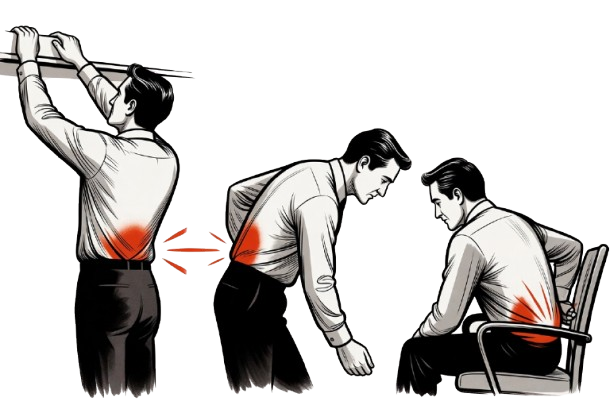
Manual Therapy's Role in Rebuilding Trust
Strength training alone does not usually dissolve fear of movement, especially in people whose guarding has become habitual over months. Manual and muscular therapy plays a different role here. Hands-on work can reduce the background tension in the hip flexors, paraspinals, and thoracolumbar fascia that a guarded person has been holding for so long they no longer notice it, including the kind of chronic trigger points that build up around a guarded spine. Releasing that chronic bracing often lets someone feel, for the first time in a long while, what a relaxed bend actually feels like, before we ever ask them to load it on equipment.
This combination, manual work to lower the baseline tension and MedX to rebuild measurable strength through a full range, tends to move people through the fear faster than either approach alone. The manual therapy quiets the alarm system. The strengthening work gives the nervous system evidence that the alarm was outdated.
What Recovery Timelines Actually Look Like
People want a date on the calendar. I cannot give an honest one, because tissue healing times vary and because fear of movement does not resolve on a fixed schedule either. What I can say is that Nelson's 1995 study followed 627 completers out of 895 chronic low back pain patients and found 76% reported excellent or good outcomes, with 94% of those good or excellent results maintained at one-year follow-up [PMID 8584467]. That is a study of pain and functional outcomes in chronic low back pain patients, not fear specifically, but it demonstrates something relevant: outcomes built through progressive strengthening tend to hold. They are not a temporary fix that fades once the fear returns the following winter.
In my own practice, of clients who arrived with spinal surgery already scheduled, 86.5% avoided surgery. That is not a peer-reviewed statistic. It is a pattern I track in my own caseload, and I mention it because a meaningful number of the people in it came in afraid to bend, not in acute pain. Confidence restored through graded, measured strengthening is often enough to change the trajectory entirely, before surgery is ever necessary.
The Hard Truth About Avoidance
Avoiding a bend forever is not a strategy. It is a slow trade, trading short-term comfort for long-term capacity. Every week a spine does not bend is a week the tissues around it adapt to not bending, and that adaptation makes the eventual, unavoidable bend more dangerous, not less. The people who recover fastest from fear of movement are not the ones who wait until they feel brave. They are the ones who build, in small and measured doses, enough real strength that bravery stops being necessary.
You don't have to live with this. Backs and necks can get stronger, pain can ease, and the body is more capable of recovery than most people are told. This blog is here to give you honest, practical information about what actually helps. As we learn more, we'll keep sharing what works. If something here spoke to you, that's a good reason to reach out and start the first conversation.
Trent Shuford, LMT, Cert. MedX Tech.