You are past sixty, and somewhere along the way the message became clear. The back pain is just age. The stiffness is just age. The lost back strength is just age. Do less, expect a little more discomfort each year, and call that acceptance. Maybe a clinician said it kindly. Maybe you arrived at it on your own, after one too many mornings that began with a slow, bracing roll out of bed.
It is the most common thing older clients have been told, and it is mostly wrong. Strength is not something you simply lose to the calendar. It is something you stop training, and at any age it responds when you train it again.
The decline you were told to accept
Here is what actually happens to most backs over the decades. Pain and stiffness lead to caution. Caution leads to doing less. Doing less lets the muscles that support the spine quietly weaken, which produces more stiffness and less confidence, which leads to doing less still. It is a loop, and age gets the blame for what disuse is mostly doing.
The muscles at the center of this are the lumbar extensors, the deep muscles that run along the spine and control how it holds and moves. When they weaken, the spine loses the support it depends on. The back feels fragile because, in a real sense, it has been left unsupported. None of that is a fixed feature of being older. It is the result of a pattern, and patterns can change.
What the evidence actually shows
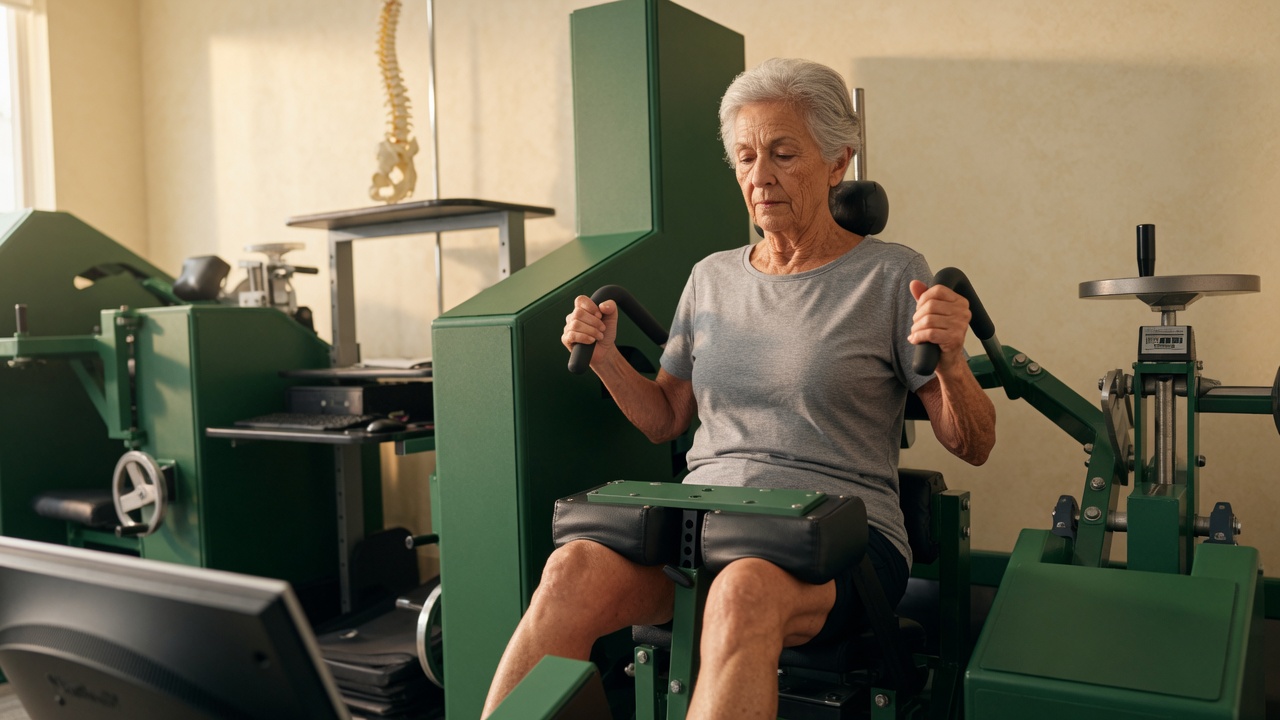
This has been measured directly in exactly the group most people assume is past helping. Holmes 1996 studied older women with chronic low back pain who trained on the MedX lumbar extension machine, starting twice a week and later reducing to once a week.
Over an average of 97 days and 20 visits, their range of motion and strength improved to match those of healthy women without back pain. Their reported pain dropped by 60 percent. The weight they could train with rose by 71 percent. These were not athletes or early retirees easing into a gym. They were older women with ongoing back pain, and their backs got measurably stronger and hurt measurably less.
The study was conducted in women, so its specific numbers describe older women rather than everyone past sixty. But the principle it demonstrates, that an aging back with chronic pain still adapts to proper strengthening, is not unique to one sex. The capacity to get stronger does not expire.
Why generic exercise does not get there
A common response to this is to start walking more, or to try the gentle stretches a video recommended. Movement is good, and none of this argues against it. But pain that needs more than rest and stretching needs the muscles addressed directly, and walking and stretching do not rebuild the lumbar extensors. Those muscles are easily bypassed. Stronger surrounding muscles take over the moment they get the chance.
Graves 1994 showed the mechanism plainly. When the pelvis was held still so the lumbar extensors could not pass the load to the hips and hamstrings, their strength improved by 23.5 percent. When the pelvis was free to move, as it is in nearly every ordinary exercise, the same muscles barely changed, a slight decline of 1.2 percent. That study was in healthy adults, so it tells us how these muscles are trained, not about pain. The lesson for an older back is direct. Without isolation, you can stay active for years and never reach the muscles that most need the work.
This is why isolated, measured strengthening is the foundation here rather than general exercise. MedX spinal strengthening stabilizes the pelvis so the lumbar extensors have to do their own work. The mechanism behind how MedX strengthening works is the same at seventy as it is at forty.
Most people have never trained the muscles that actually support the spine.
You can. MedX isolates and strengthens the deep spinal extensors that conventional exercise can't reach.
Call 425-758-4619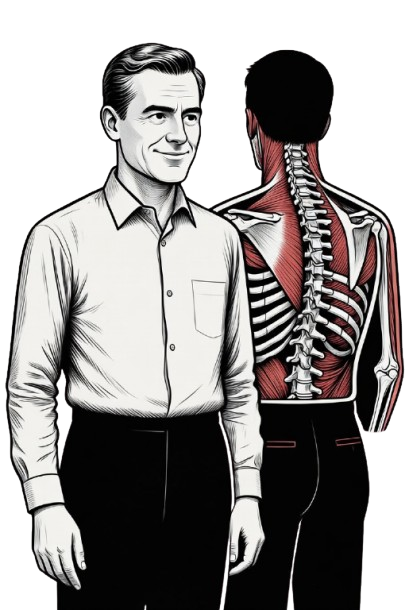
What this looks like after sixty
Done properly, strengthening after sixty is unhurried, specific, and measured. It is not about lifting something heavy or moving fast. It is a controlled effort against resistance matched to where you are now and increased gradually as you adapt, exactly as it was for the women in the Holmes study who started light and progressed over weeks. In 35 years of clinical work, the older clients who regain the most are rarely the ones who were strongest to begin with. They are the ones who started, stayed consistent, and let measured progress do its work.
The point of all of it is not exercise for its own sake. It is independence, the ability to keep doing the ordinary things that keep a life your own. We have written separately about how bone and back strength are connected, and that side of the story is worth reading on its own.
When this is not the right fit
Strengthening is powerful, but it is not the right first step for everyone. Sudden new back pain, pain that follows a fall, or pain with fever, unexplained weight loss, or new weakness, numbness, or loss of bladder or bowel control needs medical evaluation first, not an exercise program. Some conditions call for clearance from your physician before loading the spine, and we will ask for it when that is the case.
If strengthening is not appropriate for you yet, the honest answer is that we will say so. We turn away people who are not the right fit. But for a great many older adults who were told the only option was to manage and wait, there is more available than they were led to believe.
Aging is real, and it does change the body. What it does not do is make a weak back permanent. The decline most people accept after sixty is, in large part, a strength problem wearing the costume of age. Strength problems have answers. The first step is deciding that slowing down is not the only option, and then doing the specific work that gives the back its support back.
Trent Shuford, LMT, Cert. MedX Tech.