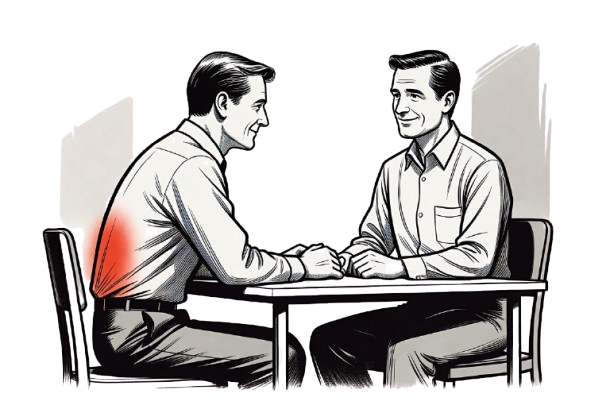

A client came in last month describing something he had never mentioned to anyone else. He braces his abs every time he stands up from a chair, a back-bracing habit he has kept for years, ever since a physical therapist told him to "engage his core" before any movement that might stress his back. He does it in meetings, in the car, reaching for a coffee mug. He thought he was protecting his spine. He was exhausted, and his back still hurt.
This is one of the more common patterns I see in clients who have been through the standard advice loop for back pain: brace the core, keep the abs tight, protect the spine at all costs. The advice is not wrong in a gym context where someone is about to deadlift a loaded barbell. It becomes a problem when it turns into a 16-hour-a-day habit applied to walking across a room or picking up a phone.
Why Constant Bracing Backfires
Muscles that are never allowed to relax do not get stronger. They get tight, fatigued, and eventually less capable of producing force when it actually matters. A muscle held in a constant low-level contraction is working, in a sense, all day. It is also never recovering. By evening, the muscle group a client has been bracing since 7 a.m. is not protecting the spine anymore. It is simply tired, and tired muscle does not stabilize anything well.
There is also a breathing problem buried inside this habit. Constant abdominal bracing restricts the diaphragm's normal range of motion. Breathing becomes shallow and upper-chest dominant. Clients do not usually connect their shallow breathing to their back bracing habit, but the two are mechanically linked. The diaphragm is part of the core system. When it cannot move freely because the abdominal wall is locked down, the whole stabilization strategy for the spine is compromised rather than improved.
What the Spine Actually Needs From Its Muscles
The lumbar spine is stabilized by a system of muscles that are supposed to turn on and off in response to the task, not sit in one fixed state of tension. The deep stabilizers, including the multifidus, are designed to make small adjustments as load shifts. A back that is braced rigid all day cannot make those adjustments. It can only hold one position and hope the position is correct for whatever is coming next. It usually is not.
This is where the research on pelvic stabilization becomes relevant. Graves 1994 found that isolated lumbar extensor strength improved by 23.5% when training included proper pelvic stabilization, and barely changed (a loss of 1.2%) without it [VERIFIED PMID 8311680]. San Juan 2005 measured 51% greater multifidus activation when pelvic stabilization was used correctly during training [VERIFIED PMID 16287377]. Both studies point to the same mechanical truth: the deep stabilizing muscles need a stable base to work from, and they need to be trained through a real range of motion, not held static all day long. Constant bracing is the opposite of that. It is a static hold applied to a dynamic system.
The Fear Behind the Habit
Most clients who brace constantly are not doing it because someone told them to and they forgot to stop. They are doing it because they are afraid that if they do not brace, something in their back will give out. That fear usually traces back to an injury, a scary flare-up, or advice from a well-meaning provider that got taken too literally. The habit becomes a coping mechanism for anxiety about the spine, not an actual mechanical strategy.
The problem is that fear-driven bracing does not fix the underlying issue. If a disc is irritated, if the facet joints are inflamed, if the deep stabilizers are weak, bracing the superficial abdominals all day does nothing to address any of that. It just adds a layer of chronic muscular fatigue on top of an unresolved mechanical problem. The client ends the day with two issues instead of one.
Still living around your pain?
Let's change that. Call us and describe what you're dealing with — we'll tell you honestly if we can help.
Call 425-758-4619
Training the Muscles That Actually Need to Get Stronger
The deep spinal stabilizers, particularly the lumbar extensors and multifidus, respond to progressive resistance training through a full range of motion, not to being held in a fixed brace. Pollock 1989 documented a 102% increase in lumbar extensor strength at 0 degrees after 10 weeks of once-weekly training in healthy subjects, a strength gain finding rather than a pain outcome [VERIFIED PMID 2532867]. That kind of adaptation comes from controlled loading and controlled release, from muscles contracting and then letting go, not from a muscle locked in isometric tension from breakfast to bedtime.
This is the mechanical logic behind MedX spinal strengthening. The equipment isolates the lumbar extensors with pelvic stabilization so the muscles that are supposed to do the work actually get trained, through a measured range of motion, with resistance that increases as the muscle gets capable of handling more. It is not about teaching a client to brace harder. It is about rebuilding the strength and coordination so that bracing is not something the body has to do consciously and constantly just to feel safe standing up from a chair.
Letting Go Without Losing Stability
For most clients caught in the all-day bracing pattern, the first step is not strength training. It is relearning that relaxing the abdominal wall at rest will not cause their back to collapse. That takes a combination of manual and muscular therapy to release the chronically overworked tissue, and progressive strengthening to rebuild confidence in the muscles that actually need to be strong. Clients who go through this process often describe a specific moment, usually a few weeks in, when they realize they went an entire afternoon without thinking about their abs at all. That moment tends to matter more to them than any strength number on a machine readout.
The irony of constant bracing is that it is an attempt to protect a system by overriding the very mechanism, dynamic, responsive muscular control, that is supposed to protect it. A spine that only knows one position, held tight, is more fragile than one that can move through its full range with the right muscles firing at the right time. Bracing all day does not build that capacity. It just postpones the exhaustion.
You don't have to live with this. Backs and necks can get stronger, pain can ease, and the body is more capable of recovery than most people are told. This blog is here to give you honest, practical information about what actually helps. As we learn more, we'll keep sharing what works. If something here spoke to you, that's a good reason to reach out and start the first conversation.
Trent Shuford, LMT, Cert. MedX Tech.