
A client came into the clinic last month convinced his standing desk had saved him. He had switched over eight months earlier after reading that sitting was the new smoking. His low back pain was worse than ever. This is not a rare story. The desk is not the problem. How the spine is loaded while a person occupies that desk, the disc load itself, is the problem, and those are two very different questions.
The Myth That Sitting Itself Destroys the Spine
The popular narrative says sitting compresses the discs, shortens the hip flexors, and slowly wrecks the lumbar spine, so the fix is to stand more, move more, buy a different chair. If sitting itself were the injury mechanism, every office worker on earth would be disabled by age 40. They are not. What varies enormously between two people sitting the same eight hours is spinal position, loading pattern, and how often the tissue gets a true mechanical break. A person who sits with a neutral lumbar curve, shifts position periodically, and has adequate extensor strength can tolerate long sitting far better than a person who stands all day in a slumped, unsupported posture. Posture and load management matter more than the furniture category.
What Actually Changes Disc Load at a Desk
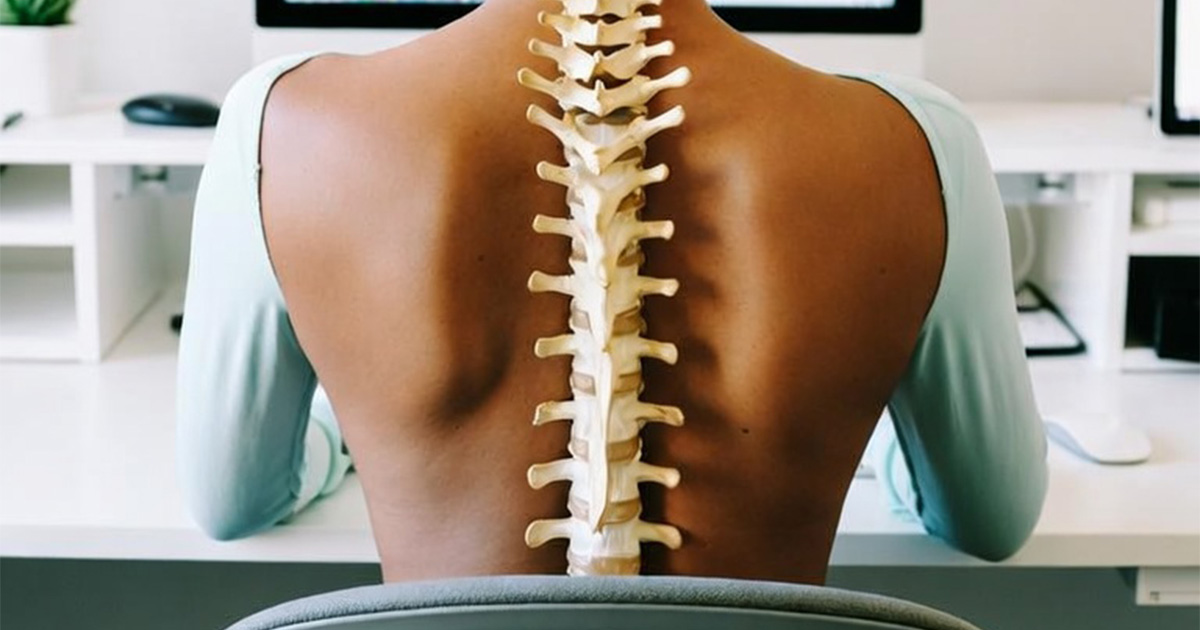
Intradiscal pressure rises with flexion. When the lumbar spine rounds forward into a slouched sitting position, the anterior portion of the disc is compressed while the posterior annulus is placed under tensile stress, which is the exact loading pattern associated with disc bulging and herniation over time. Sitting upright with the natural lordosis preserved distributes load much more evenly across the disc. This is not a matter of willpower. It is a matter of whether the deep spinal extensors have the endurance to hold that position for hours without fatiguing into collapse. Most people slouch not because they are lazy but because their lumbar extensors fatigue long before lunch.
The Hip Flexor Confusion
Clients are often told their psoas has "shortened" from sitting and that stretching it will fix their back pain. Length is only part of the story. A psoas that is tight because it is compensating for weak or inhibited lumbar extensors will not release with stretching alone, because the muscle is doing a job the spine's deeper stabilizers are failing to do. The hip flexors are a downstream symptom of an upstream capacity problem. For a deeper look at this mechanism, see "The Psoas Muscle: The Hidden Driver of Chronic Low Back Pain."
Still living around your pain?
Let's change that. Call us and describe what you're dealing with — we'll tell you honestly if we can help.
Call 425-758-4619
Why Pelvic Position Decides Everything
Graves 1994 found that isolated lumbar extension strength improved only when the pelvis was stabilized during testing and training, with a 23.5% strength gain in the stabilized group versus a 1.2% change in the group without pelvic stabilization. San Juan 2005 found multifidus EMG activity was 51% greater with pelvic stabilization than without it. Translate that to a desk chair: a pelvis that is free to tilt and rotate with every shift in sitting position cannot deliver a consistent training stimulus to the lumbar extensors, and it cannot maintain the lordotic curve that protects the disc. Chairs with no pelvic support, chairs that tilt backward, chairs that let the pelvis slide forward into a slouch, all undermine the one structural anchor the lumbar spine depends on for safe loading. The chair is not neutral. It is either stabilizing the pelvis or it is not. For more on why generic core exercises do not solve this, see "Why Core Workouts Alone Will Not Fix Your Back Pain."
Standing Desks Are Not a Loophole
Standing does reduce disc compression compared to slumped sitting, but standing with locked knees and an anteriorly tilted pelvis for eight hours creates its own fatigue pattern in the lumbar extensors and often produces more end-of-day pain than sitting did, not less. Alternating between sitting and standing helps only if both positions are loaded correctly. Switching from bad sitting to bad standing changes the furniture, not the mechanics.
What Builds Tolerance for Desk Work
Pollock 1989 demonstrated a 102% increase in lumbar extensor strength at 0 degrees after ten weeks of once-weekly MedX training in healthy subjects. That is a strength outcome in healthy adults, not a pain outcome in a clinical population, but it illustrates a mechanical point directly relevant to desk workers: the lumbar extensors respond to targeted, pelvic-stabilized loading at a rate most people assume is impossible for a muscle group trained only once a week. A spine with stronger, more fatigue-resistant extensors holds a protective curve longer into the workday before it collapses into the flexed position that raises disc pressure. This is not about sitting less. It is about building a spine that can sit, stand, and move without defaulting to the position that hurts it. For more detail on how this training works in practice, see "Why MedX Spinal Strengthening Works When Everything Else Has Failed."
You've tried other things.
This is different. Our approach addresses the structural deficit most treatments miss entirely.
Call 425-758-4619
The Hard Truth About Desk Advice
Most desk ergonomics advice treats posture as a discipline problem, something to be corrected with reminders, lumbar pillows, or a new chair. For a spine with adequate extensor strength, good posture is nearly effortless to maintain. For a spine without it, no chair, no reminder app, and no amount of willpower will hold that position past the point of muscular fatigue. The furniture is not the fix. The capacity of the muscles holding the spine in position for eight hours a day is the fix, and that capacity has to be built, not purchased.
You don't have to live with this. Backs and necks can get stronger, pain can ease, and the body is more capable of recovery than most people are told. This blog is here to give you honest, practical information about what actually helps. As we learn more, we'll keep sharing what works. If something here spoke to you, that's a good reason to reach out and start the first conversation.
Trent Shuford, LMT, Cert. MedX Tech.