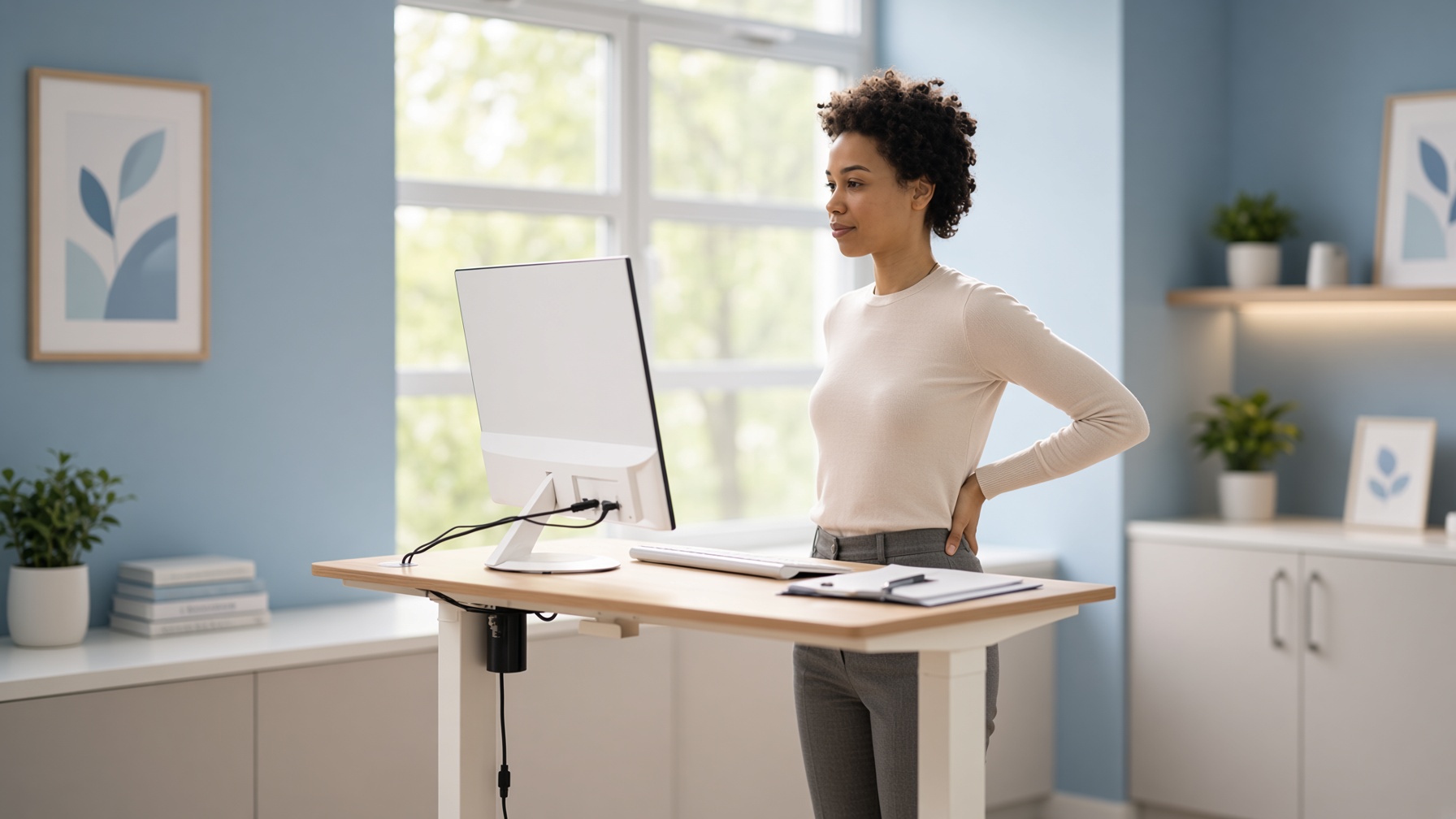

A client brought his new sit-stand desk into the clinic last month, not literally, but he described it the way people describe a new car. He had read that sitting was the new smoking, bought the desk, set a timer to alternate every 30 minutes, and six weeks later his back pain was worse. He wanted to know what he was doing wrong.
Nothing, mechanically speaking. He was doing exactly what the marketing told him to do. The problem is that standing is not the opposite of sitting when it comes to spinal load. It is a different static posture, and a different static posture held for 30 minutes is still a static posture.
The Misconception That Sells Sit-Stand Desks
The pitch behind every sit-stand desk is simple: sitting compresses the spine and standing does not, so alternating between the two should cut your risk of pain. It sounds logical. It is also incomplete.
Standing still shifts load rather than removing it. The lumbar spine in relaxed standing often carries more compressive load than people assume, and the postural muscles that are supposed to be resting while you sit are now the ones holding you upright for the next half hour, frequently in the same unsupported lean that got you into trouble at the desk in the first place. If those muscles are already deconditioned, trading one static position for another does not give them a break. It gives them a different job they are equally unprepared for.
This is why clients so often report the same ache whether they are sitting or standing at the desk. The desk changed. The underlying strength of the muscles meant to stabilize the spine did not.
What a Sit-Stand Desk Actually Changes
The spine is built to tolerate a wide range of positions, as long as the muscles around it are strong enough to control movement between those positions and endure time spent in them. A sit-stand desk only delivers on its promise if the body using it can do two things: generate enough isolated lumbar extensor strength to support upright posture, and actually move between positions rather than parking in a new one.
Pollock's 1989 research found that isolated lumbar extensor strength increased 102% at zero degrees of flexion after 10 weeks of once-weekly MedX training in healthy subjects. That number describes a strength gain, not a pain outcome, but it points to something the desk industry rarely mentions: the muscles responsible for holding you upright, whether seated or standing, respond specifically to loaded, isolated training. A timer that switches your position every half hour does not train those muscles. It just moves them around.
Graves' 1994 research adds the detail that matters most for anyone sitting in an office chair all day. Isolated lumbar strength improved only when pelvic stabilization was used during training, 23.5% gain with stabilization versus a 1.2% loss without it. The pelvis is the anchor point for the entire lumbar spine. Train around it without stabilizing it, and the lumbar muscles barely engage. Sit or stand around it all day without ever challenging it, and the same thing happens by default.
Movement Has to Be Built, Not Assumed
The honest advice is less convenient than "buy a sit-stand desk." Alternating position throughout the day is a reasonable habit, but it is a habit layered on top of a spine that needs actual strengthening work, not a substitute for it. Five minutes of standing instead of sitting does not replicate loaded extension work any more than standing at a kitchen counter replicates a workout. The same logic applies to other popular fixes: core workouts alone will not fix your back pain if the deeper stabilizing muscles are never addressed, and if a client's real issue is trigger points keep coming back, no desk configuration will resolve that on its own.
Clients who get the most out of a sit-stand desk are usually the same clients who have already done the harder work elsewhere, isolated MedX strengthening to build true extensor capacity, manual and muscular therapy to address the trigger points and restrictions that keep certain muscles from firing at all, and in persistent cases, spinal traction or decompression to relieve pressure on compressed segments so the muscles around them can actually do their job again. The desk becomes a tool for maintaining gains, not a tool for creating them.
If your back still hurts at the end of the day no matter how many times the timer tells you to switch positions, the desk is not the problem and it is not the solution. The muscles holding your spine up are undertrained, and no amount of furniture changes that on its own. In the most stubborn cases, this is where MedX spinal strengthening works when everything else has failed.
Still living around your pain?
Let's change that. Call us and describe what you're dealing with — we'll tell you honestly if we can help.
Call 425-758-4619
Set the Timer, But Train the Muscles First
An office worker who alternates positions every 30 minutes without any underlying strength work is, in effect, doing two kinds of nothing instead of one. The fix is not to abandon the sit-stand desk. It is to stop treating it as a treatment and start treating it as what it is, an ergonomic accessory that only pays off once the lumbar extensors and the stabilizing muscles around the pelvis can actually do their job.
That is a harder sell than a desk. It is also the part that determines whether the back pain goes away or simply changes shape.
You don't have to live with this. Backs and necks can get stronger, pain can ease, and the body is more capable of recovery than most people are told. This blog is here to give you honest, practical information about what actually helps. As we learn more, we'll keep sharing what works. If something here spoke to you, that's a good reason to reach out and start the first conversation.
Trent Shuford, LMT, Cert. MedX Tech.