
A client came into the clinic last month after two years of daily crunches and planked core routines. His back pain had not moved an inch. He could hold a plank for three minutes. He still could not sit through a movie without shifting every ten minutes. This is not a rare story. It is the most common story I see in clients who have done their homework on paper but not on the actual muscle that runs the length of the spine. The muscle they needed was never the abdominal wall. It was lumbar extension strength, the capacity of the deep paraspinal muscles to hold the spine upright under load.
Here is the misconception: back pain is a flexion problem, so the fix is flexion training. Crunches, sit-ups, cable woodchops, endless "core" circuits built around bending the spine forward. It sounds logical. It is also backward. The muscle group most commonly weak, underused, and structurally undertrained in chronic low back pain clients is not the abdominal wall. It is the lumbar extensors, the deep paraspinal muscles that run along the back of the spine and are responsible for holding you upright against gravity all day, every day.
The Muscle Nobody Trains Because Nobody Can Isolate It
Try to do a bodyweight exercise that isolates the lumbar extensors through a full range of motion without recruiting the hips, hamstrings, and glutes to take over the work. You cannot. Not with a barbell, not with a resistance band, not with a machine built for the gym floor. The lumbar extensors sit deep, they are short-lever muscles, and the moment you add a hip-hinge movement like a deadlift or a back extension, the hips and hamstrings do the majority of the work while the actual spinal muscle rides along for free.
This is why so many clients report doing "back strengthening" for years with no measurable change in the muscle itself. They were training around the lumbar extensors, not through them. Pelvic stabilization changes this equation entirely. When the pelvis is fixed and the movement is isolated to the lumbar spine itself, the extensors have nowhere to hide. Graves 1994 measured this directly: isolated lumbar strength improved 23.5% with pelvic stabilization, compared to a 1.2% decline in the unstabilized group performing the same general exercise. Same intention, same effort, radically different outcome, because one approach reached the target tissue and one did not.
San Juan 2005 added the electromyography evidence. With pelvic stabilization in place, multifidus activation, the deep stabilizing muscle that runs segment to segment along the spine, was 51% greater than without it. The multifidus is not a muscle you can consciously flex the way you flex a bicep. It responds to mechanical loading applied at the right angle, through the right range, with the pelvis locked so the load has nowhere to escape to.
Why Lumbar Extension Strength Beats Flexion Training
Pollock 1989 tested this in healthy subjects using isolated lumbar extension training at zero degrees, once a week, for ten weeks. The result was a 102% increase in lumbar extensor strength. That is not a typo and it is not a patient outcome study, it is a strength study in healthy subjects, but it tells you something important about the tissue itself: the lumbar extensors respond fast and dramatically to isolated, resisted loading, once you actually reach them.
Now connect this to a population that already hurts. Nelson 1995 followed 895 chronic low back pain patients through an isolated lumbar extension strengthening protocol. Of the 627 who completed the program, 76% reported excellent or good outcomes. A year later, 94% of those good and excellent outcomes were still holding. That is not a short-term fix that fades once the client stops paying attention to their posture. That is a structural change in a muscle that is now strong enough to do the job it was always supposed to do.
Why Flexion-Based Training Can Actively Work Against You
Chronic low back pain clients are frequently sitting for eight, ten, twelve hours a day in a flexed spinal position already. Their extensors are already underused, already deconditioned, already the weak link. Adding more flexion-dominant training, crunches, sit-ups, forward-folding core circuits, reinforces the exact posture and muscular imbalance that is driving the pain in the first place. It is training the muscle that is already overworked relative to its partner, while continuing to ignore the muscle that has been quietly losing capacity for years.
This does not mean flexion-based core work has zero value. It means it is not the priority for a client whose extensors are the limiting factor, and for most chronic low back pain clients, the extensors are exactly that. Strength training that never touches the actual weak link will never resolve the problem it is aimed at.
Still living around your pain?
Let's change that. Call us and describe what you're dealing with — we'll tell you honestly if we can help.
Call 425-758-4619
What This Looks Like in Practice
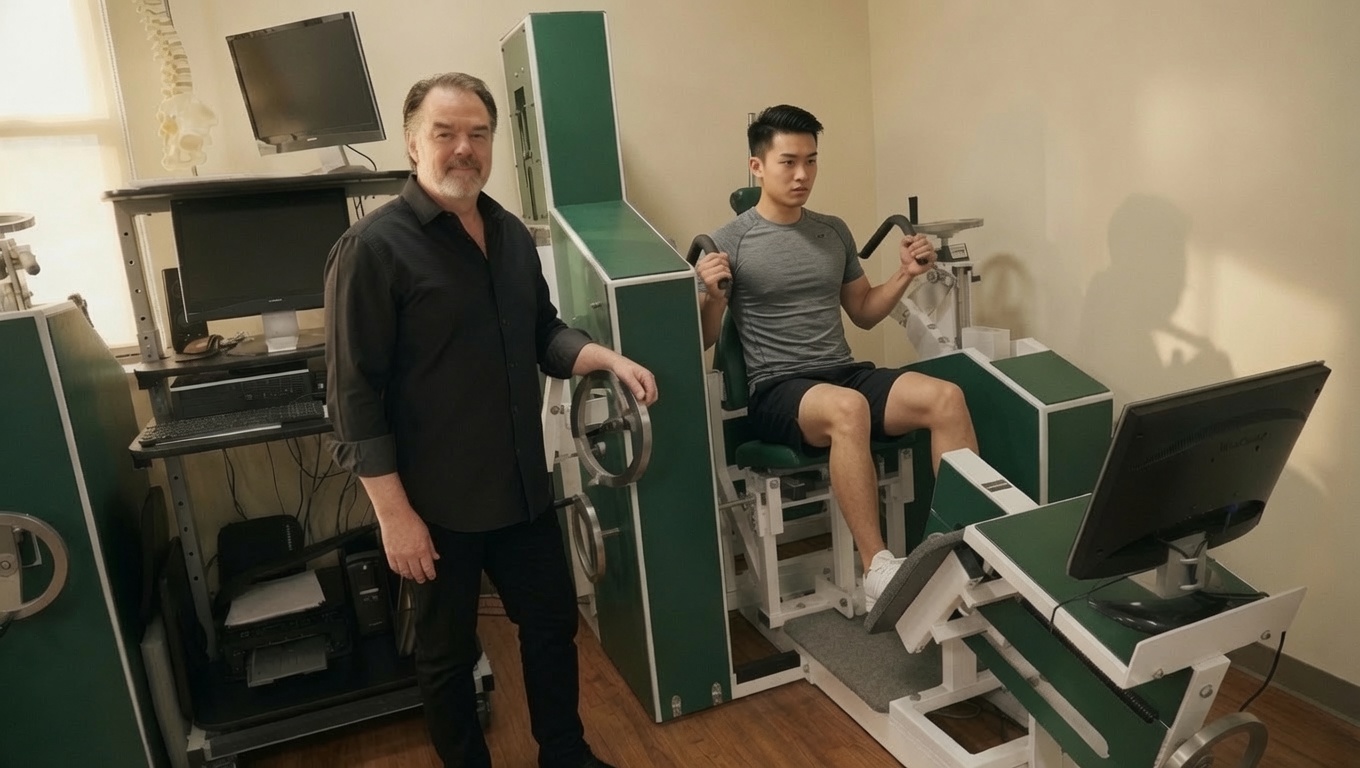
At Fix Back & Neck Pain, MedX spinal strengthening and rehabilitation is built specifically to isolate the lumbar extensors through pelvic stabilization, the same mechanism Graves and San Juan measured directly. It is paired with manual and muscular therapy to address the surrounding soft tissue restrictions that often develop alongside a weak extensor chain, and with spinal traction and decompression where disc-level compression is part of the picture. In my own practice, of clients who arrived with spinal surgery already scheduled, 86.5% avoided surgery. That number is not a clinical trial result. It is a practice-tracking figure from clients whose surgery date was already on the calendar before they walked through our door, and it reflects what happens when the actual weak structure finally gets loaded correctly instead of trained around.
The lumbar extensors do not respond to willpower or to more sit-ups. They respond to isolated, progressive, mechanically correct loading, applied consistently, over weeks, not days. Clients who skip this step and keep training flexion patterns instead are, in effect, strengthening the side of the equation that was never the problem.
You don't have to live with this. Backs and necks can get stronger, pain can ease, and the body is more capable of recovery than most people are told. This blog is here to give you honest, practical information about what actually helps. As we learn more, we'll keep sharing what works. If something here spoke to you, that's a good reason to reach out and start the first conversation.
Trent Shuford, LMT, Cert. MedX Tech.