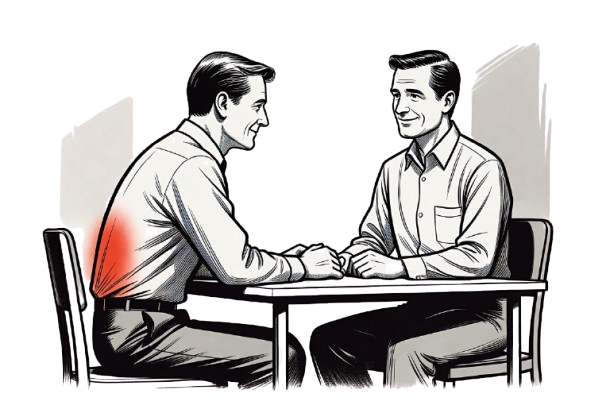
A client came in last spring describing a pattern that confuses almost everyone who has it: she could stand at the kitchen counter chopping vegetables for twenty minutes with no pain, but walking to the mailbox and back left her bent forward, gripping a fence post, waiting for her legs to stop burning. She had been told this was just arthritis, something to manage with rest. That explanation does not hold up once you understand what is actually happening inside a stenotic spinal canal, a condition called spinal stenosis.
Spinal stenosis is a narrowing of the space available for the spinal cord or nerve roots, usually from a combination of disc bulging, thickened ligaments, and bony overgrowth at the facet joints. The common assumption is that stenosis is a static problem: the canal is a certain size, and that size determines your symptoms. If that were true, walking and standing would feel the same. They do not, and the reason is mechanical, not mysterious.
Spinal Stenosis and the Mechanics of Walking
The lumbar spine changes shape depending on posture. When you extend the spine, as happens naturally with an upright walking gait and especially downhill walking, the vertebral segments move closer together on the back side of the canal. Ligamentum flavum buckles inward. Facet joints approximate. The already-tight space narrows further, and that is when nerve roots get compressed enough to produce the classic burning, heaviness, or numbness down the legs, a pattern clinicians call neurogenic claudication.
Flexion does the opposite. Bending forward, like leaning on a shopping cart or sitting, opens the canal slightly. This is why clients with stenosis often feel better slouched over a counter than standing fully upright, and why they unconsciously lean forward more and more as the walk goes on. It is not weakness of character. It is geometry.
This single fact changes how stenosis should be approached. If the problem were purely bony and fixed, no amount of positioning or strengthening would matter. But because posture and spinal extension drive the narrowing, the muscles and soft tissue controlling spinal position become part of the solution, not just scenery around the bones.
The Misconception That Keeps People Sedentary
Most clients with stenosis are told to avoid activity that provokes symptoms, which in practice means avoiding walking altogether. That advice treats the leg pain as the enemy rather than as information. The result is deconditioning: weaker extensors, stiffer hips, less tolerance for any upright activity, and a smaller and smaller radius of movement until someone is homebound.
Avoidance does not shrink a narrowed canal. It just shrinks the person's world. What actually changes outcomes is addressing the muscles that control how much extension the spine goes into and how well the trunk tolerates load before symptoms fire.
What Isolated Strengthening Changes
This is where pelvic stabilization matters, and where generic exercise falls short. Graves (1994) found that isolated lumbar extensor strength improved only when the pelvis was stabilized during testing and training, with a 23.5% strength gain in the stabilized group compared to a 1.2% decline in the unstabilized group. San Juan (2005) showed why: multifidus activation on EMG was 51% greater with pelvic stabilization than without it. The deep stabilizing muscles that actually control segmental position, the ones most relevant to how much a stenotic segment narrows under load, do not get meaningfully trained by sit-ups, planks, or a general gym routine that lets the pelvis move freely.
Pollock (1989) demonstrated that isolated lumbar extensor training produced a 102% increase in strength at 0 degrees of lumbar flexion within ten weeks of once-weekly sessions, in healthy subjects. That number describes a strength adaptation, not a pain outcome, and it should not be read as a claudication result. But it tells you something important about dose: the lumbar extensors respond rapidly and substantially to properly isolated, properly loaded training, far faster than most people assume muscle adapts.
Stronger, better-controlled extensors change the mechanics of walking. A trunk that can hold a slightly more neutral, less hyperextended position through a gait cycle buys back canal space before the leg symptoms start. This does not reverse bony stenosis. It changes the functional threshold at which the narrowing becomes symptomatic, which in practical terms means a longer walk before the legs give out.
Still living around your pain?
Let's change that. Call us and describe what you're dealing with — we'll tell you honestly if we can help.
Call 425-758-4619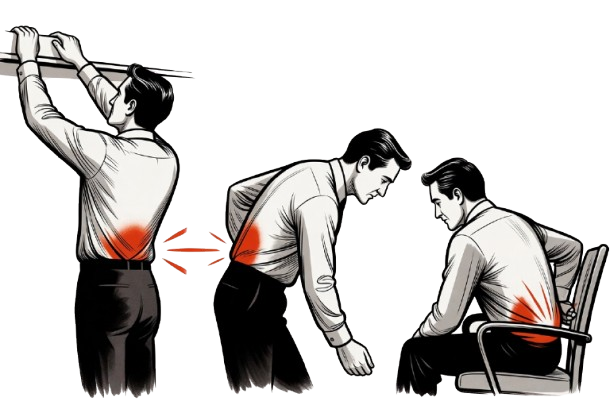
What This Looks Like in Practice
At our clinic, the approach for stenosis-related leg pain pairs MedX spinal strengthening/rehabilitation, with its pelvic stabilization design, against the deep extensors and surrounding trunk musculature, with spinal traction/decompression to reduce load-related crowding in the canal during the session itself. Manual and muscular therapy addresses the compensatory bracing that develops in the hips and lower back from months of guarded walking. For clients with significant inflammatory flare contributing to nerve irritation, Piezowave shockwave therapy and Low Level Laser Therapy (LLLT, 830nm) are used as adjuncts to calm the local tissue environment so strengthening work can proceed without provoking a flare.
None of this happens in one visit. Clients who come in already scheduled for spinal surgery are a meaningful part of our caseload, and in my own practice, of clients who arrived with spinal surgery already scheduled, 86.5% avoided surgery. That figure is not a clinical trial result. It is a practice observation, and it should be read as one, but it reflects a consistent pattern: a narrowed canal is often a mechanical problem that responds to mechanical intervention, not only a surgical one.
The Hard Truth About Stenosis and Walking
Stenosis will not disappear because the extensors get stronger. The bony narrowing is still there on imaging, and no exercise program rebuilds canal diameter. What changes is the body's tolerance for the positions that provoke symptoms, and that tolerance is built through controlled, progressive, properly stabilized loading, not through rest. The clients who improve are not the ones who waited for the canal to feel less narrow. They are the ones who trained the muscles that decide how narrow it gets.
You don't have to live with this. Backs and necks can get stronger, pain can ease, and the body is more capable of recovery than most people are told. This blog is here to give you honest, practical information about what actually helps. As we learn more, we'll keep sharing what works. If something here spoke to you, that's a good reason to reach out and start the first conversation.
Trent Shuford, LMT, Cert. MedX Tech.