
A client came into the clinic last year holding an MRI report like it was a eviction notice. The radiologist had written "Grade 1 spondylolisthesis at L5-S1" and somewhere between the parking lot and my office, that phrase had turned into a conviction that her spine was unstable and one wrong lift away from catastrophe. She had already canceled a trip that required lifting luggage. She had stopped gardening. The word "slipped" does that to people.
Here is the correction that needed to happen before anything else could: a slipped vertebra is not a vertebra about to fall off the spine. Spondylolisthesis means one vertebral body has shifted forward relative to the one below it, usually L4-L5 or L5-S1 because those segments carry the most load and rotation in the lumbar spine. Grade 1 means less than 25% slippage. Grade 2 is 25-50%. It is a structural finding, and structural findings are common. Plenty of people walk around with a Grade 1 slip and no pain at all, discovered incidentally on an MRI ordered for something else entirely. The finding on the film and the pain in the body are two different conversations, and conflating them is how a treatable mechanical problem turns into a lifelong fear of movement.
That does not mean the diagnosis is meaningless. It means the question is not "do I have a slip" but "why is this segment unstable, and what is my body doing to compensate for it."
What Causes Spondylolisthesis to Progress
Spondylolisthesis comes in a few flavors, and the cause changes the treatment logic. Isthmic spondylolisthesis comes from a stress fracture in the pars interarticularis, the thin bony bridge at the back of the vertebra, often from repetitive extension loading in adolescence: gymnastics, football linemen, divers. Degenerative spondylolisthesis shows up later in life, when the facet joints and discs wear down enough that the vertebra above loses its restraint and creeps forward. There is also a congenital form where the bony architecture was never fully formed to resist the shear.
Different causes, same mechanical consequence: the vertebra has lost some of its passive restraint. The ligaments and bone that used to hold it in place are no longer doing the full job. What stops a Grade 1 slip from becoming a Grade 2, and what often determines whether someone lives with low-grade discomfort or disabling pain, is whether the muscular system around that segment can pick up the slack.
This is where most treatment plans go wrong. They either ignore the muscular compensation entirely and just manage pain, or they prescribe generic core exercises that never reach the specific muscles doing the holding.
Why Generic Core Work Misses the Target
The deep stabilizers of the lumbar spine, particularly the multifidus, are the muscles tasked with resisting the forward shear at an unstable segment. Most core programs do not train them in a way that transfers to spinal stability, because most core programs do not isolate the lumbar spine from the hips and pelvis. When someone does a plank or a crunch, the pelvis and hip flexors take over a large share of the work, and the lumbar extensors barely engage. See Why Core Workouts Alone Will Not Fix Your Back Pain for a deeper look at this gap.
Graves' 1994 research found that isolated lumbar extensor strength improved only when the pelvis was stabilized during testing and training, with gains of 23.5% in the stabilized group against a loss of 1.2% in the unstabilized group. San Juan's 2005 research measured the multifidus directly and found 51% greater activation when pelvic stabilization was used. For someone with spondylolisthesis, that is not a minor technical detail. The multifidus is precisely the muscle that needs to be strong enough to resist the forward slide at the unstable segment, and the standard gym approach to core training is not reaching it.
This is why a client can do months of planks and bird dogs and still feel instability at the same spot every time they bend forward to tie a shoe. The exercise was not wrong in principle. It was not isolating the right joint.
Isolating the Segment That Needs the Strength
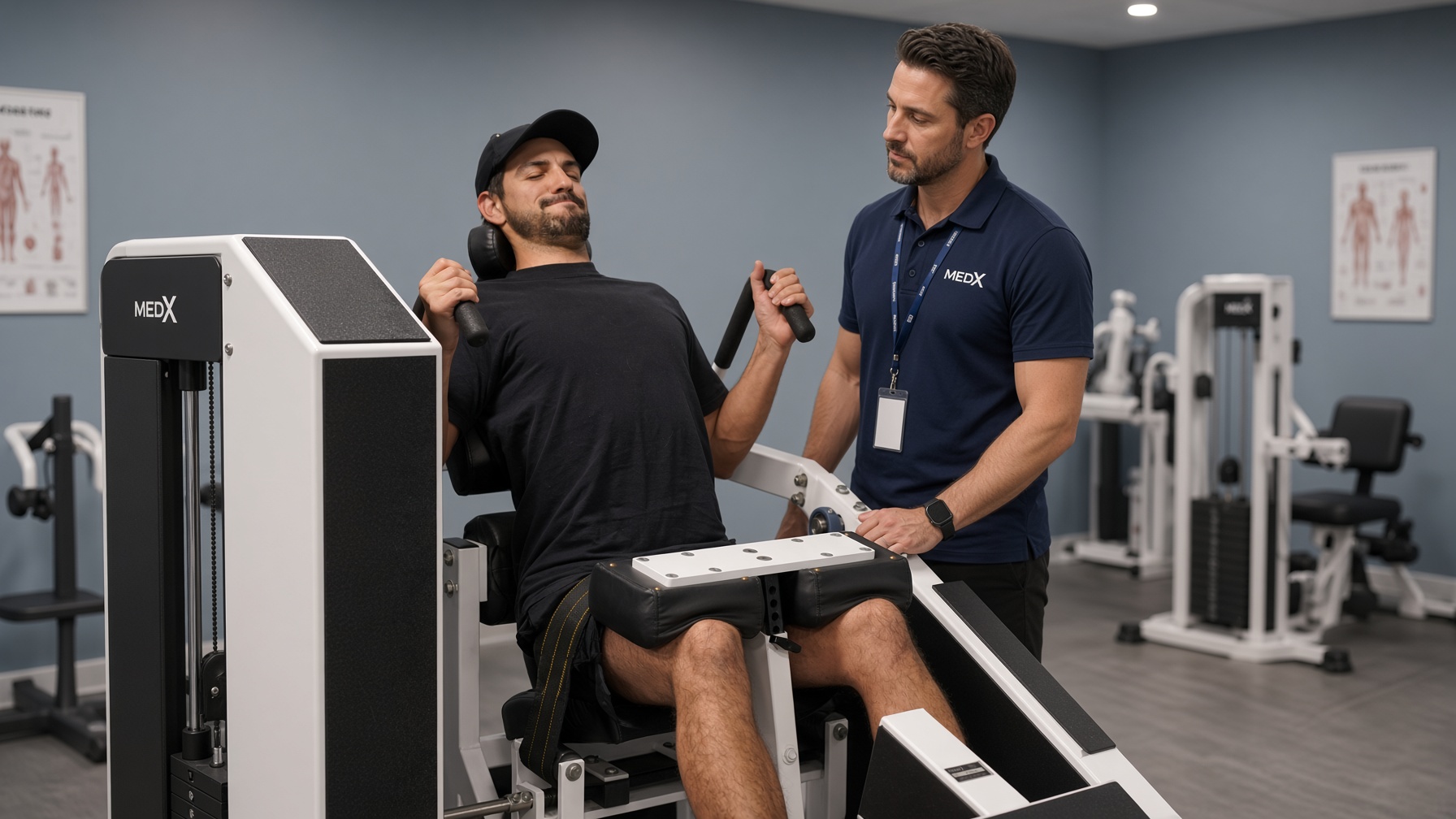
At the clinic, the MedX lumbar extension machine stabilizes the pelvis and femurs so that when a client with spondylolisthesis performs resisted extension, the force goes directly into the lumbar segments instead of leaking into the hips. This is the same mechanical principle Graves identified: isolate the segment, and it gets stronger. Let the pelvis compensate, and it does not. For more on how this approach compares to other methods that have not worked, see Why MedX Spinal Strengthening Works When Everything Else Has Failed.
Pollock's 1989 research measured a 102% increase in lumbar extensor strength at 0 degrees over ten weeks of once-weekly training in healthy subjects. That is a strength outcome in healthy subjects, not a pain outcome in a patient population, and it should not be quoted as if it means something it does not. What it does establish is the capacity of isolated lumbar extensor training to produce substantial strength gains in a short window, which matters directly for a spine that is relying on muscle to compensate for a structural shift.
Nelson's 1995 research followed 627 completers out of 895 chronic low back pain patients and found 76% achieved excellent or good outcomes, with 94% of those good or excellent results maintained at one year. That is a patient population with chronic low back pain broadly, not spondylolisthesis specifically, and it should be read that way. It does, however, support the broader premise that strengthening the lumbar extensors through an isolated, progressive protocol produces outcomes that hold up over time rather than fading in a few months.
A slipped vertebra does not need to be feared into stillness. It needs the muscles around it strengthened in a way that actually reaches the segment doing the compensating.
Still living around your pain?
Let's change that. Call us and describe what you're dealing with — we'll tell you honestly if we can help.
Call 425-758-4619
Where Manual Therapy and Traction Fit In
Strengthening is the long-term answer, but a segment under chronic shear stress often develops secondary problems that strength training alone will not resolve in the short term. The muscles surrounding an unstable segment frequently guard, and that guarding can create trigger points and restricted movement in the surrounding soft tissue. Manual and muscular therapy addresses that guarding directly, releasing the compensatory tension so the segment is not fighting itself before it even gets to the strengthening phase.
Spinal traction and decompression can also play a role, particularly when the slip has narrowed the space available to a nerve root and the client is dealing with radiating pain down the leg in addition to the local mechanical instability. Decompression creates temporary space at the segment, which can reduce nerve irritation while the strengthening work addresses the underlying muscular deficit. These are not competing approaches. They address different parts of the same mechanical problem on different timelines.
When Surgery Enters the Conversation
Surgical fusion is sometimes necessary, particularly with higher-grade slips, progressive neurological symptoms, or instability that has not responded to a genuine strengthening effort. Choi's 2005 research on post-discectomy patients found 87% returned to work within four months compared to 24% of controls, which speaks to how effective surgery can be when it is the right tool for the right problem. Surgery is not the enemy here. The problem is how often it gets scheduled before a structured strengthening protocol has been tried at all.
In my own practice, of clients who arrived with spinal surgery already scheduled, 86.5% avoided surgery. That is not a peer-reviewed statistic and I say that plainly, but it reflects what happens repeatedly when the muscular compensation for an unstable segment gets addressed directly instead of being bypassed. Not everyone in that position should cancel their surgery. Some genuinely need it. But the decision deserves to be made after the muscles around the slip have actually been tested under a real strengthening protocol, not before.
A diagnosis of spondylolisthesis is a description of where your spine's architecture has changed. It is not a verdict on what your body is still capable of building around that change. For a closer look at one of the underlying structures often involved in these compensation patterns, see The Psoas Muscle: The Hidden Driver of Chronic Low Back Pain.
You don't have to live with this. Backs and necks can get stronger, pain can ease, and the body is more capable of recovery than most people are told. This blog is here to give you honest, practical information about what actually helps. As we learn more, we'll keep sharing what works. If something here spoke to you, that's a good reason to reach out and start the first conversation.
Trent Shuford, LMT, Cert. MedX Tech.