
A client came in last month because reaching to the top shelf of her pantry had started lighting up her low back. Not her shoulder. Not her neck. Her low back, every time she stretched up to grab something. She assumed it was a hip flexor or a core weakness. It was neither. Her thoracic spine, the stretch of twelve vertebrae between the shoulder blades, had quietly stopped rotating and extending the way it should, and her lumbar spine had been drafted to cover the shortfall.
This is a mechanical story, not a mystery. The misconception worth overturning first: overhead reach is not a shoulder-only movement. A clean reach overhead requires the thoracic spine to extend, the shoulder blades to rotate upward, and the ribcage to expand. When any of those links stiffen, the body does not refuse the task. It finds motion somewhere else, and the low back is the nearest, most obliging joint willing to donate range it was never built to spare.
The Thoracic Spine Is Built to Move, Then Stops Limiting Overhead Reach
The thoracic spine has twelve segments and, on paper, generous potential for rotation and extension. In practice, years of sitting, driving, and looking at screens flatten the natural curve and glue the facet joints into a mildly flexed, locked position. Ask that stiffened spine to extend overhead and it will not. The nervous system does not ask permission before redistributing the job. It simply recruits the lumbar spine, a region built for stability and small ranges of flexion and extension, not for repeated compensatory overhead reach.
Do this often enough, loading groceries onto a shelf, hanging a picture, lifting a suitcase into an overhead bin, and the lumbar segments taking on the thoracic spine's share start to show wear in exactly the pattern you would expect: facet irritation, disc stress at the segment working hardest, and a deep ache that shows up at the end range of reach rather than at rest. The low back was never weak. It was asked to be flexible in a direction it was not designed to supply. Why Core Workouts Alone Will Not Fix Your Back Pain goes deeper into this pattern, where strength exists but the wrong joint keeps absorbing the load.
Why Stretching the Low Back Makes It Worse, Not Better
Here is where most self-treatment goes wrong. A client who feels low back pain on overhead reach almost always stretches the low back more. It feels logical. It is also exactly backward. The lumbar spine is already hypermobile relative to its neighbors in this pattern. Stretching an already-overworked segment does not restore the missing thoracic extension. It adds more motion to the joint that has too much motion already, which is why the relief from stretching tends to last minutes, not days.
The segment that actually needs mobilizing is the thoracic spine. Until that region regains extension and rotation, the lumbar spine has no alternative but to keep covering for it. This is a mechanical hierarchy, and it does not respond to willpower or more flexibility work aimed at the wrong joint.
What Restoring the Hierarchy Actually Requires
Mobility work for the thoracic spine matters, but mobility without stability behind it tends to drift back to baseline within days. This is where isolated, supported strengthening earns its place. Pelvic stabilization isolates the targeted segment so the muscles meant to do the work actually do it, rather than the body recruiting compensatory patterns, which is precisely why Graves 1994 found lumbar extensor strength improved 23.5% with pelvic stabilization versus a 1.2% decline without it in research subjects, and why San Juan 2005 measured 51% greater multifidus activation under the same stabilized condition, also in research subjects rather than clients. The same logic applies moving up the spine: if the thoracic segments are going to hold their new range instead of surrendering it back to the low back within a week, they need loaded, stabilized work at end range, not just foam rolling and doorway stretches.
Manual and muscular therapy can release the soft tissue restrictions around the ribcage and thoracic facets that block extension in the first place. Spinal traction and decompression can create the joint space needed before that range is even accessible. But none of it holds without strengthening the pattern once it is unlocked, and that is the step most people skip because it is slower and less satisfying than a stretch that provides two minutes of relief.
Still living around your pain?
Let's change that. Call us and describe what you're dealing with — we'll tell you honestly if we can help.
Call 425-758-4619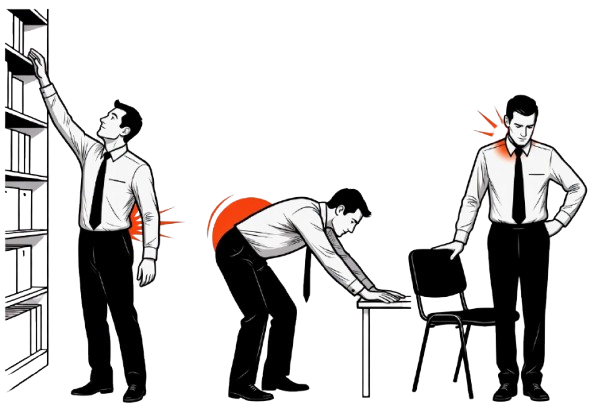
The Hard Truth About Where the Pain Shows Up
The site of pain and the site of the problem are rarely the same place in this pattern, and that single fact explains why so much self-directed treatment fails. A client chasing low back relief by stretching the low back is treating the symptom while the actual restriction, sitting one region higher, goes untouched. The reach will keep hurting until the thoracic spine gets its motion back and the low back gets permission to stop filling in.
You don't have to live with this. Backs and necks can get stronger, pain can ease, and the body is more capable of recovery than most people are told. This blog is here to give you honest, practical information about what actually helps. As we learn more, we'll keep sharing what works. If something here spoke to you, that's a good reason to reach out and start the first conversation.
Trent Shuford, LMT, Cert. MedX Tech.