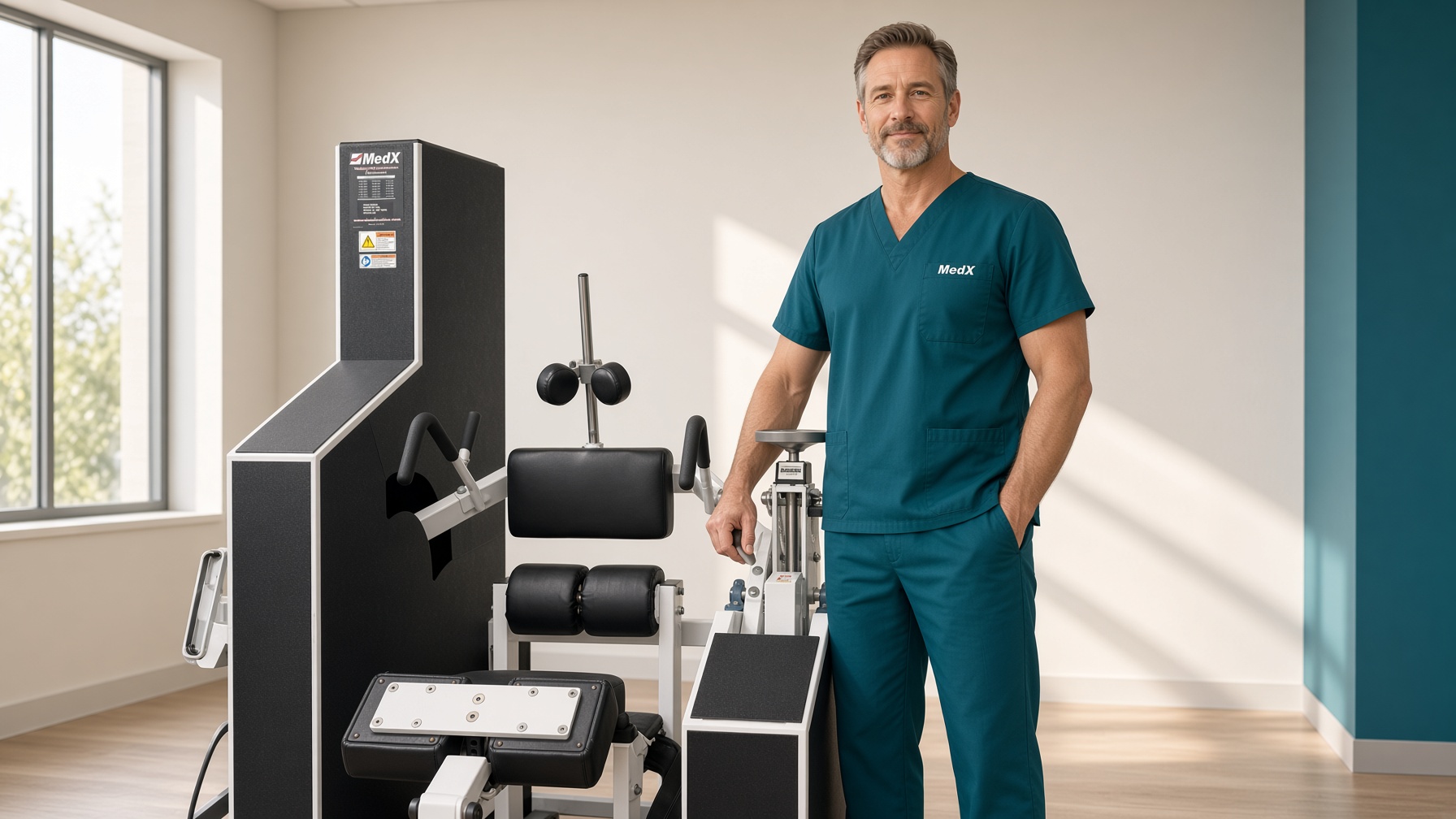

A woman I treated two winters ago asked me a question I hear in some form almost every week. She was six months out from finishing her MedX program, her back felt strong, and she wanted to know if that strength was going to quietly disappear the way a gym membership does when you stop showing up. She was bracing for the answer she expected: that she would need to keep paying for sessions forever or watch the gains evaporate.
That is not what the research shows, and it is not what I see in my own clients.
The Misconception That Keeps People From Finishing
Most people assume that spinal strengthening works like a cardio program. Stop running and your VO2 max fades in weeks. So the logic goes that if you stop MedX, your lumbar extensors will detrain just as fast and the pain will creep back in.
The lumbar extensors do not behave like your calves on a treadmill. They are small, deep, postural muscles that get almost no direct training in daily life, which is exactly why they atrophy so easily in people with chronic back pain in the first place and why, once properly loaded, they tend to hold their gains differently than a muscle you use constantly and can therefore also neglect constantly without much consequence. Pollock's 1989 study found a 102% increase in lumbar extensor strength at 0 degrees after ten weeks of training just once per week in healthy subjects, a strength outcome in people without back pain, not a pain outcome in a patient population. That number tells us how fast the muscle responds to isolated loading. It does not by itself answer the durability question. For that, we look at outcome tracking over time, not strength curves in a lab.
Do Spine Strengthening Results Last One Year Later
Nelson's 1995 study followed 627 completers out of 895 chronic low back pain patients who went through intensive spinal extensor rehabilitation. Seventy-six percent reported excellent or good outcomes. The number that matters for this conversation is the follow-up: of those who achieved a good or excellent outcome, 94% maintained it at one year. That is not a snapshot at discharge. That is a year later, after the daily reinforcement of a clinic visit is gone and the person is back to driving kids to school and sitting through meetings.
Durability like that does not happen by accident. It happens because the training target was specific. Graves' 1994 study showed that isolated lumbar strength improved only when the pelvis was stabilized during the exercise, 23.5% gain with stabilization versus a 1.2% loss without it. San Juan's 2005 study measured why: multifidus EMG activity was 51% greater with pelvic stabilization than without it. If you do not isolate the segment, you are training the muscles around the spine to compensate for it, and those compensations degrade the moment you stop supervising them closely. Isolate the muscle that was actually weak, and the gain sticks around because it was never borrowed from somewhere else.
For more on why generalized core work does not reach this muscle, see Why Core Workouts Alone Will Not Fix Your Back Pain.
Why Surgery Candidates Are the Clearest Test Case
If spinal strengthening produced a fragile, temporary result, the people who would reveal that fastest are the ones with the most at stake: clients who arrived at my practice with a surgery date already on the calendar. In my own practice, of clients who arrived with spinal surgery already scheduled, 86.5% avoided surgery. That is not a peer-reviewed statistic, and I say that plainly because it deserves to be said plainly. It is a practice-tracked number from my own caseload, not a clinical trial. But it is also the group with the least room for a result that fades. Nobody cancels a scheduled surgery because they felt better for eight weeks. They cancel it because the mechanical problem that put them on the surgical schedule got meaningfully and durably addressed.
For the subset who did have surgery, Choi's 2005 study found 87% of patients returned to work within four months of discectomy, compared to 24% in the control group. Strengthening before or after a procedure is not a competing strategy to surgery. It is part of what makes the outcome, surgical or not, something that holds. For the mechanics of why this training approach reaches a problem other methods miss, see Why MedX Spinal Strengthening Works When Everything Else Has Failed.
Most people have never trained the muscles that actually support the spine.
You can. MedX isolates and strengthens the deep spinal extensors that conventional exercise can't reach.
Call 425-758-4619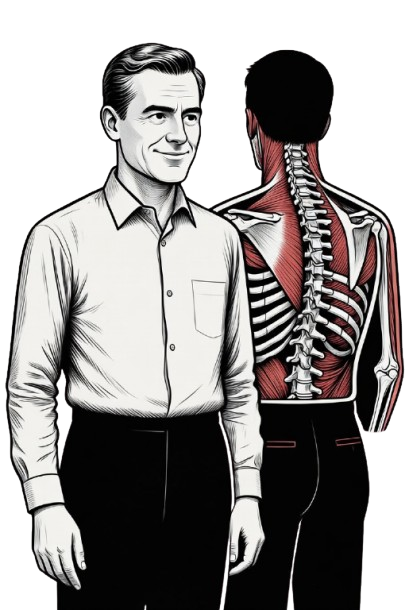
The Honest Caveats Nobody Wants to Hear
None of this means the result is permanent in the sense of never needing attention again. A year of maintained strength is not a lifetime guarantee, and the body that got weak once can get weak again if the load that built the strength disappears completely and the person returns to the same postural habits, the same unaddressed trigger points, the same sedentary stretch of the day that caused the problem originally. Strength training changes the tissue. It does not change gravity, your desk job, or your car seat.
This is also where I have to be honest about what is not proven yet. There is early interest in inhaled hydrogen gas as a recovery add-on available during red light therapy sessions. Shibayama's 2020 study in trained athletes found lower urinary markers of oxidative stress and less loss of jump height after exercise, with other performance markers unchanged. Zhao's 2024 study in rugby players found higher nitric oxide and antioxidant markers and lower inflammatory markers. Neither study tested back or neck pain, and no trial has. If someone tells you hydrogen gas treats back pain, that claim is ahead of the evidence. I am not going to let the fact that it is available here change what the research actually says.
What Actually Determines Whether Your Result Lasts
The honest predictor of durability is not the modality alone. It is whether the underlying mechanical problem, isolated weakness in the lumbar extensors, a psoas that never released, a joint that never regained its range, got corrected at the segment that was actually failing. A program that strengthens around the spine instead of at the spine will show a result that fades within months, because the compensation pattern that masked the weakness in the first place reasserts itself the moment supervision stops. A program that isolates the true deficit, the way Graves and San Juan describe, builds a result that is still there a year later because there was never a shortcut taken to get there.
If your back pain has been treated repeatedly without the weakness itself ever being measured and targeted, that is usually why the relief does not last. The fix is not more sessions. It is the right target. If a psoas that never released is part of your story, The Psoas Muscle: The Hidden Driver of Chronic Low Back Pain walks through how that gets missed.
You don't have to live with this. Backs and necks can get stronger, pain can ease, and the body is more capable of recovery than most people are told. This blog is here to give you honest, practical information about what actually helps. As we learn more, we'll keep sharing what works. If something here spoke to you, that's a good reason to reach out and start the first conversation.
Trent Shuford, LMT, Cert. MedX Tech.