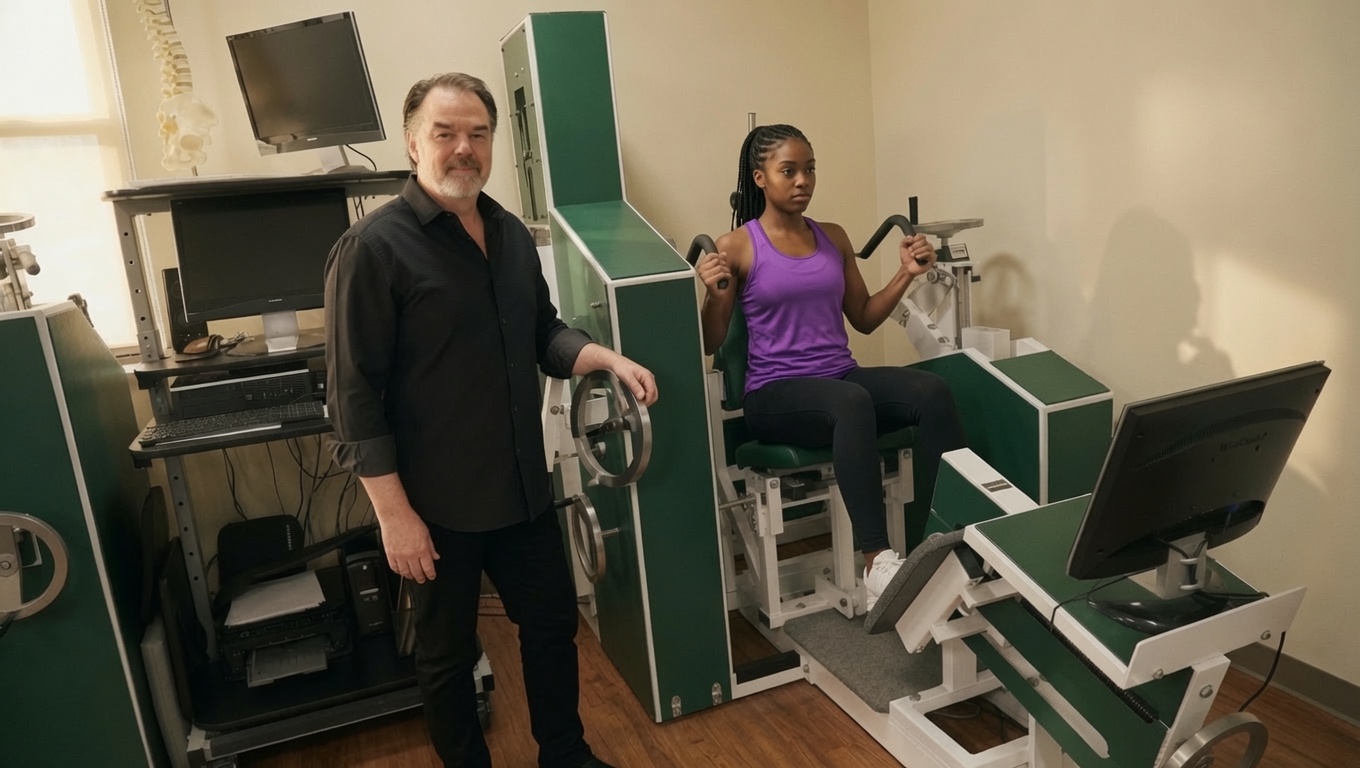

A client once told me he felt cheated. His first MedX session let him move through maybe a third of the arc his low back could theoretically bend through, and he wanted the full range on day one because that is what he assumed "real" exercise looked like. He was wrong, but his instinct is common, and it deserves a real answer instead of a brush-off.
MedX Range of Motion: Why More Is Not Always Better
Most people think more range of motion always means more benefit. That belief comes from general fitness culture, where a deeper squat or a fuller stretch is treated as inherently superior. The lumbar spine does not work by that logic. A disc, a facet joint, and a surrounding ring of stabilizing muscle are not the same structure as a hamstring. When you load a damaged or deconditioned spine through its full available arc before the tissue and nervous system are ready, you are not training the muscle more, you are asking a compromised structure to do work it cannot yet control.
Here is the mechanical piece that gets skipped. The lumbar extensors are the only muscle group in the body that requires the pelvis to be stabilized in order to be isolated. Graves 1994 demonstrated this directly: lumbar extension strength improved 23.5% when the pelvis was stabilized during testing and training, while an unstabilized protocol produced a 1.2% decline despite the same movement pattern. That number is not a rounding error. It means that without pelvic restraint, the muscles you are trying to strengthen are not the muscles doing most of the work. Hip and hamstring musculature compensates, and the lumbar extensors stay weak no matter how much range you move through.
A shorter arc, properly stabilized, puts the resistance directly where it belongs. That is the starting point for almost everyone who walks into the clinic with a spine that has been protecting itself for months or years. The muscle has often been underused and underloaded for so long that the nervous system has forgotten how to fire it through anything but a protective, truncated pattern. Starting short is not a compromise. It is the only way to make sure the lumbar extensors, not the hips, are receiving the load.
San Juan 2005 adds the second half of the picture. With pelvic stabilization in place, multifidus EMG activity was 51% greater than without it. The multifidus is the deep stabilizing muscle that most low back pain protocols never reach, because most equipment and most exercises cannot isolate it. A shorter, stabilized range of motion is often the only mechanical condition under which that muscle actually turns on. Chasing a bigger arc before that foundation exists just rewards the compensators that got the spine hurt in the first place.
Progression happens, but it happens on a timeline dictated by tissue adaptation and by what the person can control through strict pelvic stabilization, not by what looks impressive. As strength and control increase, the arc increases with it, session by session, in small increments that most clients barely notice happening. Pollock 1989 is the reference point people cite for the ceiling here: a 102% increase in lumbar extensor strength at 0 degrees of flexion over 10 weeks, training once per week. That study was done on healthy subjects measuring strength, not a patient pain outcome, and it is often misquoted as a pain result, so it deserves to be stated precisely. But it tells you something real about what structured, progressive loading of an isolated lumbar extensor can accomplish when the mechanics are controlled from the first session onward.
The client who felt cheated on day one was, six weeks later, moving through a dramatically larger arc than he started with, and he was doing it without the guarding and bracing that had defined his movement for over a year. He did not get there by forcing range early. He got there by letting the muscle earn it. A spine that has been protecting itself does not respond to being rushed. It responds to being loaded correctly, in whatever range it can actually control, and being trusted to expand that range on its own terms. This is the same principle behind MedX spinal strengthening: controlled, isolated, progressive loading rather than a race toward maximum range.
You don't have to live with this. Backs and necks can get stronger, pain can ease, and the body is more capable of recovery than most people are told. This blog is here to give you honest, practical information about what actually helps. As we learn more, we'll keep sharing what works. If something here spoke to you, that's a good reason to reach out and start the first conversation.
Trent Shuford, LMT, Cert. MedX Tech.