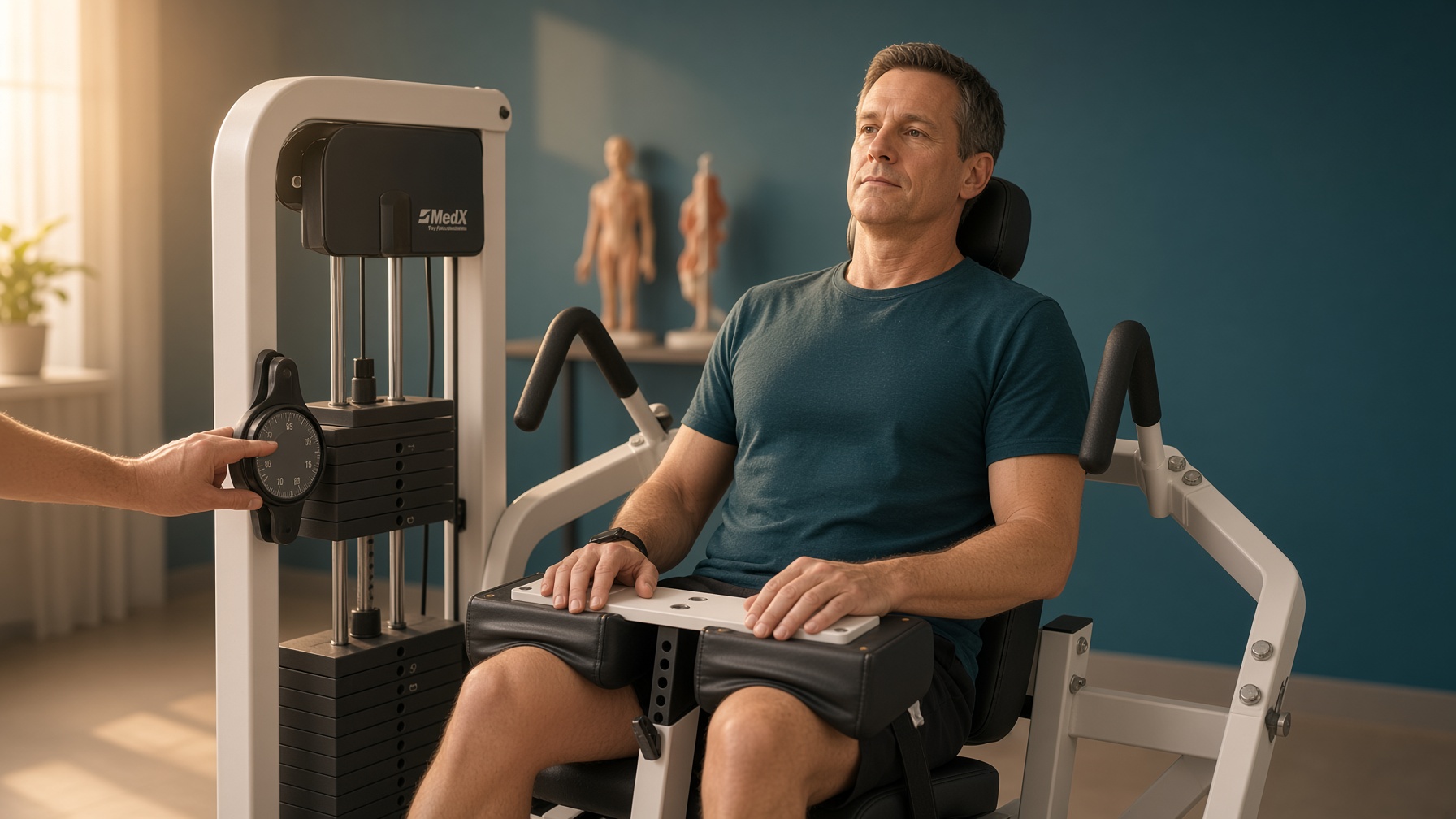

A client came in last month after three nights of broken sleep, apologizing before she even got on the table. She thought skipping her MedX session was the responsible move, that a tired back needed rest instead of load. That assumption is backwards, and it costs people months of progress.
Poor sleep does not mean your spine stops needing mechanical input. It means the input needs to be adjusted, not abandoned. Muscle tissue, including the lumbar extensors and multifidus, repairs and adapts during sleep. When sleep is short, the nervous system that coordinates spinal stabilization is running on a deficit before the session even starts. The muscle itself is not necessarily weaker overnight. The communication between brain and muscle is slower, less precise, and more easily fatigued.
Why Skipping Rehabilitation After Bad Sleep Backfires
Clients who miss sessions after a rough night often tell me they are trying to avoid re-injury. The logic feels protective. But spinal rehabilitation, done correctly on MedX equipment with proper stabilization, is not a high-risk activity that a tired body cannot tolerate. It is a controlled, isolated load through a fixed range of motion. The real risk of skipping is momentum loss. Graves 1994 demonstrated that isolated lumbar extensor strength improved only when the pelvis was stabilized during testing and training, with a 23.5% increase in the stabilized group against a 1.2% decline in the unstabilized group. That stabilization principle matters here too: a well-stabilized, well-supervised session on a tired day is still mechanically sound. An unsupervised attempt at the gym on a tired day, where form drifts and bracing fails, is a different story.
The honest answer is not "push through exactly as planned" and it is not "skip it." It is "adjust the variable that matters."
What Actually Changes When You Are Sleep-Deprived
Three things shift after poor sleep: proprioception, fatigue resistance, and pain sensitivity. Proprioceptive feedback, the sense of where your spine is in space, dulls with sleep restriction. That is why form on an unsupervised exercise is riskier when you are exhausted. Fatigue resistance drops, meaning the same load feels harder and technical breakdown happens sooner in a session. Pain sensitivity rises. A stimulus that felt like normal muscular fatigue on a well-rested day can register as sharp or alarming after a bad night, not because tissue damage increased but because the nervous system's threshold moved.
None of these changes means the exercise is unsafe on a supervised, stabilized machine. They mean the intensity should flex. On a MedX unit, that might look like reducing resistance by a provider-set increment, slowing the tempo, or trimming the number of sets while keeping the full range of motion and isolation intact. What should not change is frequency. Consistency, even at reduced intensity, is what built the results Nelson documented: 76% excellent or good outcomes among 627 completers out of 895 chronic low back pain patients, with 94% of those good or excellent outcomes maintained at one year. That data came from people who kept showing up, not people who waited for a perfect night's sleep first.
The Traction and Manual Therapy Piece
Sleep deprivation also changes how a body tolerates spinal traction and manual therapy. Tight, guarded muscle after a poor night can make decompression feel more intense initially, and a skilled therapist will modulate the force and duration accordingly rather than forcing the same protocol regardless of how the tissue presents that day. Manual and muscular therapy sessions after bad sleep often need more time spent on release work before any stabilization exercise, because the guarding pattern itself increases load on structures that are already working harder to compensate for a less responsive nervous system. This is not a reason to cancel. It is a reason to tell your provider before the session starts.
Still living around your pain?
Let's change that. Call us and describe what you're dealing with — we'll tell you honestly if we can help.
Call 425-758-4619
What To Actually Do the Morning After a Bad Night
Tell your provider. That single sentence changes the session more than anything else on this list. A provider who knows you slept two hours can adjust resistance, modify the manual therapy approach, or reorder the session to prioritize decompression before load. A provider who does not know will proceed as planned, and that is where unnecessary strain creeps in, not from the exercise itself but from a mismatch between the planned intensity and your actual capacity that day.
Hydrate before the session. Dehydration compounds the fatigue-related drop in proprioception and makes disc tissue, which relies on fluid exchange, less resilient under load. Eat something with protein beforehand if the session is more than a few hours after waking. Low blood sugar on top of poor sleep is a combination that makes any physical task, rehabilitation included, feel disproportionately hard.
Do not use a bad night as the reason to disappear for a week. One missed or modified session is a Tuesday. A pattern of skipping every time sleep is imperfect is how six months of MedX progress erodes back to baseline, because the lumbar extensors documented in Pollock's research to gain 102% strength at 0 degrees over 10 weeks of once-weekly training did not get there through sporadic effort. They got there through consistency that outlasted bad weeks.
When Poor Sleep Is the Symptom, Not the Cause
Sometimes the restless night is not random. Chronic low back pain itself disrupts sleep, through positional discomfort, through the body's inability to find a resting posture that does not provoke the psoas or the lumbar paraspinals, through the general sympathetic activation that unmanaged pain produces. In my own practice, of clients who arrived with spinal surgery already scheduled, 86.5% avoided surgery, and many of them described sleep improving well before pain did, as the first sign that the nervous system was settling. If poor sleep has become a recurring pattern rather than an occasional bad night, that pattern itself is diagnostic information worth bringing to your provider rather than something to solve with a different mattress alone.
A single bad night is a variable to manage. A pattern of bad nights tied to back or neck pain is a signal the rehabilitation plan needs to address the underlying mechanical driver, not just the sleep hygiene around it.
For more on why MedX works even when other approaches have failed, see Why MedX Spinal Strengthening Works When Everything Else Has Failed. If sleep-position guarding and the psoas seem connected to your pattern, see The Psoas Muscle: The Hidden Driver of Chronic Low Back Pain.
You don't have to live with this. Backs and necks can get stronger, pain can ease, and the body is more capable of recovery than most people are told. This blog is here to give you honest, practical information about what actually helps. As we learn more, we'll keep sharing what works. If something here spoke to you, that's a good reason to reach out and start the first conversation.
Trent Shuford, LMT, Cert. MedX Tech.